American Philosophy: A Love Story by John Kaag

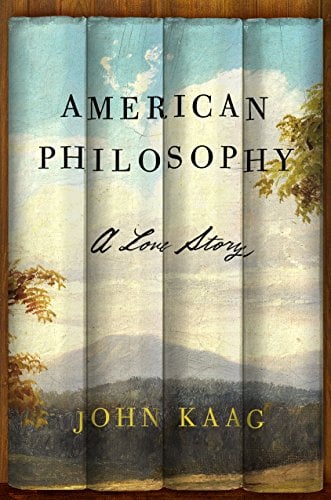
I picked up American Philosophy, A Love Story after reading Kaag’s earlier book Hiking with Nietzsche and coming across several of his essays in The Atlantic. John Kaag is, in my opinion, one of the most talented working writers who also happens to be an actual practicing professor of philosophy. That combination — the rigor of the academic and the accessibility of a great essayist — makes him worth following closely.
The Most Underrated Philosophy You’ve Never Studied
Here’s the thing that bugs me about how philosophy gets discussed in American culture: when philosophy bubbles up into the mainstream, it’s almost always Greek, Roman, or something vaguely European. Yet America has a deep, rich homegrown philosophical tradition that I’d argue actually runs this country — hiding in plain sight as common sense, axioms, and the kind of folk wisdom that gets printed on motivational calendars.
I’m talking about the tradition of Emerson and Thoreau, William James, Charles Sanders Peirce, and John Dewey — the Transcendentalists and the Pragmatists. This is the philosophy of a young, rambunctious country that was a cauldron of Protestant denominations, frontier rule-of-thumb, democratic Christianity, and Northeastern intellectuals desperately trying to prove that America could produce serious ideas. It gave us pragmatism — a uniquely American school of thought that says, more or less, that truth is what works in practice.
Once you start reading it, you realize it’s everywhere. It’s just never been systematically pointed out.
What the Book Is Actually About
The hook of American Philosophy, A Love Story is that Kaag stumbled onto something remarkable: a long-lost private library on the Hocking family estate in rural New Hampshire, full of rare, annotated texts that traced the actual intellectual lineage of American philosophy. He volunteered to catalog the collection — thousands of books that had sat largely untouched — and in doing so was able to map the influences on the American philosophical tradition in a way that hadn’t really been done before.
That alone would make for a compelling book. But Kaag doesn’t write it as a straightforward intellectual history. He writes it as a memoir.
The cataloging project happens during one of the most transitional periods of his life — he’s going through a divorce, navigating a career change, and at the same time meeting the woman who will become his wife. The personal story and the philosophical story run side by side, each illuminating the other. It’s a structure that could easily feel forced, but Kaag pulls it off because the themes genuinely align: American pragmatism, at its core, is a philosophy about how to live through uncertainty.
What I Liked
Kaag is an earnest writer. Deeply, almost disarmingly earnest. His other books have the same quality — there’s no ironic distance, no hedging. He believes in the project, and it shows. If you’re already interested in philosophy or the history of ideas, that earnestness is infectious. If you’re skeptical or just mildly curious, it might wear on you a bit. Know your tolerance going in.
The writing itself is excellent. It moves. The memoir structure keeps things personal enough that you never feel like you’re slogging through a textbook, and the moments where he slows down to actually explain a philosophical idea — what Peirce meant by pragmatism, what James meant by radical empiricism — are clear and genuinely illuminating.
Takeaways
The big one for me is that American philosophy deserves a much wider audience than it gets. The Pragmatists were not writing abstract theory for ivory towers. They were trying to figure out how to live — how to find meaning, how to act with integrity, how to hold beliefs without becoming rigid about them. That’s as relevant now as it was in the 1880s.
The other takeaway is that Kaag is building a body of work worth reading in sequence. Hiking with Nietzsche, this book, and his subsequent work all circle the same questions from different angles. If this one resonates, go read the others.
Next Steps
If you’re the kind of person who enjoys the history of ideas — not just philosophy, but how ideas develop, spread, and quietly reshape a culture — this is very much the nerd’s nerd book. Highly recommended.
John Kaag's American Philosophy, A Love Story is part intellectual history, part memoir — and it works as both. Kaag catalogs a long-lost private library to trace the roots of America's Pragmatist tradition while navigating divorce, career upheaval, and new love. The result is a surprisingly personal case for why Emerson, Thoreau, James, and Peirce matter more to everyday American life than most people realize. Earnest, well-written, and worth your time.
- Memoir structure makes dense philosophical history genuinely readable and personal
- Makes a compelling case that American Pragmatism quietly shapes everyday American culture
- Kaag is an exceptional writer — clear, earnest, and never condescending
- Kaag's earnestness can feel relentless if you're not already bought into the subject
- Light on context for readers with zero philosophy background
- The personal narrative occasionally overshadows the intellectual history

Quotes
Social organization, professional affiliation, athletic camaraderie, physical exertion, experimental drug use-James found that all of these worked to broaden a person’s otherwise narrow conception of selfhood. But they didn’t work well enough, which is why he remained fascinated by religious experience and spiritualism.
Over time, I came to realize that this was the point of reading Emerson and, for that matter, Thoreau and Margaret Fuller and all the rest of them. The reason to read the American Transcendentalists wasn’t to hang on to their every word, but to be inspired by them. This early American philosophy was about inspiration, about moving beyond the inert and deadening ways of the past.
Hocking himself had a name for this philosophical method of trial and error: “negative pragmatism.” He didn’t buy the pragmatic idea that truth was that which works, but he did endorse the converse, that untruth or falsity is that which doesn’t. The Nobel Prize-winning physicist Richard Feynman, yet another of Hocking’s many famous friends, resuscitated the idea in his Cornell lectures from 1964. “We never are definitely right,” said Feynman, “we can only be sure we are wrong.”
To this day, American philosophy is regarded as provincial and narrow in its focus, just another by-product of the nation’s politi-cal and cultural exceptionalism. And to some extent, that char-acterization is spot-on. Emerson and James wanted to escape the strictures of traditional philosophy, which occasionally meant downplaying or criticizing the intellectual resources of the rest of the world. But a quick walk through West Wind revealed a slightly different story: American thinkers were in constant contact with European and non-Western philosophy. There was Emerson’s In-dian Superstition, an early commentary on the Vedas. And there were James’s copies of Buddhism in Translation. Hocking had carefully collected these books; they were pieces of evidence sug-gesting that American philosophy could be, and in some sense always had been, intercultural. As Western expansion exhausted itself at the beginning of the twentieth century, Americans-and the philosophers in their midst-began to more explicitly set their sights abroad. Such thinkers as Addams, Dewey, and Hock-ing, who lived through World War I, argued that American phi-losophy could not fulfill its potential if it remained narrowly American; its ideals of self-determination, pluralism, and loyalty should be employed in structuring the modern international com-munity. Their recommendations often stood in marked contrast to long-standing norms of American diplomacy, which is to say that they were often ignored. But on rare occasions they had their say, dramatically affecting U.S. foreign policy.
When she met Hocking, he was in the midst of preparing the commission’s three-hundred-page report, Re-thinking Missions: A Laymen’s Inquiry After One Hundred Years, which provided a sys-tematic and ultimately devastating critique of the Protestant mis-sionary system. When it was published in October 1932, the book was hotly debated and immediately featured in Time. It was not Hocking’s magnum opus, but Re-thinking Missions was the book that made him famous. The report was grounded in empirical social science-teams of academics, led by Hocking, had con-ducted a year of field research in Japan, India, and China-but after all the data were collected, it was Hocking who interpreted and passed judgment on the findings. He concluded that most missionaries, so intent on saving the Asian horde from eternal damnation, were in fact dangerously out of touch with the local populations they hoped to rescue. Some attempts at salvation, ac-cording to Hocking, were not only counterproductive, but ab-surdly so. He observed that most missions were just a lot of talk: preaching, moralizing, proselytizing, more preaching. According to him, salvation turned on one’s willingness not to talk, but to do. Missionaries should assume a pointedly ecumenical posture, give up their self-righteous sermonizing, and emphasize the meaning-ful similarities between world religions. Instead of holding forth on Christian ideals of humility, charity, duty, and love, missionar-ies should try to embody them. Rural Chinese didn’t need scrip-tural lessons or warnings about the tortures of hell. They were all too familiar with the tortures of earth. What they needed were basic social services.
About longevity in the face of destruction, about dealing with loss, about love and free-dom, but also about the discipline of philosophy. Philosophy, and the humanities more generally, once served as an effective cult of the dead-documenting, explaining, and revitalizing the mean-ing and value of human pursuits. It tried to figure out how to preserve what is noble and most worthy about us. At its best, phi-losophy tried to explain why our lives, so fragile and ephemeral, might have lasting significance. In Hocking’s words in The Mean-ing of Immortality, we must learn to “treat the present moment as if it were engaged in business allotted to it by that total life which stretches indefinitely beyond.” Royce’s son Stephen had written an inscription at the bottom of his father’s note: “Last written words of Josiah Royce found on his desk after his death never completed.” Never completed. At least that is the hope-when it comes to both the cult of the dead and philosophy’s dying words.