7 Notes on Visiting St. Vincent National Wildlife Refuge

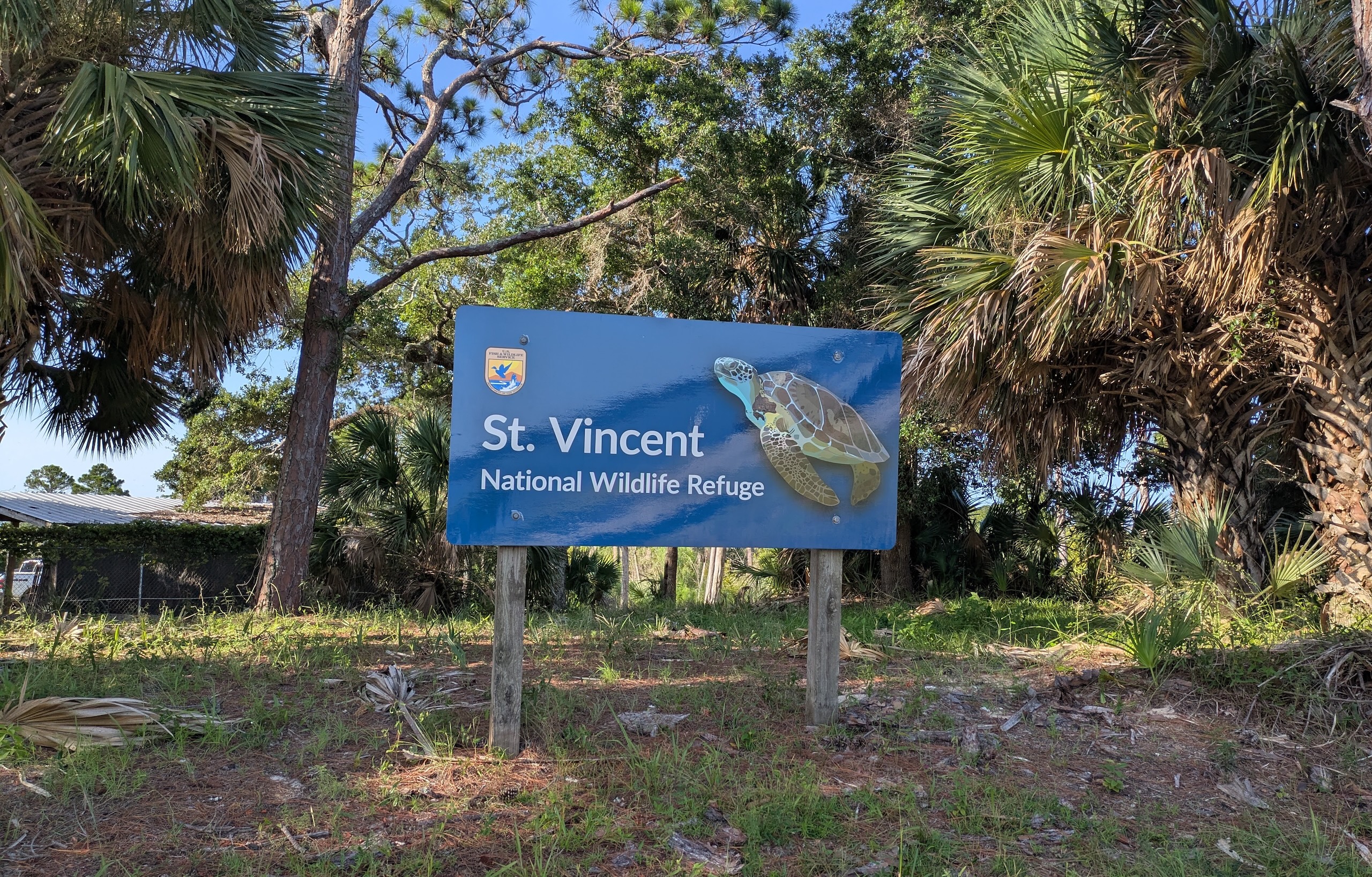
For years, my family has vacationed on St. George Island in the Florida panhandle. And every year, I’d look at the map and see this big, undeveloped island just to the west of Little St. George – St. Vincent Island. No roads. No houses. No bridge.
I always wanted to go. But the logistics seemed tricky, and there’s not a lot of good information on the Internet about actually visiting.
This summer, I finally figured it out and went. Here’s what I found.
St. Vincent National Wildlife Refuge is a ~12,500 acre National Wildlife Refuge established in 1968. It’s entirely owned by the U.S. Government with zero development. It’s home to migratory birds, gopher tortoises, sea turtles, sambar deer (from Southeast Asia – more on that in a minute), and most importantly, endangered red wolves.
Red wolves are America’s other wolf. They once ranged across the entire Southeast into central Texas, before being hunted, trapped, and bulldozed out of their habitat. By 1980, they were declared extinct in the wild. Today, they’re critically endangered, with only a few dozen living wild in eastern North Carolina.
St. Vincent functions as a breeding site. Red wolves raised on the island can “graduate” to the Alligator River National Wildlife Refuge in North Carolina, where the U.S. Fish & Wildlife Service is trying to recover the species in the wild.
Getting To St. Vincent Island
The logistics are both easier and harder than I expected.
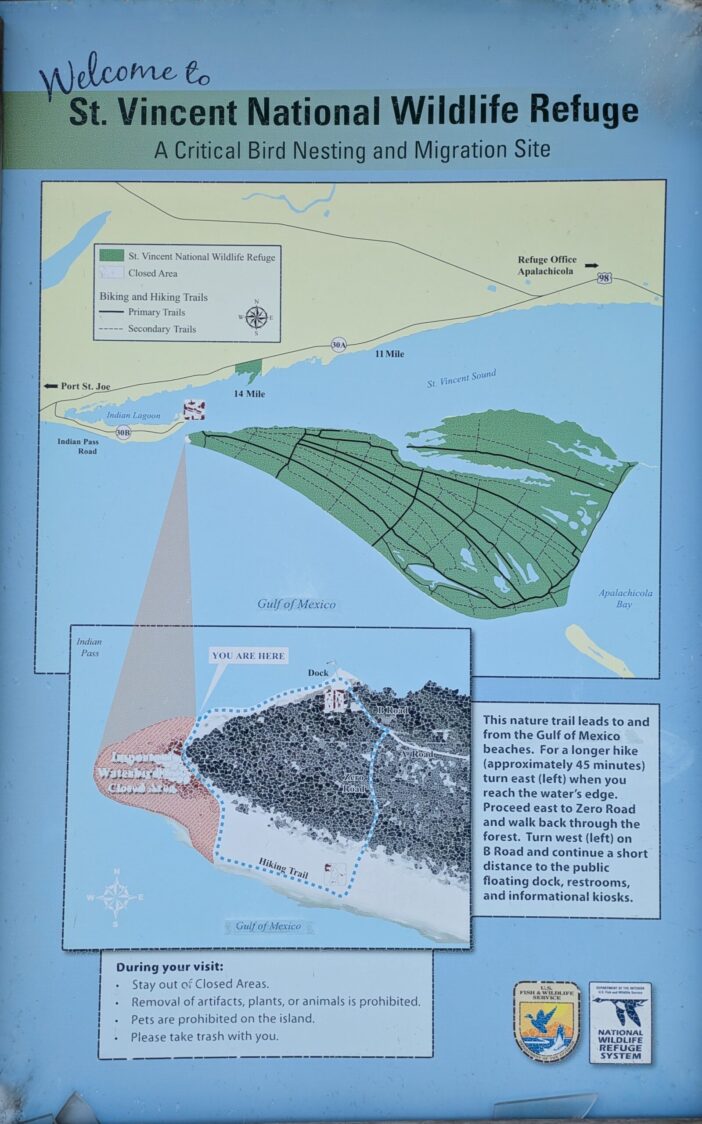
The refuge has a boat dock on the west end of the island, right at Indian Pass. Directly across that channel is the Indian Pass Campground and the Indian Pass Boat Ramp, which are county-owned.
The channel is narrow. It’s a couple hundred feet across – less than a football field. The water is usually calm. You could kayak across it. You could probably float across it. If you are a really, really strong swimmer, you could probably swim it.
The catch is that the Indian Pass boat ramp is pretty far from anything – whether you’re coming from Port St. Joe or Apalachicola. So the main issue is getting a boat to the boat ramp. Plenty of people have boat trailers. But if you don’t have a boat trailer, and you don’t want to get soaking wet paddling across with a life jacket and a pool float, you’re going to need a shuttle.
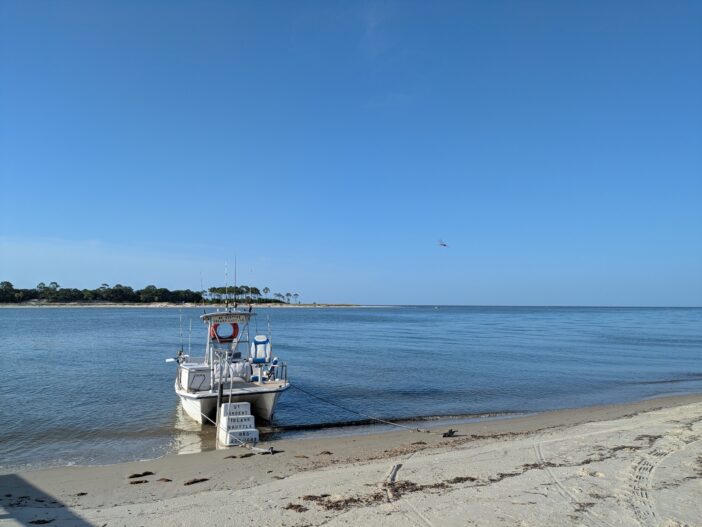
Thankfully, there’s a small charter company called the St. Vincent Island Shuttle. They mainly run fishing charters, but for $20 per person, they’ll run you across the channel from the Indian Pass Boat Ramp to the refuge.
It is a very informal operation.
- You need actual, physical cash.
- You need to call them. There’s no online reservation system, no booking app. You call their office during business hours.
- A very, very nice receptionist will ask where you’re going and how long you want to stay. They’ll check the weather, write your name down on a piece of paper, and set your pickup time.
- You show up at the boat ramp at that time and get on the boat.
The boat isn’t big – it’s a small fishing boat – but it’s big enough to take bikes for an extra fee. The ride is maybe 3 minutes. They roll right up onto the beach and put down some stairs. And they come back for you at your arranged pickup time, so don’t be late.
Informal, but an excellent operation. Highly recommend.
What to Know Before You Go
This place is meant for the animals. It is not meant for humans.
The U.S. Fish & Wildlife Service’s mission is to protect wildlife – not to provide recreation for humans. That means there are no facilities. There’s a building for Fish & Wildlife personnel, but it’s not for visitors. No restrooms, no water fountains, no snack bar, nothing.
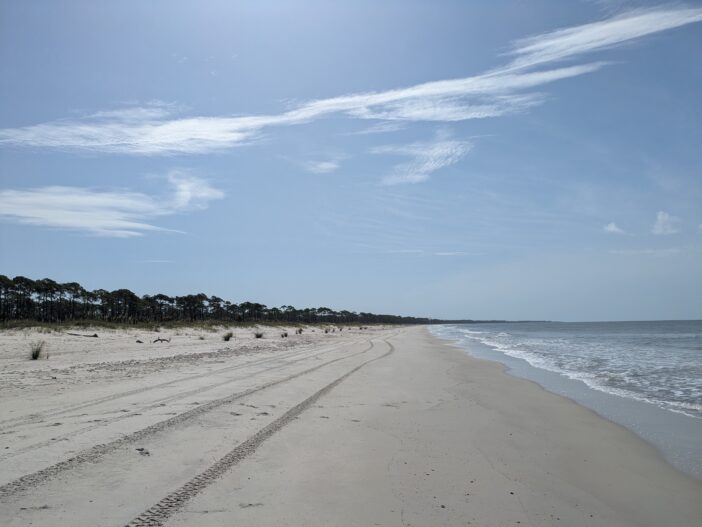
You can visit during the day, from sunup to sundown. It’s public land, so you can walk around anywhere that’s not cordoned off. When I went, a big section of beach was roped off for nesting shorebirds. If you approach a nesting colony, it’s not just one bird that leaves – the entire colony will abandon their nests. Hundreds of birds, gone. So leave them alone.
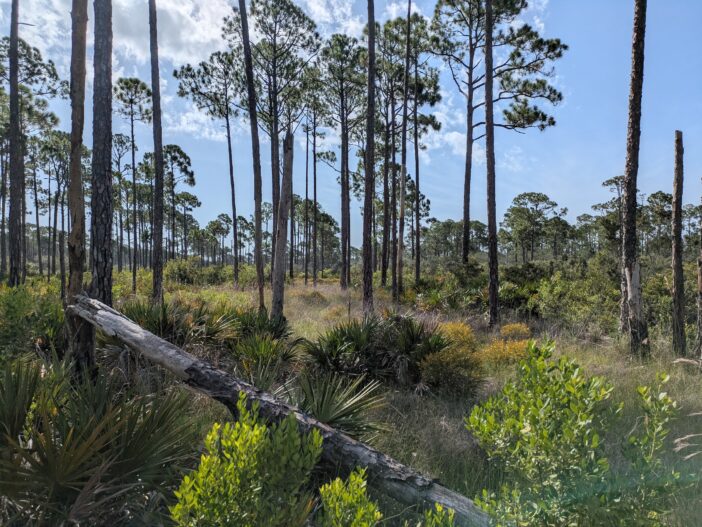
The trails are mostly service roads – basically ATV trails cut through the forest with a Bobcat so refuge staff can get in with ATVs and small pickup trucks to manage the land. There are a few marked footpaths to the beach.
Before you go, stop by the refuge headquarters and visitor center in Apalachicola for maps and current conditions. Also check the refuge’s hunt schedule – St. Vincent runs managed hunts (including sambar deer hunts), and you want to know about those before you’re wandering around the interior.
And keep in mind that this is all Type 2 fun. The beach is great for swimming, but there are no lifeguards and nobody around to see you. I’d definitely go with someone. If you’re going solo – be an adult. Don’t be an idiot.
What to Bring
- Water. More than you think.
- Food.
- Sunscreen & sunglasses.
- A plan for your human waste. You need to be cool with properly disposing of it outside.
- Bug spray. Specifically DEET.
- A head net.
About those last two.
My lord almighty, the insects.
If you want to visit, you have to have DEET. So much DEET. And you need a head net. The bugs – good lord almighty, the bugs. Every species of mosquito known to science is represented on St. Vincent, plus a few biting flies that are there just to make a point.
Quick Tips
- No pets are allowed on the refuge.
- Get there early. The heat and bugs only get worse through the day.
- Go in fall, winter, or spring if you can. Better birding, fewer bugs.
- The beach has tons of driftwood, and you’ll likely have it all to yourself.
- Bikes are a great way to cover more ground on the service roads.
- We spent about 3 hours hiking around 3 miles, which felt like a good amount for a first visit.
For us, it was simple. Drove up, handed the guy $20, rode across the channel, and spent a few hours hiking around. It was great.
Here are my takeaways from the trip.
St. Vincent Is Wild
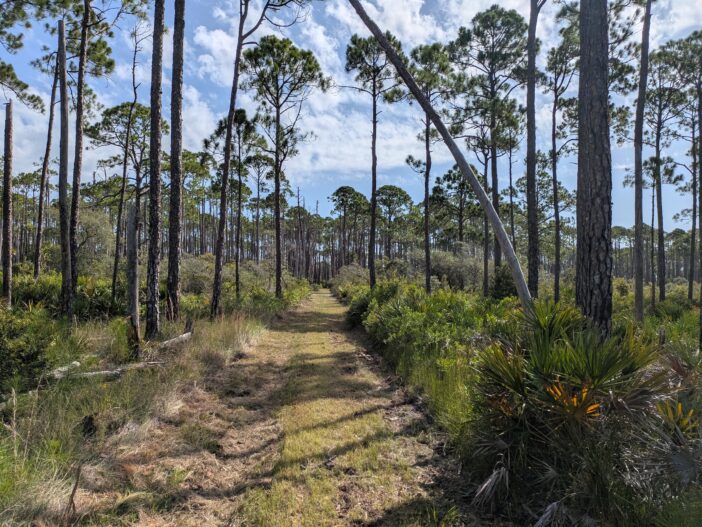
There’s basic human infrastructure on the island, but this is a place for wild animals – for insects and fish and birds and plants and trees.
We had to change our route because of that. We were headed down a north-south trail that dips into a wetland. Right as we turned, not 20 feet in front of us, an alligator leapt out of the water and grabbed some kind of small mammal – a rabbit or something.
And so now there’s an alligator sitting in the trail. And there’s nothing to do but turn around.
We saw snakes. We saw sambar deer tracks. Sambar deer are native to South and Southeast Asia and were introduced to the island as exotic game by a previous owner in the early 1900s. They’re giant – about the size of an elk – and they’re still there, more than a century later.
The trails that hadn’t been cut in the past couple of weeks were already getting overgrown. The place is wild.
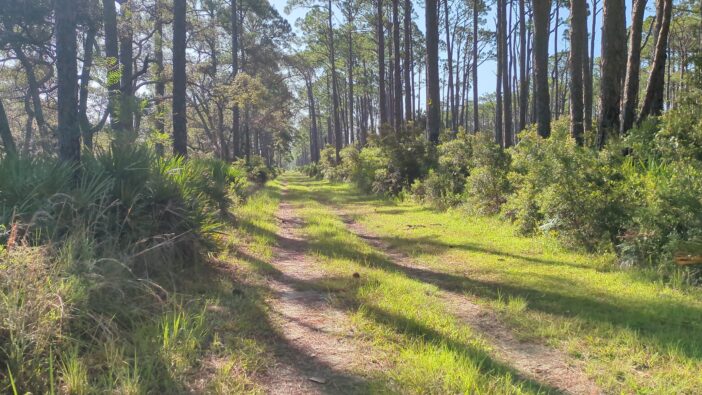
If you love wild places – if you love being deeply away from permanent human infrastructure and feeling like just another Homo sapiens in the ecosystem – St. Vincent is where it’s at.
The Red Wolves
I put the odds of actually seeing a red wolf at less than 1%. They do not want to see humans, and they definitely won’t seek you out.
But I was blown away when I saw tracks.
It had rained the night before, and the tracks were fresh. Pets aren’t allowed on the refuge, and these were definitely not dog tracks. They were canine tracks.
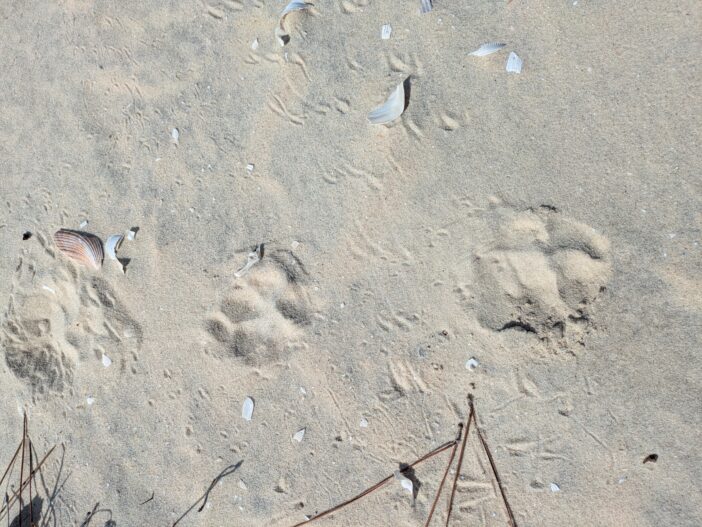
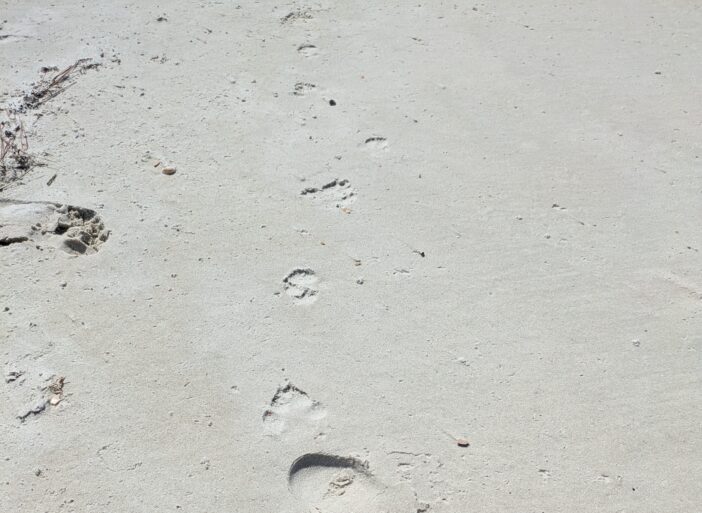
Now, there are also coyotes on the island. So these were either giant coyotes or red wolves.
I’m going to say they’re red wolves.
It felt very special just to be there and know they were there too. I won’t say it’s like visiting the African savanna and seeing lions. You probably won’t see a red wolf. But to share space with a predator – especially a top-tier canine – you feel both the very human fear of predators and the power and majesty of an animal at the top of the food chain.
The fact that it’s in Florida makes it even better.
Red wolves are also a reminder that humans run this planet – and we tend to forget that. We get scared, we overcompensate, and we drive species to near extinction. But we’re also the only ones who can bring them back. We can destroy, and we can save.
In North Carolina, the Alligator River National Wildlife Refuge has been identified as the best red wolf habitat because it sits next to a big chunk of U.S. Department of Defense land. The wolves are doing okay there, but U.S. Highway 64 runs right through the habitat. Unlike their coyote and dog cousins, red wolves have zero road sense, so they’re getting hit by cars. And the Fish & Wildlife Service is having a very hard time imposing even the slightest inconvenience on humans on behalf of the wolves.
So here’s my ask:
- Check out the Red Wolf Coalition, the nonprofit devoted to red wolf conservation.
- Let the U.S. Fish & Wildlife Service know that you support red wolf recovery.
- If you live in North Carolina, please let your Senators and Representatives know that you are happy to host red wolves.
And go watch some videos of red wolf pups. You’re welcome.
The Birding Is Incredible
You need the Merlin app on your phone.
Get off the boat, walk a few hundred feet inland, turn Merlin on…and mine just lit up. All the things.
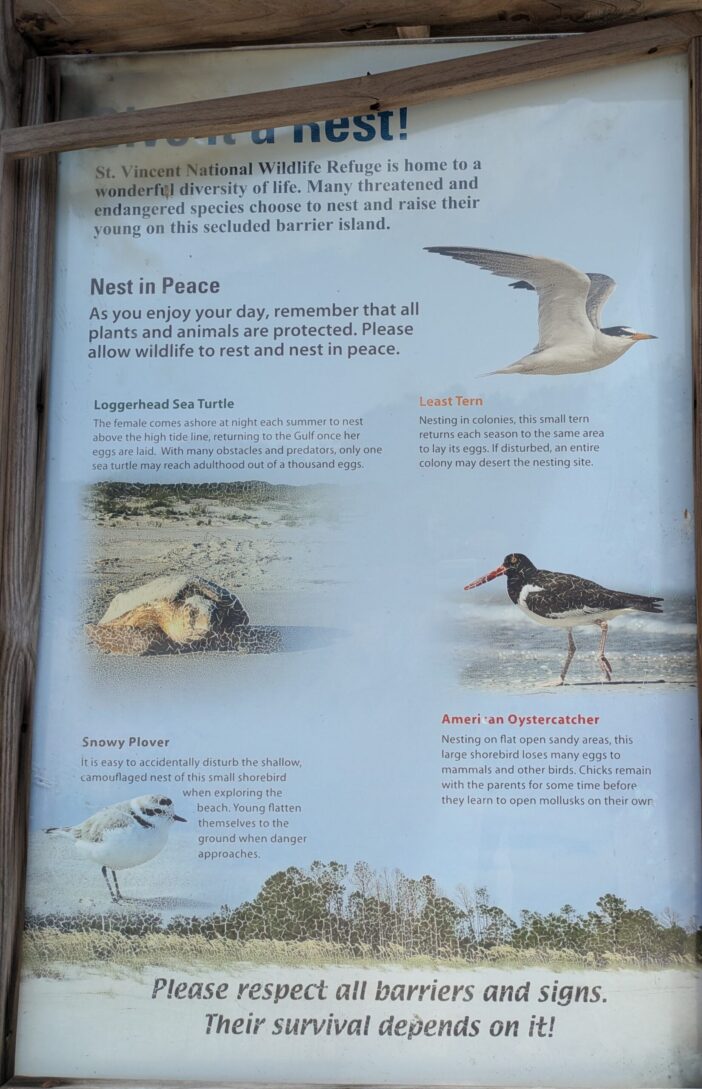
We were there in the summer, and I can only imagine that spring or fall would be even better. St. Vincent is on the coast and on the migration flyway. But it also has an unusual range of habitat for an island – wetlands on the east side, thick pine forest on the west side, and freshwater ponds in the interior. There’s a lot going on for the birds.
Nature Isn’t Separate
This is the deeply ironic thing about St. Vincent.
Even though it’s wild – and parts of it reminded me of the Okefenokee National Wildlife Refuge – it’s also a stark reminder that there is no separate “nature.” There’s not a human world and a nature world, even though that’s kind of how we manage a lot of our lands. We’re all on the same planet.
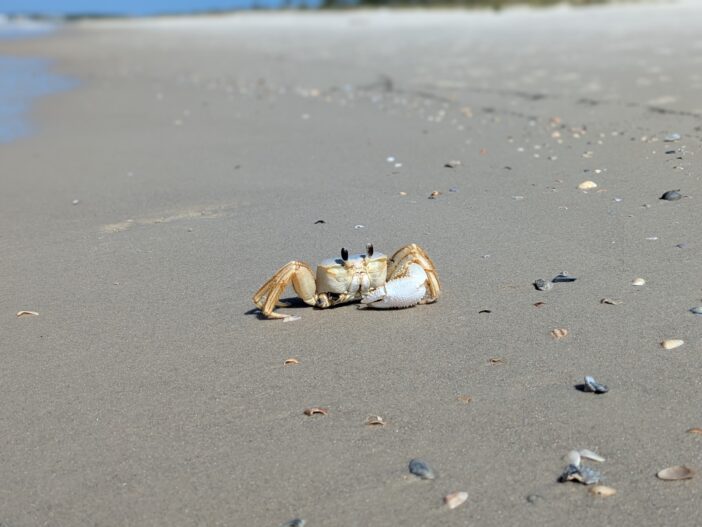
There are places on the trail where you pop out, and a few hundred feet across the bay, there are vacation houses doing vacation things.
There’s also trash on the beach. Not from visitors – I think visitors do pretty well with Leave No Trace. But it’s the Florida coastline, and waves have a habit of washing stuff up. It’s still a beautiful beach, mainly because it’s undeveloped with gorgeous scenery and tons of driftwood. You’ll have it all to yourself. But there’s definitely trash.
Old Florida Does Not Want Homo Sapiens
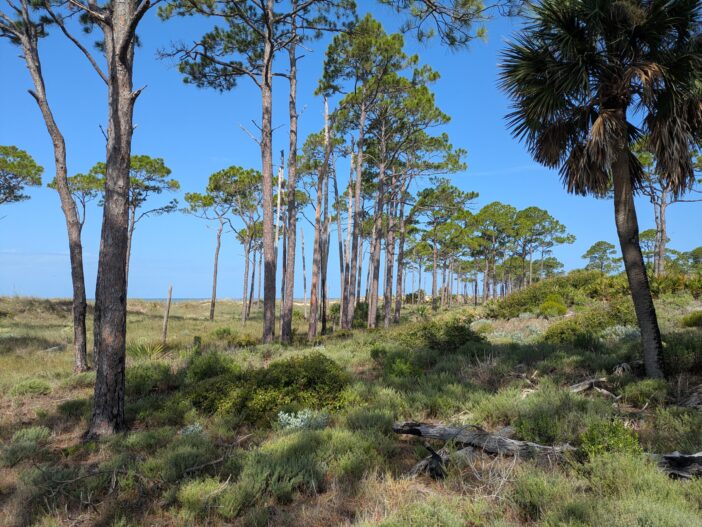
St. Vincent was designated a refuge in 1968, but it was purchased from a family who generally hadn’t done a whole lot with it. It reminded me of Cumberland Island National Seashore in Georgia. But unlike Cumberland Island – which has a whole estate and settlement built by the Carnegie family – St. Vincent was never used as intensively as many other barrier islands along the Gulf and Atlantic.
So it felt like an honest picture of what Old Florida may have been like.
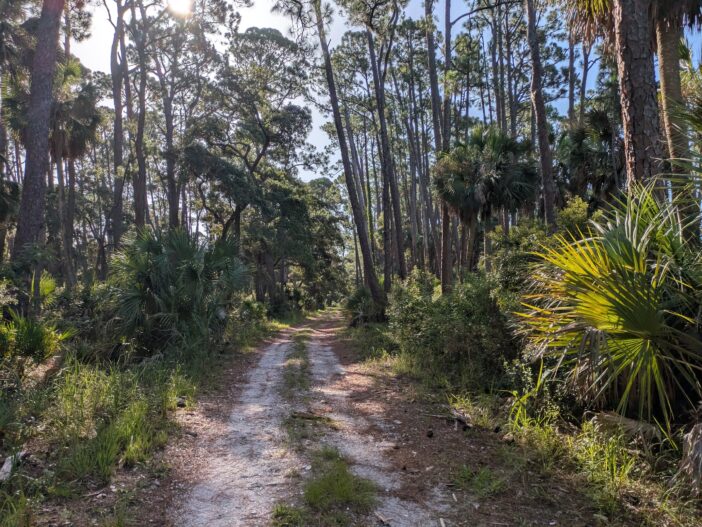
I recently read The Gulf: The Making of an American Sea by Jack E. Davis (which won the Pulitzer Prize – highly recommend). Walking the shoreline, it was easy to imagine the Narváez expedition stumbling along this coast in 1528 before building rafts and floating west on their awful journey toward Texas. It was easy to imagine the tribes who lived here as far back as the Woodland period, all the way up to the Seminole and Creek era, trying to carve out a living – and just how difficult that must have been.
It made me realize how much of what we know as Florida in 2026 is due to human engineering and grit – our ability to dig ditches, bulldoze land, and build out air conditioning at massive, serious scale.
On one hand, it’s sad because of what’s been lost. On the other hand, it’s impressive what humans can do.
It was also a good reminder that some parts of the world welcome humans. They’re great habitat for us.
And then there are places on Earth that are just anti-human. Places where the insects and flora and fauna have banded together in a confederation and decided to make it Hell on Earth.
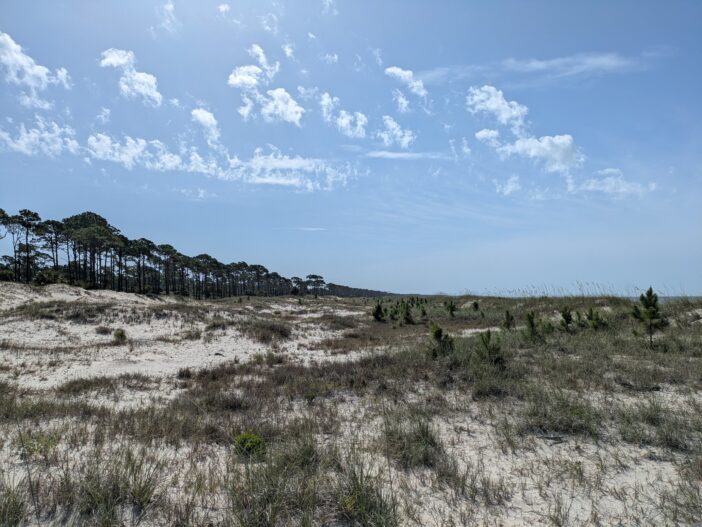
It is no joke that some of the public land just north of St. Vincent is literally called Tate’s Hell State Forest.
It was beautiful to see – and also a reminder that some places humans should probably just leave alone.
The National Wildlife Refuge System Is Underrated
I’ve been able to visit a few National Wildlife Refuges now, and the National Wildlife Refuge System is an underrated gem of American public lands.
The way America manages public lands is absolutely incredible. It took so much forethought from people like Theodore Roosevelt and Gifford Pinchot to set it up.
And in modern times, we’ve realized that Native Americans were managing this land pretty well long before any of our agencies took it over.
Between the National Park Service, the U.S. Forest Service, the Bureau of Land Management, and the U.S. Fish & Wildlife Service, it can be confusing to figure out what land is what. Americans obviously know our National Parks the most. They preserve land and provide recreation.
But the National Wildlife Refuge System is severely underrated. We have an entire system of lands – huge swaths of acreage – devoted to protecting our flora and fauna. It’s not really meant to be shared with humans. It’s not meant to be shared with industrial or commercial interests.
It just is.
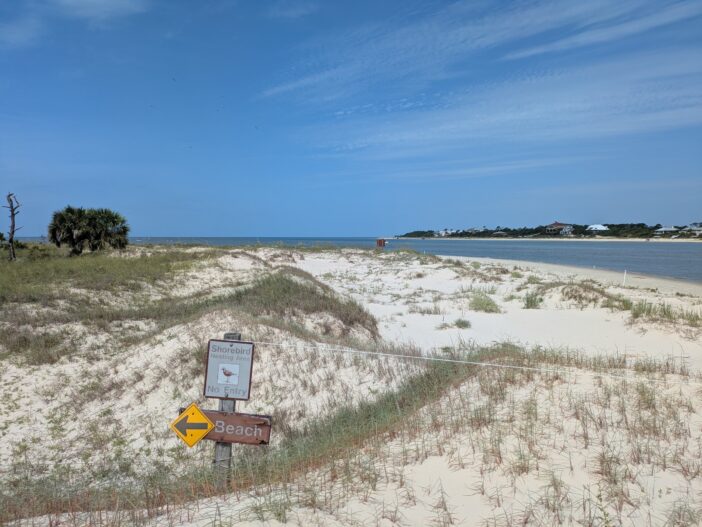
It doesn’t have the same protections as designated Wilderness, though some refuges do contain Wilderness areas. And the Fish & Wildlife Service makes plenty of bad decisions. But they also make a lot of good ones. And there are a lot of people within the agency, on the actual ground, doing incredible, thoughtful, consistent work year over year over year.
There’s a saying in the conservation movement: if you see the land, you’ll know the land. If you know the land, you’ll love the land. If you love the land, you’ll protect the land.
I think the National Wildlife Refuge System deserves more press, more praise, and more visits – so that Americans know the special thing we’ve built over the last 120-odd years.
It’s a special institution. We should keep it going.
Get Posts Automagically
…also via RSS or Fediverse – just copy link & paste in your favorite reader :)