Snow by Orhan Pamuk

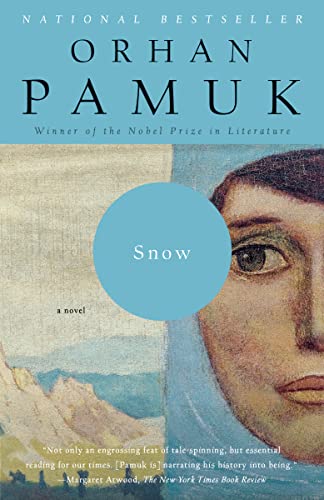
If you’re coming to Snow because you loved A Strangeness in My Mind – and that’s exactly why I picked it up – adjust your expectations. Same author, but it’s a very different book. I’d tell you that Snow is better read alongside The Reluctant Fundamentalist by Mohsin Hamid than alongside anything else in Pamuk’s own catalog.
Which is not a complaint. I thoroughly enjoyed it. But it’s a different book.
The novel is set in Kars, a remote, snowed-in town in eastern Turkey. A poet called Ka returns from political exile, ostensibly to investigate a wave of suicides among young girls from conservative Muslim families. The investigation is the reason he’s there. It is not really what the book is about.
What the book is about is culture and religion and who gets to belong. Who fits in? What actually counts as a free choice? Where does the freedom of the individual end and the freedom of the group begin? Most of that gets worked out through the headscarves — what they mean, who’s demanding them, who’s banning them, and what it costs a girl either way.
I’ll say one more structural thing and then stop, because spoilers would genuinely wreck this one: the narrator isn’t the main character, but he’s sort of the main character, because he’s the one piecing together what happened to Ka. Sit with what that implies.
What I Liked
The layering. There’s a plot, there’s a poem being written, there’s a theater troupe, there’s a coup, and there’s an argument about the soul of a country — all of it happening in a town cut off by snow. Pamuk keeps every one of those threads live.
The setting does real work. The isolation isn’t atmosphere for its own sake. Kars is cut off, poor, and full of people who have decided that whatever is happening in Istanbul isn’t happening to them. That’s the whole reason the book’s arguments can play out at full volume.
It’s uncomfortable in the right direction.
What I Did Not Like
It’s a slow burn, and the middle sags. There’s a long stretch where I’d lost track of where the story was going – not confused about the plot exactly, just unsure what the book was doing with me. I stuck with it and I’m glad I did, but I won’t pretend that stretch was fun.
You do have to bring some background. Turkish secularism, Kemalism, the specific politics of the headscarf ban – Pamuk doesn’t stop to explain, and I was looking things up.
What I Learned
This book sharpened my thinking on liberalism and democracy more than anything I’ve read in a while.
Here’s why it’s uncomfortable in the right direction: the girls in Kars are choosing the headscarf. It’s the secular state doing the policing. Which means the book hands the reader – especially a Western, secular, liberal-minded reader – the version of the problem that doesn’t let you off the hook.
Because if you actually believe in individual freedom, you have to commit to it. You can’t go policing behavior or judging it. Well – you can. But then you don’t have liberalism, you have a liberalism that picks and chooses, which is just your own preferences wearing a nicer coat.
And yes, there’s a contradiction baked in. How do you tolerate the intolerant? I don’t have a clean answer to that, and I’m suspicious of anybody who says they do.
What I do think is that you’ve got to pick a lane. There’s a lot of rising populism right now, in America and across Europe, and a lot of it runs on the claim that a defined culture and tradition is what makes individual freedom possible in the first place. Maybe. But if an individual freely chooses not to uphold those traditions, that’s the deal you signed up for. Human culture evolves because people change it, and if you claim to value freedom of expression, you have to accept that evolution rather than try to freeze it.
Pamuk doesn’t resolve any of this, which is the point. He just puts it in a snowed-in town with real people in it and lets it get awkward.
Recommendation
If you’re new to Pamuk, start with A Strangeness in My Mind. It’s warmer, more generous, and a much easier on-ramp. Come to Snow second, when you’re ready to work a little.
But do come to it. It’s set in a very specific place at a very specific moment, and it’s about arguments we are all having right now.
Snow by Orhan Pamuk follows a poet who returns from exile to a snowed-in Turkish town, ostensibly to investigate a wave of suicides among girls from conservative Muslim families. What he finds instead is an argument about culture, religion, and belonging — worked out through the headscarf. A slow burn with a saggy middle, but it sharpened my thinking on liberalism more than anything I've read lately.
- Layered plot, poem, coup, and theater troupe all held together in one isolated town
- The setting does real work — Kars being cut off is why the arguments can run at full volume
- Hands secular readers the uncomfortable version of the freedom question rather than the easy one
- Slow burn with a middle stretch where it's hard to tell where the book is going
- Assumes background on Turkish secularism and the headscarf ban that it never explains
- Not the Pamuk to start with — A Strangeness in My Mind is the better on-ramp

Get Posts Automagically
…also via RSS or Fediverse – just copy link & paste in your favorite reader :)


