A Strangeness in My Mind by Orhan Pamuk

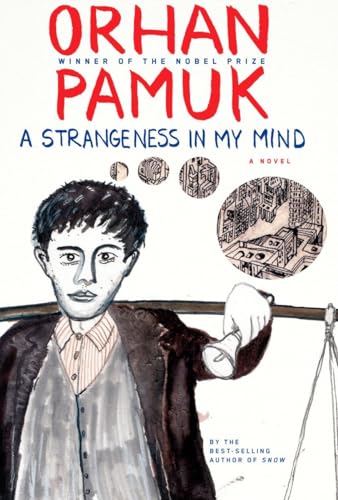
A Strangeness in My Mind by Orhan Pamuk is one of the Top 5 best novels I’ve ever read.
I don’t say that lightly. And I almost missed it entirely.
I was browsing a vintage bookstore, snapped a photo of a shelf, and asked Claude for recommendations based on two books I’d loved — Mohsin Hamid’s How to Get Filthy Rich in Rising Asia and Marina Lewycka’s A Short History of Tractors in Ukrainian. Both are books that share something hard to define: immigrant experience, dark humor, and a kind of earned humanity that sneaks up on you. Claude pointed me toward Pamuk. I’m grateful it did.
What It’s About
The novel follows Mevlut, a boza seller working the streets of Istanbul across several decades of the 20th century. Boza is a mildly fermented, lightly alcoholic drink with deep roots in Ottoman culture — it thrived partly because it occupied a gray area when alcohol was banned, something like a kombucha that everyone agreed not to look at too closely. The boza seller became a fixture of Turkish street life, and Mevlut is one of the last of them.
But the book isn’t really about boza. It’s about a boy born in rural Turkey who follows his father to Istanbul, a city exploding with migrants and ambition and poverty. It’s about scratching out a living in a developing-world city that doesn’t quite have room for everyone flooding into it. It’s about love, family, neighborhood, and what it means to build a life over decades in a place that keeps changing underneath you.
It is — and I mean this — everything good literature is supposed to be.
What I Liked
There’s a quote — I believe it’s John Green — that the whole point of reading literature is to live a life that isn’t yours. To borrow someone else’s perspective so completely that it changes how you see your own.
A Strangeness in My Mind did that for me in a way very few books ever have.
On paper, Mevlut and I have nothing in common. I didn’t grow up in rural Turkey. I’ve never sold anything door to door. I’ve never lived through the specific economic and political upheavals of 20th century Istanbul. And yet somewhere in the first hundred pages, I stopped noticing any of that. His interiority — the way he thinks, second-guesses himself, loves people badly, builds meaning out of a modest life — felt completely, uncomfortably human.
You know how you read a book like that and think: there can’t be another one? Like there’s a fixed number of books in the world that can do this to you, and every time you find one, you’ve spent a precious coin from a limited supply?
This is one of those books.
The scope is also impressive without ever feeling bloated. Pamuk covers decades of Mevlut’s life and traces the transformation of Istanbul alongside it — the migration, the construction, the politics, the neighborhoods rising and falling. It’s a big novel in the best sense. Not long for the sake of length, but long because the story earns every page.
What I Didn’t Like
It’s long. That’s it. And honestly, the only reason that’s a complaint is that it ended.
What I Learned
The book gave me a version of what the best novelists do (for me, it’s people like Erich Maria Remarque, Mohsin Hamid, Haruki Maurakami, Marina Lewycka, etc) — a genuine interior view of a world I’d never thought much about. Istanbul’s explosive 20th century growth. The economics of street vending. What it actually feels like to be a rural migrant trying to find a foothold in a city that’s indifferent to you.
More than anything, it reminded me why I read. Not for information, not for utility — but because sometimes a novel hands you a life that isn’t yours and you walk around in it for a few weeks and come out slightly different on the other side.
I’m going to reread this one. Highest possible recommendation.
A Strangeness in My Mind by Orhan Pamuk follows a boza seller navigating decades of life in a rapidly changing Istanbul. Found through a bookstore photo and a Claude recommendation, it turned out to be one of the best novels I've ever read — a big, decades-spanning story with a deeply human interior life. If you loved Mohsin Hamid or Marina Lewycka, read this immediately.
- Pamuk builds a fully realized interior life for a character who, on paper, has nothing in common with most Western readers — and somehow makes it universal
- The novel's scope — covering decades of Istanbul's transformation alongside one man's modest life — earns every page without feeling bloated
- Ranks among the rare books that genuinely change how you see your own life after you finish it
- It's a long book, which may require a real time commitment
- Some cultural and historical context around Ottoman-era Istanbul may be unfamiliar to readers without background knowledge
- It ends