Why Homer Matters by Adam Nicholson

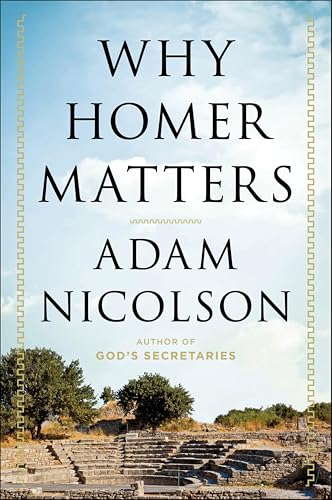
I picked up Why Homer Matters by Adam Nicolson on a lark at the library. It was during the PR hype for Christopher Nolan’s The Odyssey, and it looked like a solid book.
It was a fine read. A little too fast in places – there were parts I skimmed.
But here’s my real issue: the whole premise could have been a blog post. Probably a tweet.
The argument is that Homer matters because the Iliad and the Odyssey are the oldest surviving literature we have, and that they go back even further than the written word – back to the spoken tales of prehistoric people. They’re a window into how those people oriented themselves in life and the stories they told about it.
That’s the book. Nicolson spends a few hundred pages getting there, and the getting there is where he loses me.
What I Liked
It’s academic and fairly well sourced. Nicolson is genuinely good at this kind of book – he’d previously written one about how the King James Bible came to be, so he’s adept at navigating very tall academic weeds and explaining why a boring, fusty topic actually matters.
That skill shows up here. I came across quotes and perspectives that I never would have found otherwise, and for a topic this old and this picked-over, that’s worth something.
What I Did Not Like
He leans into some of the more unproven hypotheses about Homer – particularly the Bronze Age steppe-warrior origin theory. And there’s a lot about Homer that we don’t know. There’s also a lot about language that we don’t know.
I remember this from my linguistics class in college. When you look at something like Indo-European and you’re tracing phonemes back into fragments to figure out where people lived and when — it gets dicey fast. There are things we know that we know. There’s a lot that we know we don’t know. And then there’s an even bigger pile of stuff that we don’t know that we don’t know.
Nicolson plays fast and loose with that third category.
My other issue is that the book wasn’t what I thought it was. I expected a book about the text. I got a book about the history and context surrounding the text. Those are two different books, and only one of them was on my list.
What I Learned
Here’s the genuinely useful thing I got out of it, and it has nothing to do with Homer.
I’m glad I checked it out because it ruled out an entire line of books I thought I was going to read. I had a whole stack of “here’s why this ancient thing matters” titles queued up. After this one, I deleted them.
That’s a really good feeling. Reading a book that tells you what you don’t actually want to read next is worth the library trip.
Wrap-Up
If you want the context and history around the Iliad and the Odyssey – how they came to exist, who might have made them, what world they came out of – this is a reasonable book for that.
If you want to understand what’s actually going on in the Iliad and the Odyssey, there are much better books. Start with: Mythology by Edith Hamilton or Sailing the Wine-Dark Sea by Thomas Cahill or The World of Odysseus by Moses Finley.
Any of those will get you closer to the text itself, which is presumably why you got interested in the first place.
Adam Nicolson's Why Homer Matters argues that the Iliad and Odyssey are our oldest surviving literature and a window into how prehistoric people understood their lives. It's well-sourced and Nicolson is skilled at making fusty academic topics readable, but the core premise could fit in a blog post, and the book is about the context around Homer rather than the text itself.
- Academic, well-sourced, with quotes and perspectives you won't find elsewhere
- Nicolson is genuinely good at making dense academic topics readable
- Ruled out a whole line of similar books, which is its own kind of useful
- The entire premise could have been a blog post, probably a tweet
- Leans on unproven hypotheses, particularly the Bronze Age steppe-warrior origin theory
- Covers the history and context around Homer, not the text itself