The Complete Stories by Flannery O’Connor

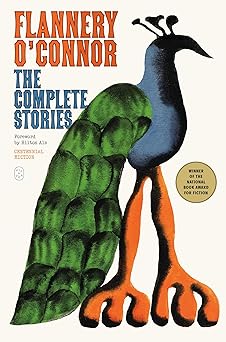
The Complete Stories is the only collection that includes every short story Flannery O’Connor ever wrote — including “The Geranium,” which she submitted as part of her master’s thesis at the Iowa Writers’ Workshop. If you’re going to read her, this is the one to get.
I’ve been looking for an excuse to sit down with this collection for a long time. There are plenty of curated selections and greatest hits editions out there, but I wanted all of it. O’Connor is, in my opinion, the single greatest American short story writer — and I don’t think it’s particularly close. Her settings are the rural South. Her characters are grotesque, flawed, and uncomfortably human. Her humor is dark enough to make you feel guilty for laughing. And somewhere underneath all of it, there’s always a collision between grace and violence that hits you harder than you expect.
If you’ve read “A Good Man Is Hard to Find” — which you probably have — you know what I mean. If you haven’t, start there, then come back for the rest.
How I Read It
I read every single story in order and took notes throughout. I also started a new practice with this book: whenever a story confused me, or whenever I suspected there was a layer of Catholic theology or Southern Gothic symbolism I wasn’t quite getting, I’d open a chat with an AI model and work through it in a back and forth.
O’Connor’s stories are packed with allusions. She was a devout Catholic writing in the Protestant South, and that tension runs through almost everything she wrote. Having a conversation partner to help unpack specific scenes — rather than just Googling a summary — made a real difference in how much I got out of the later, more complex stories.
I took all of those notes and chats and reformatted them into a short Cliff Notes-style summary for each story. They’re below. Useful for me as a reference, and hopefully useful to anyone else who’s working through this collection.
What Made It Worth the Time
Beyond the individual stories, one of the unexpected pleasures of reading the complete collection in order is watching O’Connor develop. You can see characters and themes in the early stories that eventually make their way into her novels — Wise Blood and The Violent Bear It Away. The seeds of Hazel Motes are in stories she wrote years before that novel existed. It’s like watching a writer figure out what she’s actually trying to say.
Her novels are great. Her short stories are where she’s operating at another level entirely.
Who Should Read This
If you’ve never read O’Connor: start with the short story collections A Good Man Is Hard to Find or Everything That Rises Must Converge first. Get a feel for her. If you find yourself wanting more — and you will — then come back for The Complete Stories.
If you already love her work: don’t wait as long as I did.
The Complete Stories by Flannery O'Connor is the only collection with every short story she wrote, including early thesis work. O'Connor is the greatest American short story writer — dark, funny, theologically dense, and operating at a level her novels don't quite match. Reading in order reveals how her characters and obsessions evolved over time. If you love her work, don't wait as long as I did.
- The only collection with every story, including early and hard-to-find work
- Reading in order shows O'Connor's development and the seeds of her novels
- Her short stories are the best of her work — more concentrated and hitting harder than the novels
- The stories are dense with Christian theology and Southern Gothic symbolism — easy to miss layers without some outside help
- Not the right starting point if you've never read O'Connor before
Story Summaries
The Life You Save May Be Your Own
This story is a masterpiece of irony and spiritual emptiness, centered on a collision between two predators: Tom T. Shiftlet, a one-armed drifter who claims to have a “moral intelligence,” and Mrs. Crater, a widow who is just as manipulative.
The Plot: A Transaction of Souls
- The Arrival: Shiftlet arrives at the desolate Crater farm. He isn’t interested in the mother or the daughter, Lucynell (who is deaf and has an intellectual disability). He is interested in the 1928 Ford automobile rusting in the yard.
- The Barter: Mrs. Crater wants a son-in-law to help with the farm, and Shiftlet wants the car. They enter a grotesque negotiation. Shiftlet performs “resurrections” — fixing the fence, the roof, and finally, the car — while preaching about the lack of “deep feeling” in the world.
- The Betrayal: To get the car, Shiftlet agrees to marry Lucynell. After the wedding, they drive away, but he quickly abandons her, fast asleep, at a diner called “The Hot Spot.” He tells the waiter she is just a “hitchhiker” and drives off alone.
The Takeaways: Why the Ending Matters
The Irony of “Saving a Life”
The title comes from a road sign Shiftlet sees: Drive carefully. The life you save may be your own. This is the central irony. Shiftlet believes he is a “good man” because he has a philosophy. However, by abandoning Lucynell — the only truly innocent figure in the story — he has effectively “lost” his own soul. He thinks he is saving his life by getting the car and his freedom, but he is actually destroying his spiritual life.
The Grotesque and the Car
Shiftlet’s missing arm is a physical sign of his “broken” spirit. He treats the car like a god. When he finally gets it running, he feels a sense of power, but it’s a hollow victory. He is a man in a “moving coffin.”
The Boy and the Storm
The ending features a young hitchhiker who jumps out of Shiftlet’s car after Shiftlet tries to preach to him about “mothers.” The boy yells that his old woman is “a flea-infested cat” and that Shiftlet is “the stinking polecat that ate her.” This is Shiftlet’s moment of truth — the boy sees him for exactly what he is: a hypocrite.
When Shiftlet prays, “Break forth and wash the slime from this earth!” and a storm cloud follows him, O’Connor is showing us that he is the slime. He is praying for his own destruction without even realizing it. Shiftlet is driving toward Mobile into a literal and figurative storm. He has the car, but he is more miserable and “empty” than he was when he had nothing. He is a man who “fixed” a car but broke his humanity.
The River
If “The Life You Save” is about a man who rejects a chance at grace, “The River” is about a child who pursues it with a terrifying, literal-minded intensity. While “The Life You Save” ends with a literal storm, “The River” ends with a literal immersion.
The Plot: A Tale of Two Worlds
- The City of Neglect: Harry Ashfield lives in a “grey” apartment with parents who are perpetually hungover, cynical, and emotionally absent. To them, the world is a joke or a party.
- The Baptism: His babysitter, Mrs. Connin, takes him to a healing revival at a river. There, a young preacher named Bevel tells the crowd that the river is the “River of Life” and that “if you go into this river, you’ll be someone.” Harry is baptized, taking the preacher’s words literally. He believes he now “counts.”
- The Return and the Quest: Harry returns to his parents’ apartment, but it feels more hollow than ever. He realizes he doesn’t want to be “Harry” in that world; he wants to be the “Bevel” who belongs to the River. He steals a Bible, travels back to the river alone, and tries to “baptize” himself to find the “Kingdom of Christ” the preacher promised.
The Takeaways: The Tragic “Kingdom”
The Literal vs. The Metaphorical
The tragedy of the story is a massive communication breakdown. The Preacher speaks in metaphors — “The River of Life,” “The Blood of Christ.” Harry/Bevel is a child; he takes these things literally. He believes if he goes under the water, he will find a physical kingdom where he is loved. The Parents represent modern nihilism; they believe in nothing, so they provide Harry with no framework to understand the world.
The Shift in Identity
By taking the preacher’s name (Bevel), the boy is attempting to shed his old, neglected self. In the city, he is a “nuisance.” In the river, he is a “child of God.” O’Connor is contrasting the spiritual significance of a person against the social insignificance they might have in a secular world.
Mr. Paradise: The Silent Antagonist
Mr. Paradise, the man with the “hump” on his back who follows Harry to the river at the end, represents the ultimate skeptic. He tries to “save” Harry with a piece of candy (a material bribe), but Harry sees him as a monster. To Harry, the “grey” world of the city and the “grey” skepticism of Mr. Paradise are what he is escaping.
The ending is a “Moment of Grace” in its most extreme form. As Harry struggles in the water, he feels the river “pulling him forward” until he finally stops fighting and lets it take him.
| Element | The “City” World (Harry) | The “River” World (Bevel) |
|---|---|---|
| Atmosphere | Stale air, hangovers, “sick” colors | Moving water, sun, “the red path” |
| Values | Irony, jokes, neglect | Healing, belonging, “counting” |
| Outcome | Slow spiritual death | Immediate physical death / Eternal life |
You might feel the ending is abrupt because Harry simply disappears. But for O’Connor, Harry “wins.” He rejects the “slime” of the world and chooses the only “Kingdom” he has ever been offered. He doesn’t “peter out”; he arrives.
A Circle in the Fire
This is O’Connor’s most tense “slow-burn” story. The conflict isn’t about physical action — it’s a psychological and spiritual siege. When a character is obsessed with “protecting” what they have, O’Connor usually sends someone to destroy it.
The Plot: The Siege of Mrs. Cope
- The Setup: Mrs. Cope is a woman who “manages” everything. She is obsessed with her farm and constantly tells everyone how “thankful” they should be. Her “gratitude” isn’t actually humble; it’s a way of asserting control. She acts as if her hard work has earned her a life free from disaster.
- The Arrival: Three city boys (Powell, Garfield, and W.T.) show up. Powell’s father used to work on the farm, and Powell has described it to the other boys as a kind of “Lost Paradise.”
- The Middle: The boys stay for several days. They don’t leave, and Mrs. Cope can’t quite bring herself to be “uncharitable” enough to kick them out forcefully. They spend their time riding the horses without permission and eating Mrs. Cope’s food while mocking her.
- The Power Shift: The boys treat the farm as if it belongs to them by right of memory/spirit, while Mrs. Cope treats it as hers by right of deed.
- The Destruction: The boys eventually realize they can’t have the farm, so they decide to “purify” it. They sneak into the woods and set them on fire.
The Takeaways: Why the “Middle” Matters
The Illusion of Ownership
Mrs. Cope believes she owns the land. She says things like, “It’s my woods” and “I have to protect it.” To O’Connor, this is a spiritual sin. In her view, nothing belongs to humans; everything belongs to God. The boys are the “vessel” sent to remind Mrs. Cope that her control is an illusion.
The “Prophets” in Blue Jeans
The boys are described in almost demonic or angelic terms (depending on how you look at it). They don’t want Mrs. Cope’s sandwiches; they want the feeling of the land. When they can’t possess the beauty of the farm, they decide to burn it. This is a “scorched earth” theology: if it’s not theirs, it shouldn’t exist.
The Biblical Reference
The title refers to the Book of Daniel and the story of the three Hebrew children (Shadrach, Meshach, and Abednego) who were thrown into a fiery furnace but were protected by God. In O’Connor’s story, the “three children” are the boys. The “fire” is the disaster Mrs. Cope has spent her whole life trying to prevent.
The Ending
The story ends with Mrs. Cope and her daughter (referred to as “the child”) watching the woods burn. The child watches her mother’s face, and it is the face of the “new stars and the moon” — a face the child had never seen before and would never see again.
Why does her face change? Mrs. Cope has finally lost. Her “fortress” is gone. The look on her face is one of total, helpless realization. She is no longer the “manager” of her world; she is just another human being subject to the “fire” of life. For the daughter, this is the moment she realizes her mother is not a god. The ending doesn’t “peter out” — it implodes. The physical fire in the woods reflects the internal fire that has just burned away Mrs. Cope’s pride.
The Displaced Person
This is O’Connor’s most ambitious story because it moves beyond the individual and looks at how an entire society — driven by pride and fear — can conspire to destroy a “miracle.”
The Plot: The Efficiency of the Outsider
- The Arrival: Mrs. McIntyre, a widow running a failing farm, hires Mr. Guizac, a Polish “Displaced Person” (DP) following WWII.
- The Conflict: Mr. Guizac is “too good” at his job. He is efficient, hardworking, and thrifty. This threatens the status quo: the Shortleys (the “white trash” help) feel their jobs are at risk; the Black farmhands see Guizac as competition; and Mrs. McIntyre, who initially loves him because he saves her money, is horrified when she discovers Guizac’s plan to marry his Polish cousin to one of the Black farmhands to rescue her from a refugee camp.
- The Decision: This “social sin” — interracial marriage and the breaking of Jim Crow norms — is too much for Mrs. McIntyre. She decides she must fire him, but she procrastinates because she still wants his labor.
The Takeaways
The DP as a Christ-Figure
Mr. Guizac is a Christ figure. He is the “outsider” who comes into a broken world and tries to fix it. Like Christ, he is killed by the very people he was helping because he challenged their social order and made them uncomfortable.
The Irony of “Displacement”
The title is the ultimate takeaway. Mr. Guizac is the literal Displaced Person (refugee). By the end of the story, Mrs. McIntyre becomes the displaced person. After the “murder,” her farm falls apart, she loses her health, her sight, and her property. She ends up a guest in her own life, being visited only by the Priest she used to mock.
The “Stain” of the Vision
Mrs. McIntyre thinks she can go back to “normal” once the Pole is gone. But O’Connor shows us that once you witness (or participate in) the destruction of the “innocent,” you can never go back. The “blindness” she suffers at the end is a physical manifestation of her spiritual refusal to “see” the humanity of the Displaced Person.
The Ending: Why It’s So Disturbing
The “shock” isn’t just that Mr. Guizac dies; it’s how he dies. Mr. Shortley is backing up a tractor with a heavy attachment. Mr. Guizac is lying on the ground working on another machine. Mrs. McIntyre, Mr. Shortley, and the Black farmhand Sulk all see the tractor rolling toward Mr. Guizac. Nobody says a word. They watch as the tractor slowly rolls over him, breaking his spine. It is a “passive murder.” By not shouting a warning, they all become executioners.
| Character | Their “Idol” | Their Fate |
|---|---|---|
| Mrs. McIntyre | The Farm / Efficiency | Loses the farm, becomes bedridden |
| Mr. Shortley | Job Security / Status | Becomes a drifter, loses his wife |
| The Priest | The Soul / Mr. Guizac | The only one left standing (spiritually) |
The ending isn’t just a “shocking” death; it’s the death of the farm and the death of Mrs. McIntyre’s moral world. She chose her “property” over a human life, and in the end, she lost both.
A Temple of the Holy Ghost
This story captures the transition from childhood cynicism to a profound, almost frightening, spiritual maturity. While so many O’Connor stories are about adults being “broken” by grace, this one is about a child being “opened” to it — and is O’Connor’s most beautiful meditation on the physicality of the sacred.
The Plot: The Child and the “Temples”
- The Visitors: Two boy-crazy, fourteen-year-old cousins come to visit a twelve-year-old girl (the unnamed protagonist). The cousins attend a convent school and mockingly tell her that the nuns taught them to tell off boys by saying, “Stop, sir! I am a Temple of the Holy Ghost!”
- The Conflict: The twelve-year-old — intelligent, prideful, and convinced she is superior to everyone — finds the phrase hilarious but also deeply intriguing. She spends the middle of the story alternating between being a “holy” person (imagining herself as a martyr) and being a brat.
- The Fair: The older girls go to a local fair and see a “freak” in a tent — a hermaphrodite. They describe the experience to the child later with a mix of giggles and discomfort.
- The Benediction: The story ends at the convent where the child’s mother has taken her to drop off the cousins. During a religious service, the girl has a vision that connects the “freak” at the fair to the host (the bread) in the priest’s hands.
The Takeaways: Finding God in the Grotesque
The Body as a Temple
The cousins use the phrase to protect their “virtue,” but the child begins to realize it means something much more radical: If every body is a temple of God, then even a “deformed” or “freakish” body is a residence of the Divine.
The Message of the Hermaphrodite
The most important part of the story is the child’s imagination of what the person at the fair said to the crowd: “God made me this way and I don’t complain of it… This is the way He wanted me to be and I ain’t complaining.” The person society mocks as a “freak” is actually the most spiritually advanced person in the story because they accept their “displacement” as God’s will.
The “Bloody” Sun
The ending features a striking visual. As they drive away from the convent, the child sees the sun — like an elevated Host drenched in blood. This is the girl’s moment of grace. She finally understands that the suffering of the “freak,” the sacrifice of Christ, and her own small life are all connected by a “bloody” and beautiful reality.
The ending doesn’t “peter out” or “shock” with violence. Instead, it elevates. The child realizes that the world isn’t divided into “normal people” and “freaks,” or “good people” and “bad people.” The world is a place where God is hidden inside every physical thing — even the things that make us uncomfortable.
| Character | View of the “Temple” | Outcome |
|---|---|---|
| The Cousins | A joke / A way to flirt | They remain shallow and unchanged |
| The Child | A mystery to be solved | She achieves a “vision” of the sacredness of life |
| The Hermaphrodite | A lived reality | Becomes the unintended “preacher” of the story |
The Artificial Nigger
This story — O’Connor’s personal favorite of her own work — focuses almost entirely on mercy. While many of her stories deal with judgment, this one deals with what happens after the judgment falls. O’Connor uses the racism of the characters not just as a social critique, but as a map of their spiritual poverty.
The Plot: A Journey of Pride and Betrayal
- The Quest for Superiority: Mr. Head, an old man who “knows everything,” takes his grandson Nelson to Atlanta. His goal is to “tame” the boy by showing him how dangerous and “inferior” the city is, thereby cementing his own status as the ultimate authority.
- The Descent: As they wander Atlanta, they become physically and spiritually lost. Mr. Head’s pride begins to crumble as he realizes he doesn’t know the city as well as he claimed.
- The Great Betrayal: Nelson, exhausted and scared, accidentally knocks over a woman and gets into trouble with a crowd. When the police ask Mr. Head if the boy is his, Mr. Head — terrified of losing his own social standing — denies him: “This is not my boy. I never saw him before.”
- The Reconciliation: After the betrayal, there is a literal and figurative “ice” between them. They wander in a wasteland of silence until they encounter the “Artificial Nigger” — the plaster lawn ornament.
The Takeaways: The Meaning of the Statue
The Mirror of Suffering
When they see the statue — chipped, leaning, and miserable — it represents the “misery of mankind.” It is a caricature created by racism, yet in this moment it transcends race. Both the old man and the boy see their own brokenness reflected in it. Mr. Head sees his own “chipped” soul. The statue is “common to them both”; it is a third party that allows them to stop hating each other and start hating their own shared human frailty.
The “Peter” Parallel
O’Connor is heavily referencing the biblical story of Peter denying Jesus. Mr. Head’s denial of Nelson is a “sin against love.” He realizes that his “status” as a wise grandfather was a lie. By the end, he realizes he is no better than the “lowest” person in Atlanta. He is stripped of his pride, which — in O’Connor’s world — is the only way to receive grace.
The Ending: The Return Home
As they get off the train back in their rural town, the moon is rising. Mr. Head feels “the action of mercy” covering him like a garment. He realizes that he is a “sinner” and that his only hope is forgiveness. He went to the city to teach Nelson a lesson, but the city (and the statue) taught him a lesson in humility.
| Concept | Mr. Head’s Beginning | Mr. Head’s Ending |
|---|---|---|
| His Status | “A man of wisdom” | “A sinner in need of mercy” |
| His View of Others | Tools to prove his superiority | Fellow sufferers in a broken world |
| The City | A place to be conquered | A purgatory that cleansed his pride |
Note how the “whiteness” of the moon at the end contrasts with the “blackness” of the statue. O’Connor is suggesting that true “purity” doesn’t come from your skin color or your social status, but from the “washing” of the soul after a total collapse of the ego.
Good Country People
O’Connor at her most wickedly funny and her most biting. This is a “con-man” tale where the person being conned believes they are the smartest person in the room.
The Plot: The Intellectual vs. The “Simple” Boy
- The Protagonist: Joy Hopewell is a 32-year-old woman with a PhD in philosophy and a wooden leg (the result of a childhood hunting accident). She has legally changed her name to Hulga because it sounds ugly, which she considers a badge of her cynical, atheistic “truth.”
- The Mother: Mrs. Hopewell is a woman of clichés. She categorizes people into “trash” and “good country people.” She views her daughter’s education as a strange disease and Hulga herself as a child.
- The Arrival: Manley Pointer, a nineteen-year-old Bible salesman, arrives. He appears to be a “simple, good country person” with a heart condition. Mrs. Hopewell is charmed; Hulga is intrigued.
- The Seduction: Hulga decides she will seduce Manley — not out of love, but to “enlighten” him. She wants to show him that his Bibles are junk and that there is “nothing” beyond the physical world. She imagines she will leave him with a “deeply felt spiritual trauma.”
- The Twist: They go to a hayloft. Manley asks to see her wooden leg, calling it “what makes you different.” He convinces her to take it off. Once she is “helpless,” he reveals his true self.
The Takeaways: The Theft of the Soul
The Wooden Leg as Symbol
To Hulga, the leg is a scientific fact. To Manley, the leg is a trophy. Spiritually, the leg represents Hulga’s vulnerability and her soul. She thinks her PhD is her strength, but she has placed all her “faith” in her cynicism. When Manley steals the leg, he leaves her physically and spiritually unable to stand.
The Irony of Nihilism
Hulga prides herself on being a nihilist. The irony is that Manley is a “better” nihilist than she is. Hulga’s nihilism is an academic theory; Manley’s nihilism is a lived reality. He doesn’t just “not believe”; he actively destroys. As he leaves, he tells her, “I been believing in nothing ever since I was born!”
The Hollow Bible
The most shocking moment is when Manley opens his valise. He isn’t carrying Bibles to sell; he is carrying the “vices” of the world: whiskey, playing cards, contraceptives. This is the ultimate O’Connor grotesque: the Word of God is literally hollowed out to hide human sin. It mocks Mrs. Hopewell’s clichés and Hulga’s intellectualism simultaneously.
The “Moment of Grace”
Where is the grace in a woman being left stranded in a hayloft without her leg by a sociopath? In O’Connor’s view, Hulga was “full of herself.” Her PhD and her cynicism were walls she built to keep out the world and God. By having her leg stolen by a “simpleton,” her pride is completely destroyed. She is left in a state of “absolute poverty.” For O’Connor, it is only when you are totally empty and humiliated that you are finally capable of receiving Truth.
| Character | Their Cliché/Belief | The Reality |
|---|---|---|
| Mrs. Hopewell | “Good country people are the salt of the earth” | “Good country people” can be predators |
| Hulga | “I am the smart one; I see through everyone” | She is the most easily deceived person in the story |
| Manley Pointer | “I’m just a simple boy with a heart condition” | He is a sophisticated, heartless predator |
The ending leaves Hulga watching Manley walk across the lake — a dark parody of Christ walking on water.
Greenleaf
This is perhaps O’Connor’s most mythological and haunting story — about a woman who has spent fifteen years successfully fending off God, only to be cornered by Him in the form of a scrub bull.
The Plot: The War of the “Iron Hand”
- The Conflict: Mrs. May is a widow who runs her farm with an “iron hand.” She is obsessed with respectability and considers herself superior to her hired man, Mr. Greenleaf, and his “shiftless” family.
- The Threat: A stray bull — belonging to the Greenleaf sons (who have become successful, modern farmers, much to Mrs. May’s resentment) — is wandering onto her land. It’s eating her clover and “threatening” her purebred cows.
- The Social Resentment: Mrs. May hates that the Greenleafs are “getting ahead.” Her own sons are bitter, intellectual failures who mock her, while the Greenleaf boys are thriving. To her, the bull represents the Greenleafs’ “low-class” intrusion into her orderly life.
- The Hunt: Mrs. May finally forces the lazy, passive-aggressive Mr. Greenleaf to go into the woods with her to shoot the bull.
The Takeaways: The Bull as the Divine Suitor
The “Divine Suitor”
O’Connor describes the bull in very specific ways. At the beginning of the story, he is outside her window with a “wreath” of hedge caught on his horns, looking like a “gaunt, majestic” lover or a king. This echoes the myth of Zeus appearing as a bull to abduct Europa. Theologically, the bull represents Christ as a “pursuer.” Mrs. May doesn’t want a “passionate” religion; she wants a respectable, manageable life. The bull is the wild, uncontrollable grace that refuses to stay off her “property.”
The Irony of “Order”
Mrs. May’s entire identity is built on her “good sense” and hard work: “I’ve put up with it for fifteen years!” She believes she has “earned” her safety. O’Connor’s takeaway is that human effort cannot protect you from the Divine. The more Mrs. May tries to control her environment, the more the world (and her own sons) seems to mock her.
Class and the “New South”
Like The Displaced Person, this story highlights the shifting social sands. The Greenleafs represent the “New South” — unrefined but energetic and rising — while Mrs. May represents the “Old South” — orderly but sterile and dying.
The Ending
The ending is one of the most visually stunning in all of literature. Mrs. May is sitting on the bumper of her car, waiting for Mr. Greenleaf to flush out the bull. The bull emerges from the woods and charges her.
“She continued to stare at him… as if she were the only person on the entire earth who could possibly be of interest to him.”
He “buries his head in her lap” like a lover. She seems to be “whispering some last discovery into the animal’s ear.” She has the look of someone whose “vision” has suddenly cleared. For fifteen years, Mrs. May’s heart was a “stony place.” It took the horns of the bull to literally and figuratively pierce it to let reality in. In her final moment, she is no longer the “landowner” or the “boss”; she is a human being in a violent, intimate embrace with the Divine. Her “discovery” is that she was never in control.
| Before the Bull | After the Bull | |
|---|---|---|
| Identity | Property owner / Manager | Creature / Sinner |
| Focus | Keeping the “outside” world out | A “last discovery” of the interior |
| Religion | A matter of “good sense” | A violent, inescapable encounter |
A View of the Woods
This is often considered O’Connor’s most “unredeemed” and chilling work. While many of her stories offer a “moment of grace” that — however violent — suggests a soul being saved, “A View of the Woods” is a descent into a spiritual wasteland where pride wins and everyone loses. It explores the “Progress” of the New South as a form of literal soul-selling.
The Plot: The Mirror and the Machine
- The Ego: Mr. Fortune is a 79-year-old man obsessed with “progress.” He believes that “owning” the earth means paving it. He despises his son-in-law, Pitts, whom he considers a “backward” failure.
- The Clone: Mr. Fortune’s only joy is his granddaughter, Mary Fortune Pitts. He views her as a mini-version of himself — smart, tough, and “a Fortune,” not “a Pitts.” He ignores the fact that her father, Pitts, beats her regularly, treating it as a “Pitts” problem.
- The Conflict: Fortune decides to sell the “lawn” — the lot right in front of the house — to a man who wants to build a gas station. This sale will block the family’s “view of the woods.”
- The Betrayal: Mary Fortune Pitts, surprisingly, sides with her father. She loves the woods. She sees the land as more than a commodity. This infuriates Fortune; he feels his “cloned” legacy is rebelling against him.
- The Ending: In a fit of rage, Fortune takes Mary into the woods to “beat the Pitts out of her.” In a shocking turn, the young girl fights back with animalistic ferocity. After a brutal struggle, Fortune kills her, only to realize he has destroyed the only thing he ever loved. He then suffers a heart attack and dies alone by the lake.
The Takeaways: The Price of “Progress”
The Woods as the Divine Presence
To Pitts and Mary, the woods represent something beautiful, mysterious, and permanent. To Fortune, the woods are “waste” because they don’t produce money. O’Connor often used nature to represent the “unseen” world of God. By selling the view of the woods to build a gas station, Fortune is literally trading his spiritual vision for a “convenience.”
The Illusion of the Self
Fortune’s greatest sin is his narcissism. He loves Mary Fortune only because he thinks she is him. He refuses to see her as a separate human being with her own soul. When she defends her father and the woods, his “mirror” breaks. By killing her, he is symbolically committing suicide — killing the only part of his lineage that had any spark of life.
The Machine vs. The Earth
The story is filled with the sounds of “the red monster” (the bulldozer). The bulldozer is the “prophet” of Fortune’s religion — it represents the “progress” that eats the earth. At the very end, as Fortune is dying, he sees the bulldozer “gulping” the woods. He realizes too late that the progress he championed is an insatiable beast that will eventually swallow him, too.
The Ending
Unlike many O’Connor protagonists, Fortune does not seem to find forgiveness. As Fortune lies dying by the lake, he looks across the water and sees the woods: “The woods… marched across the water and up the hill… they were not a view of the woods, they were the woods themselves.”
In his final seconds, the “view” (the commodity) becomes a reality (the Presence). He realizes that the woods — and the spiritual world they represent — are vast, unstoppable, and completely indifferent to his “progress.” He dies seeing the bulldozer sitting on the bank like a mechanical demon waiting for him.
| Character | View of the Land | Spiritual State |
|---|---|---|
| Mr. Fortune | A product to be sold | Total spiritual blindness |
| Mary Fortune | A place to belong | A mix of innocence and “Pitts” violence |
| The Woods | The “Enemy” of progress | The terrifying, beautiful Presence of God |
The Enduring Chill
This is one of O’Connor’s funniest stories, but also one of her most uncomfortable because it mocks the desire to have a “meaningful” or “artistic” death. It is her most biting satire of the “Self-Important Intellectual.” Where Hulga in Good Country People was cynical and sturdy, Asbury Fox is frail, dramatic, and desperate to be a martyr.
The Plot: The Tragedy of the Failed Artist
- The Return: Asbury Fox, a failed writer living in New York, returns to his mother’s dairy farm in Georgia. He is convinced he is dying of a mysterious, tragic illness.
- The Drama: Asbury wants to die. He sees his death as a way to finally punish his mother for her “small-mindedness” and to prove his own sensitivity. He prepares a long, dramatic letter for her to read after he’s gone.
- The Quest for a “Significant” Encounter: Asbury tries to stage-manage his final days. He tries to talk to the Black dairy workers, hoping for a “meaningful” connection with the oppressed, but they just find him strange. He asks for a priest — specifically a sophisticated Jesuit — to discuss philosophy. Instead, he gets Father Flynn, a blind, simple man who smells of tobacco and yells at him about his catechism.
- The Revelation: The doctor arrives and delivers the “bad” news: Asbury isn’t dying. He has undulant fever, a recurring, non-fatal illness caused by drinking raw milk.
The Takeaways: The Comedy of Pride
The Irony of the Illness
Asbury wanted a “poetic” death (like tuberculosis or some grand, tragic exhaustion). Instead, he has a “cow’s disease.” He got it because he tried to rebel against his mother by drinking unpasteurized milk with the workers to prove he was “one of them.” His “rebellion” didn’t lead to a grand statement; it led to a fever that will haunt him for the rest of his life. He is stuck in the very place he hates, with the mother he despises, suffering from a common farm ailment.
The “Simple” Priest vs. The “Complex” Intellectual
The scene with Father Flynn is classic O’Connor. Asbury wants to talk about Joyce and aesthetics; the priest wants to know if he says his morning prayers. Father Flynn represents the “coarseness” of actual faith. Asbury represents the “sterility” of intellectualism. Asbury realizes he doesn’t even have the “courage” to be a believer or a true atheist — he’s just a bored, middle-class boy.
The Holy Ghost as a Predator
Throughout the story, Asbury has stared at a water stain on his ceiling that looks like a bird. At the end, as the reality of his non-death sinks in, he realizes that the “bird” is descending on him. This is not a “peaceful” Holy Spirit; it is a “fierce” one.
The Ending
Most people want a “Moment of Grace” to feel like a warm hug. In this story, grace is the “enduring chill.” Asbury realizes he is going to live — but he is going to live a life of “punishing” mediocrity. He is no longer the “dying hero”; he is just a sick man in a room.
“The Holy Ghost, emblazoned in ice instead of fire, continued, implacable, to descend.”
Usually, the Holy Spirit is associated with the “fire” of Pentecost. Here, it is ice because Asbury’s pride needs to be frozen and shattered. His “grace” is the realization that he is not a genius, he is not a martyr, and he is not in charge. He is now “exposed” to a reality he can no longer write his way out of.
| Asbury’s Expectation | The Reality (Grace) |
|---|---|
| Death: A tragic, final escape | Life: A long, difficult endurance |
| Intellect: His shield against the world | Intellect: A useless toy that failed him |
| The “Bird”: A random water stain | The “Bird”: The terrifying presence of God |
The Comforts of Home
This is O’Connor’s most explicit study of the Freudian Trio: the over-indulgent Mother (Superego), the dead, cynical Father (the Id), and the paralyzed Son, Thomas (the Ego). It reads like an urban, psychological thriller — a departure from her usual rural settings. Where other O’Connor stories feature “external” invaders like drifters or bulls, this one is about the invader within the house — and within the mind.
The Plot: The Unwanted Guest
- The Sanctuary: Thomas is a 35-year-old intellectual who lives a quiet, perfectly curated life with his mother. He values his “comforts” — his books, his desk, his routine.
- The Intrusion: His mother, who is “pathologically charitable,” brings home Sarah Ham (who calls herself Star Drake). Sarah is a “ninny,” a petty criminal, and a “moral wreck.” The mother wants to “save” her; Thomas wants her gone.
- The Ghost of the Father: Thomas is haunted by the voice of his dead father, “the Squire.” The father was a loud, aggressive, practical man who despised Thomas’s “softness.” The father’s voice constantly goads Thomas to “take action” and “be a man.”
- The Botched Plan: Desperate to get Sarah out, Thomas steals his father’s old pistol and plants it in Sarah’s purse, intending to call the police and have her arrested for theft.
- The Tragedy: Sarah discovers the gun. In the ensuing confrontation, the “voice” of the father takes over Thomas’s hand. He fires at Sarah, but his mother steps between them to protect the “lost soul.” Thomas kills his mother instead.
The Takeaways: The Cost of “Virtue”
The Two Types of “Goodness”
O’Connor is contrasting two very different, and equally flawed, types of “good.” The Mother’s Goodness is blind and indiscriminate — she “loves” the girl because she is a “case,” not a person. This is what O’Connor calls “sentimental charity,” and in her world, it is dangerous because it ignores the reality of evil. Thomas’s Goodness is sterile and selfish — he wants to be “good” only so he can be left alone in his comfort. His goodness is a wall, not a bridge.
The Return of the “Squire”
The most chilling part of the story is the psychological possession. Thomas spends the whole story trying to be unlike his father. Yet, the moment he tries to solve his problems with “action” (the gun), he becomes his father. The ending implies that by trying to protect his “comforts,” he invited the most violent part of his heritage back to life.
The “Comforts” are a Lie
The title is deeply ironic. By the end, the “home” is destroyed, the “comfort” is gone, and Thomas is standing over his mother’s body. The sheriff arrives and sees exactly what the father’s “voice” wanted: a man who looks like he killed his mother to get her inheritance or to get rid of a rival. Thomas’s “reputation” — the thing he valued most — is permanently stained.
The Ending
The ending is a “Moment of Grace” in reverse. Usually, grace is a gift; here, it is a judgment. As the sheriff walks in, Thomas realizes that he is now “one” with his father. He has acted on the Squire’s impulses, and the result is the destruction of the only person who actually loved him. His intellectualism couldn’t save him, and his mother’s charity couldn’t save Sarah.
| Character | Their Goal | Their Failure |
|---|---|---|
| Thomas | Peace and intellectual quiet | Commits a violent, loud crime |
| The Mother | To “save” a lost girl | Is killed by the son she “protected” |
| Sarah Ham | To find a “home” | Becomes the catalyst for a murder |
Everything That Rises Must Converge
This is arguably O’Connor’s most poignant “mother-son” story, and the ultimate critique of the “Liberal Intellectual” of the 1960s South — someone who understands the theory of social justice but lacks the actual heart for it. While The Enduring Chill mocked the son’s artistic pretensions, this story strips away the son’s moral pretensions.
The Plot: The Bus Ride to Reality
- The Dynamic: Julian is a frustrated college graduate who sells typewriters while dreaming of being a writer. He lives with his mother, a woman who clings to her “ancestral” pride (her grandfather was a Governor) and her belief that Black people were “better off” when they “knew their place.”
- The Setting: They are on a bus in the recently integrated South. Julian’s mother is afraid to ride alone, so Julian begrudgingly escorts her to her “reducing class” (exercise class) at the YMCA.
- The Weaponized Progress: Julian uses his “progressive” views to torture his mother. He tries to strike up conversations with Black passengers specifically to annoy her. He views himself as enlightened and her as a bigot, yet he is entirely dependent on her for his food and shelter.
- The Hat: Julian’s mother buys a hideous, expensive hat. On the bus, a Black woman gets on wearing the exact same hat — a visual equalizer that signals the “convergence” of the classes.
- The Climax: When they exit the bus, the mother — in a gesture of “condescending kindness” — tries to give the Black woman’s young son a penny. The Black woman, insulted by the “charity,” swings her purse and knocks Julian’s mother to the ground.
The Takeaways: The Irony of “Convergence”
The Symbolic Hat
The fact that a poor Black woman and a “blue-blooded” white woman own the same ridiculous accessory proves that the social walls the mother relies on have crumbled. For Julian, the hat is a victory; for his mother, it is a spiritual wound she doesn’t even realize she has received.
Julian’s Hollow Virtue
Julian is perhaps O’Connor’s most unlikable protagonist. He talks about “integrating” the South, but in his mind, he is just as obsessed with status as his mother. He imagines bringing a “distinguished Negro” home just to shock her. He doesn’t see Black people as humans; he sees them as tools to prove his intellectual superiority over his mother. O’Connor is suggesting that Julian’s “enlightenment” is just another form of pride.
The Title (Teilhard de Chardin)
The title comes from the Jesuit priest Pierre Teilhard de Chardin, who believed that as humanity evolves (rises), it must eventually converge at the “Omega Point” (God). O’Connor uses this ironically: the “rising” in the South (Civil Rights) is leading to a “convergence” of the races — but this convergence is painful and violent because people like Julian and his mother are not prepared for the humility it requires.
The Ending
As Julian’s mother lies on the sidewalk after being hit, Julian continues to lecture her. He is triumphant, saying, “You got exactly what you deserved!” Then, he realizes she is having a stroke. Her face becomes distorted; she reverts to a childhood state, calling for her nurse (the Black woman who raised her).
In his mother’s collapse, Julian’s “intellectual” world vanishes. He realizes that he doesn’t just hate his mother; he loves her and is terrified of losing the only person who truly cared for him. “The tide of darkness seemed to sweep him back to her, postponing from moment to moment his entry into the world of guilt and sorrow.”
Why is this grace? Because Julian is finally “entering the world of guilt and sorrow.” For O’Connor, that world is the only place where a person can be “real.” Julian is stripped of his typewriter, his books, and his smugness. He is now just a grieving son, finally “converging” with the rest of suffering humanity.
| Julian at the Start | Julian at the End | |
|---|---|---|
| Status | Detached Judge | Grieving Participant |
| View of Mother | A bigoted burden | A dying woman he loves |
| Identity | Intellectual / “Writer” | A “guilty” human being |
The Partridge Festival
This is one of O’Connor’s most underrated satires. It targets the “Romantic Intellectual” — the person who falls in love with the idea of a rebel or a criminal because they want to feel superior to the “boring, commercial” masses. It is a hilarious but scathing look at how we often project our own fantasies onto people who are actually quite dangerous or broken.
The Plot: The Search for a “Martyr”
- The Context: The town of Partridge is holding its annual Azalea Festival — a celebration of beauty that is mostly a celebration of commerce. Calhoun, who considers himself an intellectual and a rebel, hates the festival. He thinks the townspeople are “soulless merchants.”
- The Hero: A man named Singleton is in jail for killing five people during a “rebellion” against the festival’s commercialism. Calhoun decides that Singleton is a Christ-figure — a martyr who stood up against the fake world of the merchants.
- The Partner: Calhoun meets Mary Elizabeth, another “intellectual” girl who shares his disdain for the town. Together, they decide they must visit Singleton in the mental hospital to show him their “solidarity.” They imagine a profound, soul-stirring meeting with a tragic hero.
- The Revelation: When they finally see Singleton, he is not a tragic hero. He is a lewd, grotesque, and genuinely insane old man. He mocks them, exposes himself, and behaves in a way that is utterly “non-intellectual.”
- The Ending: Calhoun and Mary Elizabeth flee in horror. As they drive away, Calhoun catches a glimpse of his own face in the mirror and realizes he doesn’t look like a rebel; he looks exactly like the merchant-uncles he has spent his life despising.
The Takeaways: The Danger of “Intellectual Sympathy”
The Myth of the “Beautiful Rebel”
Calhoun and Mary Elizabeth don’t actually care about Singleton; they care about how cool it makes them look to be the only ones who “understand” him. They use “sympathy” for the marginalized as a way to feed their own ego.
The Mirror of Reality
The ending is a classic “Narcissus” moment in reverse. Instead of falling in love with his reflection, Calhoun is repulsed by it. He realizes that his “intellectualism” was just a mask. Underneath, he is a product of his culture — just as materialistic and small-minded as the people he mocks.
The “Mock” Festival
- The Azaleas are the surface (The Town’s pride)
- Singleton is the violent reality (The Town’s shadow)
- Calhoun is the fake critic (The Town’s pretension)
The “Festival” of human pride is always eventually interrupted by the “Gore” of reality.
The “Moment of Vision”
At the end, Calhoun sees his great-uncle’s face in his own: “The eyes were small and dark and glittered… He saw his own face… and it was the face of the master merchant.”
In O’Connor’s world, self-knowledge is the first step toward salvation. Calhoun had to see that he was a “merchant” of ideas before he could ever become a real human being. He was selling “rebellion” the same way his uncles sold hardware. By losing his “intellectual” pride, he is finally forced to stand on the same level as everyone else.
| Calhoun’s Fantasy | The Reality |
|---|---|
| Singleton: A misunderstood saint | Singleton: A violent, lewd madman |
| Calhoun: A profound artist/rebel | Calhoun: A pretentious “merchant” of ideas |
| The Visit: A spiritual communion | The Visit: A humiliating disaster |
Why Do the Heathen Rage
Note: “Why Do the Heathen Rage?” is not just a short story — it is the title chapter of the third novel O’Connor was writing when she died. Because it was never finished, it exists as a haunting fragment of what would have been her most mature exploration of the “useless” intellectual. It shows O’Connor moving away from sudden “shocks” and toward a more quiet, lingering kind of spiritual paralysis.
The Plot: The Intellectual as a Ghost
- The Protagonist: Walter Tilman is 28, lives at home, and does absolutely nothing. He doesn’t even have the energy to be a “writer”; he just reads and observes.
- The Mother: After her husband has a massive stroke, the mother is desperate for Walter to take over the farm. She tries to guilt him, goad him, and shame him into “becoming a man.”
- The Father: The father is now a silent, paralyzed figure in a wheelchair. He is a “living corpse” who serves as a terrifying mirror for Walter. Walter is paralyzed by choice/cynicism; the father is paralyzed by biology.
- The Cruelty of the Letter: To amuse himself, Walter writes a letter to a social activist girl he doesn’t know. He pretends to be a poor, uneducated man seeking her help. He is “performing” a role for a joke, mocking the girl’s sincerity and the mother’s desperation simultaneously.
The Takeaways: The “Vain Thing”
The Meaning of the Title
The title comes from Psalm 2:1: “Why do the heathen rage, and the people imagine a vain thing?” In the mother’s eyes, the people changing the South (civil rights activists, modernizers) are the heathen. In O’Connor’s eyes, Walter is the one imagining a “vain thing.” His belief that he can stay detached, watching the world through books and fake letters without ever being “touched” by reality, is the ultimate vanity.
The Stroke of Reality
The father’s stroke is the reality that Walter cannot intellectualize away. The father’s “helplessness” is a physical manifestation of Walter’s spiritual state. When the mother looks at Walter and sees only “a space where a man should be,” she is identifying his spiritual void.
The Unfinished Grace
Because this was meant to be a novel, the ending of this chapter feels more like a “setup” than a conclusion. Walter thinks he is “above” the world. But by the end of the fragment, we see that he is actually terrified. He is writing letters to strangers because he is incapable of having a real relationship with his own mother or his dying father. He is a “heathen” not because he is a “sinner” in the traditional sense, but because he refuses to participate in the struggle of being human.
| Character | Their Method of Escape | The Reality They Face |
|---|---|---|
| Walter | Irony, books, and fake letters | The silent, judging presence of his father |
| The Mother | Work, farm-management, and nagging | The inevitable loss of the “Old South” way of life |
| The Father | (None) | He is the physical “End” that Walter tries to ignore |
The Lame Shall Enter First
This is O’Connor’s most direct attack on Secular Humanism — the belief that man can be “saved” through psychology, science, and good intentions rather than through the Divine. It is a tragedy of “blindness”: Sheppard is so busy looking through a telescope at the “big picture” that he fails to see the child standing right in front of him.
The Plot: The Savior and the Saboteur
- The Father: Sheppard is a widower and a city recreational director who prides himself on his “rational” mind. He believes that people are “good” but “damaged” by their environments.
- The Son: Norton is Sheppard’s young son, who is drowning in grief over his mother’s recent death. Sheppard finds Norton’s grief “selfish” and “unproductive.”
- The Project: Sheppard brings home Rufus Johnson, a delinquent with a club foot and a genius-level IQ. Sheppard is convinced he can “reform” Rufus through education and modern science. He ignores the fact that Rufus is a committed religious fundamentalist who believes in the Devil.
- The Conflict: Sheppard buys Rufus a telescope and a new orthopedic shoe to “fix” him. Rufus rejects these gifts, using the telescope to mock Sheppard and the shoe to commit more crimes. Meanwhile, Norton uses the telescope to look for his mother in the stars, becoming obsessed with the idea that she is “up there.”
- The Ending: After Rufus is arrested again, he publicly exposes Sheppard’s hypocrisy, calling him a “dirty atheist” who thinks he is God. Sheppard finally has a moment of realization — he sees that he has neglected his own son’s soul. He rushes to find Norton, only to find the boy has hanged himself to “launch” himself toward his mother.
The Takeaways: The Failure of the “Rational” Man
The Telescope vs. The Heart
The telescope is the central symbol. For Sheppard, it represents “progress” and the vast, empty universe of science. For Norton, it is a tool of hope and a way to reach the spiritual world. Sheppard’s tragedy is that he taught his son how to use the tool, but gave him no spiritual foundation to understand what he was seeing.
The “Lame” Shall Enter First
The title is a play on the biblical idea that the “last shall be first.” Rufus Johnson is physically “lame” (the club foot), but he is spiritually “whole” in his understanding of good and evil — he knows he is a sinner. Sheppard is physically “whole,” but he is spiritually “lame.” He doesn’t believe in sin, so he can never be redeemed. A “bad” person with faith (Rufus) is closer to the truth than a “good” person without it (Sheppard).
The Devouring “Goodness”
Sheppard thinks he is the most moral character, but he is actually the most destructive. He “eats” his son’s emotional life to feed his own ego as a “savior.” He doesn’t love Rufus; he loves the idea of saving Rufus.
The Ending
The ending is one of the most devastating in literature. It isn’t a “moment of grace” that leads to peace; it is a “moment of horror” that leads to total loss. Sheppard’s realization comes too late: “He had ignored his own child to feed his vision of himself. He had swept his own house empty of love.”
Why does Norton die? In his father’s sterile, scientific world, there was no room for a soul. Norton took the only “escape” he could find.
| Character | Their View of “Salvation” | Their Ultimate Fate |
|---|---|---|
| Sheppard | Science, psychology, and “enlightenment” | Total spiritual and familial ruin |
| Rufus | Acceptance of Evil and the Devil | Prison (but with his “integrity” intact) |
| Norton | Reaching his mother in the “stars” | Death / Escape from the “rational” world |
Revelation
This is the ultimate critique of “respectable” Christianity — the kind that uses God as a stamp of approval for one’s own social standing. It is one of O’Connor’s most triumphant and visually stunning “moments of grace.”
The Plot: The Doctor’s Waiting Room
- The Categorization: Mrs. Ruby Turpin sits in a crowded doctor’s waiting room. To pass the time, she mentally categorizes everyone there based on her strict Southern social hierarchy: “white trash” at the bottom, “niggers” next, then “homeowners” (like her and Claud), and finally the “rich” at the top.
- The Smug Gratitude: Mrs. Turpin is overwhelmed by her own goodness. She carries on a polite, condescending conversation with a “pleasant” lady while mentally thanking God: “Help me to be a good woman, for I already am!”
- The Messenger: Mary Grace, a surly, acne-faced college student reading a textbook titled Human Development, is watching Mrs. Turpin with increasing, silent fury.
- The Attack: When Mrs. Turpin exclaims, “Thank you, Jesus, for making everything the way it is!” Mary Grace finally snaps. She hurls her book at Mrs. Turpin, lunges at her, and whispers the message that breaks Mrs. Turpin’s world: “Go back to hell where you came from, you old wart hog from hell.”
- The Vision: Back at her farm, a devastated and angry Mrs. Turpin demands an explanation from God while hosing down her literal hogs. She looks up and sees her famous vision.
The Takeaways: Grace as a Projectile
Mary Grace as “Grace”
The girl’s name is no accident. In O’Connor’s world, grace is rarely a whisper; it is a violent interruption. Mary Grace’s book, Human Development, is the physical “weight” of the truth hitting Mrs. Turpin. She is not as “developed” as she thinks. The insult “wart hog” is the perfect antidote to her “respectable” pride.
The Irony of the “Good Woman”
Mrs. Turpin believes her “goodness” is a shield. She thinks that because she is clean, industrious, and “polite,” she is favored by God. O’Connor is showing that politeness is not the same as holiness. By looking down on others, Mrs. Turpin has committed the ultimate sin of pride, making her spiritually identical to the “wart hog” she is called.
The Reversal of the Hierarchy
The vision at the end is the “Revelation” of the title. Mrs. Turpin sees a “vast horde of souls” rumbling toward heaven. Leading the way: the “white trash,” the “niggers,” and the “freaks” she despised. At the back: people like herself and Claud, who “always had a little of everything and the God-given wit to use it right.” The crucial detail: even the “respectable” people are being saved, but their “virtues” are being burned away as they walk. They are entering heaven as equals to the people they looked down upon.
The Purging Fire
Mrs. Turpin is left in the dark, listening to the “invisible glory” of the souls. Her world was a neat, sorted filing cabinet. God’s world is a “bridge of fire.” She realizes that in the eyes of eternity, her “goodness” was just as much of a burden as anyone else’s “badness.”
| Mrs. Turpin’s Worldview | The Reality of the Vision |
|---|---|
| Hierarchy: Based on land and “cleanliness” | Equality: Everyone is a “horde of souls” |
| Gratitude: A way to feel superior | Grace: A fire that burns away pride |
| Self-Image: A “good woman” | Self-Image: A “wart hog” being purified |
Parker’s Back
O’Connor’s final completed story, written from her hospital bed as she was dying. It is perhaps her most profound meditation on the Incarnation — the idea of God becoming flesh. While many of her stories deal with the spirit as something that “breaks” the body, “Parker’s Back” is about the spirit being literally written onto the body.
The Plot: The Canvas of a Life
- The Wanderer: O.E. Parker (Obadiah Elihue) is a man obsessed with tattoos. He isn’t an artist; he just wants to fill the “empty spaces” on his skin. He is a drifter who feels a deep, nameless dissatisfaction with life.
- The Marriage: He marries Sarah Ruth Cates, the daughter of a preacher. She is a “plain,” sour woman who hates everything physical. She considers his tattoos “vanity” and “sin.” Parker doesn’t even know why he likes her, but he is drawn to her judgment.
- The Accident: While driving a tractor, Parker has a near-fatal accident where the tractor hits a tree and bursts into flames. This is his “burning bush” moment. He realizes he is “empty” and needs something final to fill the last patch of skin on his body: his back.
- The Tattoo: Parker goes to a city tattoo artist and demands a “religious” picture. He rejects the “soft,” pretty Jesuses and chooses a Byzantine Christ with “all-inclusive” and “demanding” eyes.
- The Rejection: He returns home, hoping the tattoo will finally make Sarah Ruth “see” him or love him. Instead, she is horrified. She screams that it is an “idol” and beats his back with a broom until the welts rise on the face of the tattooed Christ.
The Takeaways: The “Holy” Grotesque
The Name: Obadiah Elihue
Parker has spent his whole life hiding his real name. Obadiah means “Servant of God”; Elihue means “He is my God.” By the end of the story, Parker finally accepts his name. He stops being “O.E.” (the drifter) and becomes a man literally marked by the God he tried to run from.
The Byzantine Christ
The choice of the Byzantine style is crucial. Parker rejects the “commercial” Jesus for a God who is judging and eternal. He wants a God who looks back at him. When the tattoo is finished, Parker feels like the eyes are looking through him. He no longer “owns” his back; he is now a “temple” for those eyes.
Sarah Ruth’s Heresy
Sarah Ruth represents a specific spiritual error called Manichaeism — the belief that the physical world is evil and only the “spirit” is good. She hates tattoos because she hates the body. She calls the tattoo an “idol” because she cannot believe that God could be represented in paint and skin. By beating Parker, she thinks she is being holy, but O’Connor portrays her as the true “heathen” because she lacks the love that recognizes God in the flesh.
The Ending
Parker is left leaning against a pecan tree, “crying like a baby.” He has been “fixed.” He spent his life trying to find a “view” or a “feeling” to satisfy him. He finally found it by having Christ tattooed on his back — the one place he cannot see.
“He was leaning against the tree, crying like a baby… the welts on his back began to swell into the face of the Christ.”
He is crying because he is finally “caught.” He is no longer an individual “filling his own spaces.” He has been claimed. The physical pain of the broom-beating is the “seal” of his transformation — like a brand on cattle, the marks of the broom on the tattoo signify that he now belongs to the God whose name he bears.
| Parker’s Life Before | Parker’s Life After | |
|---|---|---|
| Tattoos | Random “vanity” and decoration | A permanent, spiritual mark |
| His Name | A secret he is ashamed of | A destiny he accepts |
| His Goal | To be “full” of himself | To be “filled” by the Divine |
Judgment Day
This is a rewrite of O’Connor’s very first published story, The Geranium, but she finished this version on her deathbed. It is her final word on the themes of displacement, race, and the stubbornness of the human heart. It deals with a man who is literally “out of place” and “out of time.”
The Plot: The Exile’s Lament
- The Exile: Tanner is an old man from Georgia living in a tiny, cramped apartment in New York City with his daughter. He hates the city — it is a “hole” to him. He is obsessed with one goal: to die in Georgia.
- The Memory: Tanner reflects on his life back home, specifically his relationship with Coleman, a Black man who was his “hired hand” but also his only real companion. Their relationship was built on a strange, Southern “code” of mutual dependence and performative roles.
- The Confrontation: Tanner tries to use this same “code” with his New York neighbor — a Black actor who moved in next door. Tanner assumes a “paternalistic” familiarity, but the neighbor (rightfully) sees it as condescension and racism. The neighbor eventually assaults Tanner, leaving the old man terrified and physically broken.
- The Escape: After a stroke, Tanner realizes he is dying. He tries to drag himself out of the apartment to get to the train station to go home. He doesn’t make it.
- The Grotesque End: Tanner dies on the stairs. His head and arms are caught in the banisters, making him look like he is “hanging” or “trapped” in the architecture of the city he despised.
The Takeaways: Home as a State of Grace
The Two Souths
Tanner represents the “Old South” in its most complicated form. He isn’t a “hateful” man in his own mind; he believes he “knows” Black people. However, O’Connor shows that his “knowledge” is a form of blindness. Back home, his relationship with Coleman was a comfortable hierarchy. In the North, that hierarchy is gone. The actor next door is a “New Negro” who refuses to play Tanner’s game. Tanner is “displaced” because the world he understood no longer exists.
Coleman vs. The Actor
Coleman is the “mirror” of Tanner’s past — two old men who found a way to live together in a broken system. The Actor is the “mirror” of the future — he represents a world where Tanner’s “wisdom” is considered garbage. Tanner’s attempt to “befriend” the actor is a tragic failure of communication.
The Literal “Judgment Day”
The title refers to the biblical Day of Judgment, but for Tanner, judgment isn’t a cosmic event — it’s the realization of his own helplessness. He is “judged” by his daughter’s lack of understanding, the neighbor’s rage, and his own failing body.
The Posture of Death
Tanner’s body is “threaded” through the banisters. His daughter eventually buries him in New York, but she is so haunted by her guilt that she finally digs him up and ships him back to Georgia. “He had a look of great interest on his face as if he had just seen something he had been looking for for a long time.”
Why is this “grace”? Tanner finally gets what he wanted — to go home — but only after he has been “stripped” of everything: his pride, his mobility, and his life. He is “judged” and found wanting, yet he is eventually “delivered” to the soil he loves. It is a grim, heavy mercy.
| Tanner’s Desire | The Reality |
|---|---|
| Home: A place of status and comfort | Home: A grave in the red dirt |
| Communication: The “old codes” of the South | Communication: A violent silence |
| Identity: The “Man of the House” | Identity: A “displaced person” in a hallway |