Where Do the Children Play? via eli Stark-Elster

The biggest misconception about American childhood -> https://unpublishablepapers.substack.com/p/where-do-the-children-play
I was generally skeptical of the 2020’s handwringing about children and technology – not because I disagree about children interacting with the world via technology, but because the media & too many parents focused on the symptoms rather than the cause. We’re all doing the “stop it and go away” form of parenting rather than addressing the root cause. This piece gets a little closer to addressing what is actually going on in the 2020s with kids.
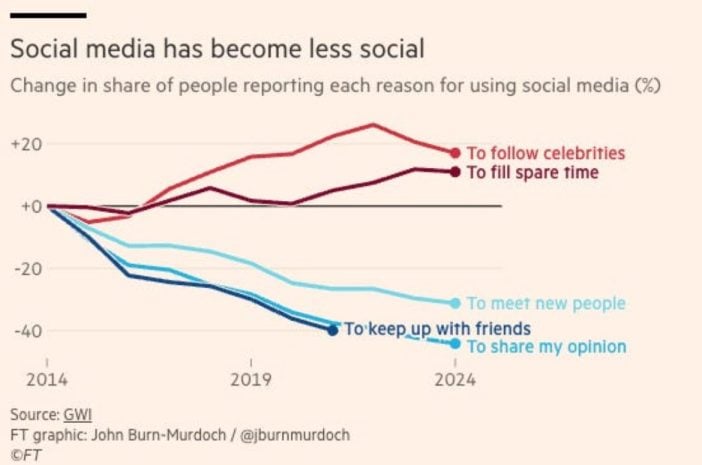
Kids never fell out of love with goofing off with friends or playing in creeks or playing sandlot baseball. They weren’t “lured” by Mark Zuckerberg or ByteDance with Godlike algorithms.
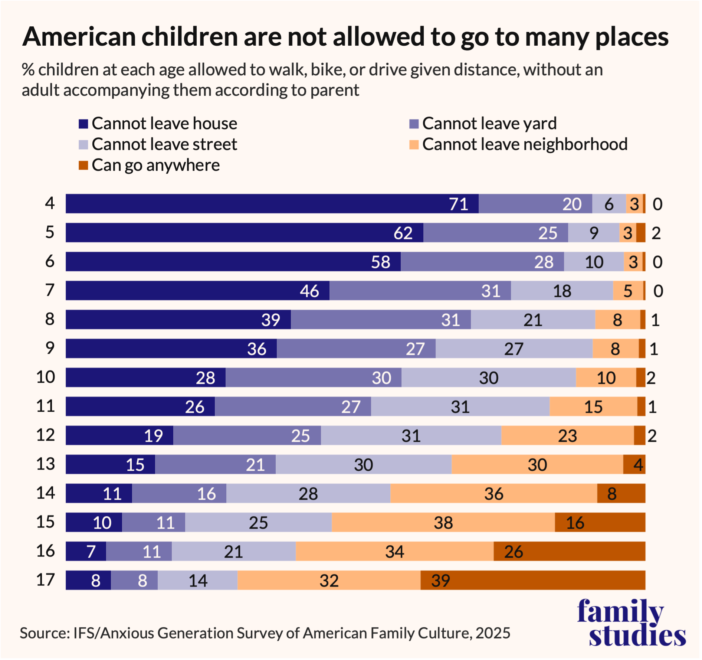
Well-intentioned adults banned children from the physical world with suburbs, rules, laws, scare tactics, drive thrus, trespassing laws, absurd “negligence” norms, etc, etc.
Consider some statistics on the American childhood, drawn from children aged 8-12:
- 45% have not walked in a different aisle than their parents at a store;
- 56% have not talked with a neighbor without their parents;
- 61% have not made plans with friends without adults helping them;
- 62% have not walked/biked somewhere (a store, park, school) without an adult;
- 63% have not built a structure outside (for example, a fort or treehouse);
- 71% have not used a sharp knife;
Meanwhile, 31% of 8-12 year olds have spoken with large language models. 23% have talked to strangers online, while only 44% have physically spoken to a neighbor without their parents. 50% have seen pornography by the time they turn 13.
In physical space, Western children are almost comically sheltered. But in digital space, they’re entirely beyond our command; and increasingly, that’s where children spend most of their time. You don’t need me to tell you about the dire consequences of that shift.
Why do our children spend more time in Fortnite than forests? Usually, we blame the change on tech companies. They make their platforms as addicting as possible, and the youth simply can’t resist — once a toddler locks eyes with an iPad, game over.
I want to suggest an alternative: digital space is the only place left where children can grow up without us1. For most of our evolutionary history, childhood wasn’t an adult affair. Independent worlds and peer cultures were the crux of development, as they still are among the BaYaka; kids spent their time together, largely beyond the prying eyes of grown-ups.
But in the West, the grown-ups have paved over the forests and creeks where children would have once hidden. They have exposed the secret places. So the children seek out a world of their own, as they have for millennia, if not longer. They find a proverbial forest to wander. They don’t know what we know: this forest has eyes and teeth.
I’m not in favor of overnight revolution, but incremental norm shifting towards freedom would be better.