Antimemetics by Nadia Asparouhova

I’ve spent most of my adult life on the Internet. It genuinely changed how I think — exposing me to ideas, people, and perspectives I never would have encountered otherwise. Complex, challenging, interesting ideas that rewired how I see the world.
But somewhere along the way, that changed. The same Internet that once felt like an endless library started feeling like a funhouse mirror. The interesting stuff got harder to find. The stuff that did spread felt increasingly cheap, loud, and shallow.
I wanted a framework for understanding why — and Antimemetics by Nadia Asparouhova delivered one.
What the Book Is About
The core premise is deceptively simple: we live in an age where ideas spread faster than ever, and yet some ideas don’t spread at all. Not because they’re obscure or unimportant — but because of something specific about their nature.
Asparouhova calls these antimemes.
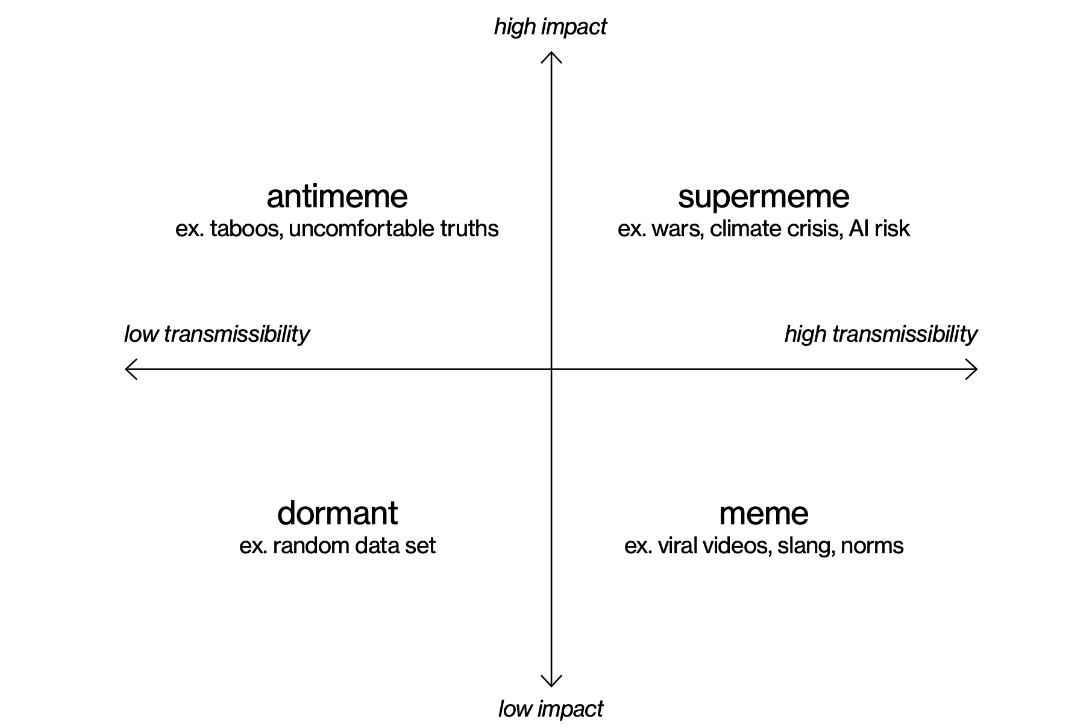
She maps the idea space on a four-quadrant grid, measuring impact on one axis and transmissibility on the other:
- High impact, high transmissibility — super memes. Wars, climate change, AI risk. Any new development becomes instant fuel for the feed. These ideas move fast because the stakes feel enormous and everyone wants to weigh in.
- High transmissibility, low impact — regular memes. Viral videos, trending moments, slang that lasts a week. Fun to pass along, forgotten by next Friday.
- Low transmissibility, low impact — just noise. Random factoids, trivia, hyperspecific historical data. Nobody’s sharing who won a state legislative race in 1838 and why.
- High impact, low transmissibility — antimemes. These are the ones that matter.
Antimemes are ideas that affect your life at the same scale as major world events — but you don’t share them. You don’t tweet them. You might not even consciously think them. They’re the water we’re all swimming in.
The book’s sharpest insight is that antimemes don’t fail to spread because we choose not to share them. They fail because we don’t want to admit them — even to ourselves.
As Asparouhova puts it: no matter how confident we are in our version of reality, we don’t know what we’re missing until someone else points it out.
What I Liked
The four-quadrant framework is genuinely useful. I’ve read plenty of books about how information spreads, but this is the first one I’ve encountered that takes seriously why certain important ideas simply don’t. That felt like a gap in the literature that needed filling.
Her observation that antimemes do spread — just slowly, quietly, through group chats and whisper networks — rings true. The uncomfortable stuff doesn’t disappear. It just travels through different channels, among people who already share enough common ground to say it out loud without violating some unspoken tribal norm.
Attention manipulation is the example she uses that resonated the most. Nobody wants to admit their attention is being engineered. But the evidence that it is — and the consequences of that for everything from politics to culture to personal relationships — is hard to overstate. It’s high impact. And it goes almost nowhere in public discourse.
She pulls historical examples throughout to show this isn’t a new phenomenon, which grounds what could have been a tech-culture navel-gaze into something with actual depth.
What I Didn’t Like
The book gets dense in places. The framework is strong, but some of the later extensions of it required me to slow down and re-read — not because the writing was bad, but because the ideas needed room to land.
If you want a breezy read, this might not be it. It rewards patience more than speed.
Who Should Read This
If you’ve ever felt like the Internet used to give you something it no longer does — like the good stuff got harder to find and you couldn’t explain why — this book gives you the vocabulary to understand what happened.
It’s also essential reading for anyone who works in media, marketing, or anywhere ideas and attention intersect. Understanding why some ideas move and others don’t is table stakes for operating in any information-dense environment right now.
Antimemetics is a short book with a long aftertaste. Recommended.
- The four-quadrant framework is immediately useful and genuinely original
- The "whisper network" insight — that antimemes do spread, just quietly — is one of those ideas you can't unsee
- Short enough to finish in a sitting, substantive enough to stick around much longer
- Gets dense in the second half; rewards patience over speed
- Some concepts need more room to land than the book gives them
- Niche enough that readers without an existing interest in information theory may bounce early