Network State by Balaji Srinavasen

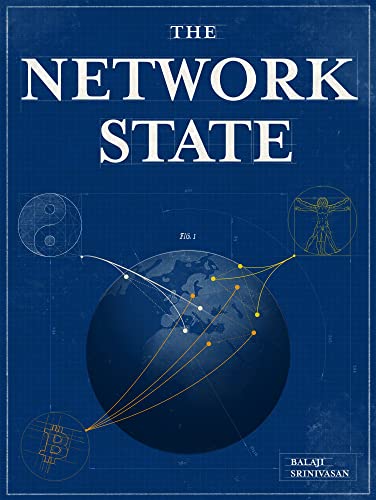
The Network State by Balaji Srinivasan is a book I picked up mainly because my work is tech-adjacent, and for a while this book was everywhere among the tech elite. Even though it seemed ridiculous on the cover, I wanted to understand what my peers were paying attention to.
I’d heard Balaji on some interviews, and he seemed like a guy who’s too smart for his own ideas — someone who came up with grand visions not rooted in human reality. But I read the book anyway.
It was a pretty fast read, which I appreciated. And I’ll say this: I think it’s helpful for humans to throw out big ideas every once in a while, even if they just get shot down. New ideas are useful and we need more in the marketplace.
But this one was absurd, ridiculous, and vacuous. I was taken aback that so many people celebrated as smart and well-read were praising this book. I must be missing something, because it has so many things wrong with it.
The Basic Idea
The core premise is that because we can decentralize trust through cryptography and distributed databases, there’s a way to form political states. Individuals and groups can achieve self-rule and self-sovereignty through crypto and distributed autonomous organizations (DAOs).
Interesting in theory. Naive and dangerous in practice.
Instead of trying to make liberal democracy better and shore up the mistakes we’ve seen in the past 10-15 years, the attitude here is: let’s ditch this whole system and start something completely new that has no connection to lived human reality among masses of populations. No anchor in the last 10,000 years of civilization.
That’s not just unhelpful — it’s genuinely dangerous to liberal democracy. I think he should go read Camus’ The Rebel.
Recognition & Sovereignty
Balaji proposes that network states can achieve recognition through moral innovation and demonstrating governance capacity that’s supposedly more efficient with cryptonomics, cryptography, and distributed databases.
But this ignores that international recognition is fundamentally political. It’s given by existing states.
You can check all the boxes and still not exist as a state. Somaliland checks all the boxes. Kurdistan checks a lot of boxes. South Ossetia checks a lot of boxes. Abkhazia checks a lot of boxes. But they still don’t exist as states because you can only become a state if other states let you.
And other states are not big fans of just letting every random group of people create their own self-sovereign state. That’s not how Westphalian sovereignty works. If you have no strategic interests to another state, you’re just not going to get recognition.
This is incredibly naive and, honestly, a distraction.
Violence & Coercion
The book acknowledges that states traditionally monopolize legitimate violence — this is International Relations 101, going back to Thomas Hobbes. But then it focuses on forming a “nation in the cloud” digitally and getting land last.
This doesn’t grapple with the fact that states rely on coercive power. Borders need defending. Laws need enforcing.
Even though most of the world thankfully does not live under authoritarianism, even liberal democracies ultimately rely on deputized individuals of the state to physically force you to comply when it comes down to it.
You can’t just form a state and go set up somewhere. Violence and coercion aren’t bugs in the state system — they’re features.
Territory as Afterthought
The framework treats territory as almost an amenity you acquire after you build your network. But you’ve got to have land. That’s just not how it works.
It’s like people in the real estate industry who talk about housing exclusively as an investment and ignore the fact that your body has to live somewhere. We live and cooperate as humans in physical reality.
Just like humans need a physical home to live in, a nation — a group of people — needs a physical place to exist in.
States as Service Providers
This is where the book gets truly destructive. Balaji treats states as service providers, like companies in an anarcho-capitalist hellscape, competing for citizen-customers.
This isn’t just wishful thinking — it’s corrosive to democracy.
By seeing yourself as just an individual consumer who can switch between Dubai, Singapore, the United States, the UK, the EU, and Israel like you’re choosing between Starbucks or Caribou Coffee or home brew — you’re missing the entire point.
A democracy is not an individual consumption good. A democracy is a shared story for collective action and trust among a bunch of people. Yeah, you may not agree with it. You may not like it. But so far, it’s the best way humans have come up with to deal with our disagreements and build a complex civilization that no single person can possibly achieve.
The technology, the infrastructure, the lives we live in the 21st century are simply not possible without extreme division of labor. And extreme division of labor is only possible because we’re all acting as individuals in a collective.
Customers don’t build great companies. Citizens build great nations. Employees build great companies that serve customers — but Balaji has the whole framing backwards.
He ignores the state’s role in security, redistribution, and managing collective action.
What I Liked
The book is a fast read. I appreciated that.
And honestly, I do think it’s useful to throw out speculative visions, even absurd ones, just to get people thinking. Some of the individual observations about digital coordination and online communities are interesting in isolation.
What I Did Not Like
Pretty much everything else.
The book cites examples like charter cities and special economic zones while deliberately ignoring that charter cities are created by states. Special economic zones are created by states. Digital nomad visas are created by states.
Instead of trying to come up with an alternative to the state, maybe we should try to strengthen it.
The fact that so many people who have the economic and political power to pull the levers of the state at the highest level are entertaining not just interesting visions, but visions that actively work against making the whole thing better — that saddens me.
It seems like an exit plan rather than a commitment to collective human progress.
Wrap-Up
I guess if it’s useful to know what your fellow citizens (or at least the tech elite) are thinking, it’s an interesting read. But I wouldn’t really recommend it to anyone.
And if anyone is reading it, I hope they recognize not just how absurd it is, but how much of a destructive detour away from collective human progress this represents.
We have real problems with liberal democracy that intelligent, hard-working people like Balaji could work on instead of crypto-libertarian fan fiction.
The Network State by Balaji Srinivasan proposes forming political states through cryptography and distributed databases, treating nations as service providers competing for citizen-customers. While popular among tech elites, the book ignores fundamental realities: international recognition is political, states require coercive power and physical territory, and democracy is collective action, not individual consumption. Instead of strengthening liberal democracy, it offers a naive, destructive detour into crypto-libertarian fantasy.
- Fast, accessible read that moves quickly
- Introduces speculative ideas worth debating, even if ultimately flawed
- Some interesting observations about digital coordination and online communities in isolation
- Fundamentally misunderstands how international recognition and sovereignty work in practice
- Ignores that states require physical territory, coercive power, and aren't optional service providers
- Treats democracy as individual consumption rather than collective action, undermining rather than strengthening liberal institutions