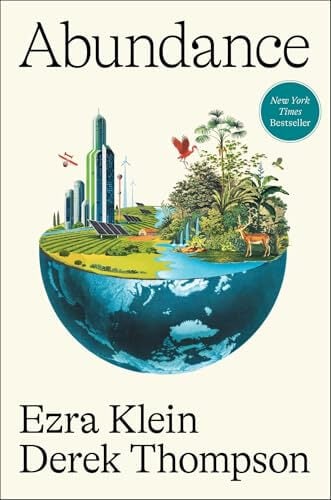
Abundance by Ezra Klein & Derek Thompson

I don’t usually read best-selling political books of the moment. They feel too tied to whatever news cycle is happening right now, and I’d rather read something that has aged a bit.
But it feels like we’re at a genuine inflection point in American politics. The party coalitions that formed in the late 60s and early 70s—now going on 50 years old—are breaking down. Politicians sense it. Voters sense it. Even though passing new laws seems impossible right now, it reminds me of other transition moments in American history: around 1900, the 1940s, the late 1970s. Moments where everything felt zero-sum because coalitions were locked in, right before a reset.
That’s where Abundance comes in.
What the Book Argues
The short version: Abundance is a manifesto for the Democratic Party to reframe public goods in terms of abundance rather than distribution.
Klein and Thompson argue for a return to a New Deal/1950s form of governance. Instead of focusing on making sure all Americans have equal opportunity through targeted distribution of public goods, they want to make public goods so overwhelmingly abundant that questions of distribution, equality, and equity become moot. Make the pie so giant that arguing over slices becomes irrelevant.
They trace the Democratic Party’s current problems back to the late 1960s and 1970s, when the focus shifted to constraint and process. Not just constraining big corporations, but also constraining big government itself. Constraining the ability of government to operate fast and big in the public interest.
This focus on process—lawsuits, environmental reviews, endless planning requirements—has created a zero-sum mentality (among other issues). If my neighborhood gets a new road, yours doesn’t. If a data center gets built, it takes energy away from my house. Klein and Thompson want to move the Democratic coalition away from just turning out voters to win zero-sum elections and toward building a coalition where everyone wins.
Their target areas: energy, housing, healthcare, and transportation.
What I Liked
First, it’s very well written and fast-paced. They marshal excellent arguments with solid data.
There’s no question that many of the landmark laws we passed in the 1970s—laws designed to constrain the worst impulses of both government and corporations—have had unintended consequences. The National Environmental Policy Act and all the planning structures we created to prevent bulldozing whole neighborhoods or building useless highways have made people cynical about government. They’ve given ammunition to people who don’t want public goods, period.
We can’t be content with the devil we know. We can’t accept endless lawsuits over process after process while nothing actually gets built.
The Tennessee Valley Authority is the best example of this tension. Nowadays, the TVA is known for creating some of the worst environmental disasters in American history—coal plants, lack of maintenance, nasty lakes management. But what’s forgotten is that the TVA brought abundance to the poorest region in America during the worst hard time.
For 30 years before the TVA, everyone hoped private companies would electrify the South. They didn’t. It was only with the creation of the Rural Electrification Administration and the TVA that massive, massive change came to an entire region. Abundant electricity. Abundant irrigation. Flood control. These projects were built unimaginably fast and succeeded in creating the abundance that allowed America to grow well and have a peaceful, win-win political economy for several decades.
The same goes for the Pacific Northwest, the Great Plains, the Desert Southwest. The huge infrastructure projects of the 1930s, 40s, and 50s created real abundance.
I also appreciate that Klein and Thompson focus specifically on the Democratic coalition. Too many political books try to talk to “America in general.” But the way our system works, we have two parties made of coalitions. If you want to change your party, you have to change your coalition. The bigger the coalition, the more elections you win, and the more things you can do. As President Obama once quipped, if you want more Democratic policies, the solution is not to punish your team – it’s to elect more Democrats.
For the past 10 years, the Democratic Party has been undoing what Obama did in 2008, which was expand the vote base. I appreciate the push to stop excluding groups of voters and to focus on building the Democratic Party as the vehicle for increasing American wealth, freedom, and pursuit of happiness through equal opportunity and abundant opportunity.
What I Didn’t Like
The book is too soft on the real downsides of the abundance era.
Yes, the TVA brought electricity. It also destroyed entire ecosystems and displaced thousands of people with basically no recourse. The Interstate Highway System connected the country but also ripped through black and brown neighborhoods with devastating consequences (see my review of White Flight for Atlanta’s experience with this).
Klein and Thompson acknowledge these downsides, but they move past them too quickly. They argue we can have abundance and environmental protection, abundance and equity. But they don’t really grapple with the fact that the constraints they want to roll back exist because the abundance era was genuinely terrible for a lot of people.
The book also feels optimistic about Democratic coalition-building in a way that might age poorly. Writing a manifesto for what the Democratic Party should do is very different from what it will do. The party has shown remarkably little ability to expand its coalition in recent years. It’s like everyone agrees intellectually that culture wars are bad…but good lord, everytime a fake culture fight shows up…it’s like Lucy and Charlie Brown all over again.
I also wish they’d engaged more with conservative or libertarian abundance arguments. There are right-wing versions of this thesis that focus on deregulation and getting government out of the way entirely. Klein and Thompson want government-led abundance, but they don’t really defend why that’s preferable beyond “private companies didn’t electrify the South” – especially when all the sectors where Americans feel scarcity are areas with clear market failure.
They also don’t deal with the fact that so much of an abundance agenda runs up local governments – which can be conservative or liberal at the national level. Right now, I live in Georgia. Oconee County (home of Rep. Andrew Clyde (R) has a closet ban on building new homes while Walton County (also deep Red) fought tooth and nail to stop a new electric vehicle factory. And that’s in Georgia – it’s the same deal in states like Massachusetts and California where even when the State wants to build…there’s too much power on the local level.
Takeaways
I think Abundance will be relevant at least through the next presidential election. If you’re trying to understand Democratic Party politics and what policy writers are thinking when it comes to reforming the American regulatory system, this is worth reading.
I’d pair it with Public Citizens by Paul Sabin, which provides essential background on why the regulatory state came to be and why we focused on distribution in the first place. You need both books to understand the full picture.
Klein and Thompson are both self-aware and willing to criticize their own tribe in constructive ways. That alone makes the book valuable. Derek Thompson’s writing is consistently good, and Ezra Klein has a keen eye for nuance and trade-offs.
But go in knowing this is a manifesto, not a balanced analysis. It’s a book arguing for a specific political strategy, not a neutral examination of what works. That’s fine—sometimes manifestos are exactly what we need to shift conversations. Just don’t mistake it for the final word on how to build things in America.
- Well-written, fast-paced with solid data and arguments
- Focuses specifically on Democratic coalition strategy rather than vague appeals
- Self-aware authors willing to criticize their own political tribe
- Too dismissive of why regulatory constraints were created in the first place
- Optimistic about Democratic coalition-building without addressing recent failures
- Doesn't engage with conservative/libertarian abundance arguments