How To Have Impossible Conversations by Peter Boghossian

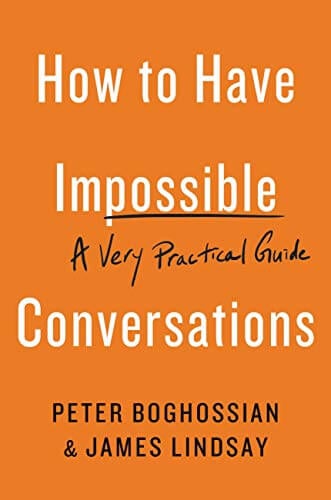
How to Have Impossible Conversations: A Very Practical Guide by Peter Boghossian and James Lindsay is a book I picked up after hearing the authors on a podcast. I can’t remember which one, but their pitch was compelling enough to buy it.
And I’m glad I did. This is one of those rare books that’s immediately useful whether you apply the exact tactics or just absorb the basic framework.
The Core Reframe
The main takeaway is simple but powerful: there is no such thing as winning an argument or changing someone’s mind in the moment. That’s not how people work.
What you can do is build understanding and find common ground. That’s it. That’s the whole game.
I find this reframe genuinely exciting. It takes the pressure off trying to “convince” someone and redirects all that energy into listening and asking questions. It works for work conversations, relationship conflicts, neighborhood disputes, and yes, politics.
The authors aren’t academics. They’ve built their skills through constant real-world practice. You can tell. The book is tactical, not theoretical.
Managing Your Own Reactions
One of the most useful sections covers managing your internal emotional reactions during conflict. Your brain has a very predictable, very unsophisticated response to disagreement: fight or flight.
Just knowing this helps. When you feel that surge of defensiveness or anger, you can recognize it for what it is—a blunt instrument your brain is wielding because it perceives a threat.
The trick is to reframe that spike of emotion into intense curiosity. Double down on listening. Ask more questions. Keep the conversation going.
This works even in conversations that aren’t “impossible.” It’s just a better way to talk to people.
The Socratic Method (Without Being a Jerk)
The book walks through how to use the Socratic method in a genuine, non-manipulative way. Keep asking the person you’re talking with to explain their thinking. Ask them to clarify. Ask them to keep going.
This isn’t about setting traps. It’s about giving someone space to think out loud while you actually listen.
Because here’s the thing: the only way change or compromise happens is if the conflict doesn’t escalate. If you’re starting a fight or keeping a fight going, nothing productive will happen.
This reminded me of something from my International Affairs classes at UGA. We studied the Camp David Accords, and one of the American diplomats involved had a quote I’ve never forgotten: “As long as there’s talking, there’s no bullets flying.”
The negotiators started by getting everyone to agree on the type of table they’d use. Not where people would sit. Just the table itself. Round or square? Wood or vinyl?
It sounds absurd. But that’s rapport building. You find the smallest possible point of agreement and build from there.
Whether you’re figuring out who should unload the dishwasher, debating healthcare policy with a neighbor, or trying to understand why someone thinks completely differently than you about immigration—the principle is the same. Keep talking. Find any small thing you agree on. Build from there.
What I Liked
The book is extremely practical. Even if you just skim it, you’ll come away with something useful.
The authors are honest about their own failures and learning process, which makes the tactics feel achievable rather than aspirational.
The framework of “no winning, just understanding” has genuinely changed how I approach conversations where I know the other person disagrees with me. I’m calmer. I’m more curious. I get better outcomes.
What I Didn’t Like
The book occasionally repeats itself. Once you get the core concept, some of the later chapters feel like variations on a theme.
It’s also very focused on ideological or political conversations. I would have loved more examples from workplace or relationship conflicts, which is where most people actually need these skills.
The tactics work, but they require practice. You can’t just read the book and suddenly be great at impossible conversations. You have to actually try this stuff and fail a few times.
Wrap-Up
How to Have Impossible Conversations is worth reading. If everyone absorbed just the basic premise—that conflict resolution requires keeping the conversation going, not winning—the world might be slightly less exhausting.
I’ve used the framework in conversations with neighbors, with clients, and with family members who have very different political views than I do. It doesn’t magically solve everything, but it makes those conversations less draining and occasionally more productive.
If you’ve ever felt stuck in a conversation where both people are just waiting for their turn to talk, this book will give you something better to do.
Key Takeaways
- Focus on building understanding rather than changing minds – genuine curiosity is more effective than argumentation
- Use “rapoport’s rules” when restating someone’s position: state their view in terms they would agree with before responding
- Ask gentle questions about how someone arrived at their beliefs rather than challenging the beliefs themselves
- Look for common ground and shared values even when disagreeing on specific issues
- Practice “parallel talk” by sharing similar experiences rather than directly contradicting someone
- Learn to recognize and manage your own emotional triggers during difficult conversations
- Start with easier topics to build trust before tackling more controversial subjects
- Pay attention to epistemology – how people know what they claim to know
- Use scales of certainty (1-10) to explore confidence levels about beliefs
- Remember that changing minds is usually a gradual process requiring multiple conversations
How to Have Impossible Conversations by Peter Boghossian and James Lindsay offers a practical framework for navigating disagreements. The core premise: you can't win arguments or change minds instantly, but you can build understanding through curiosity and active listening. The authors provide tactical approaches to managing emotional reactions, using the Socratic method genuinely, and finding common ground. It's immediately useful for work conflicts, relationship discussions, and political conversations.
- Extremely practical with actionable tactics, not just theory
- The reframe from "winning" to "understanding" genuinely changes how you approach conflict
- Authors are honest about their failures and learning process
- Repeats core concepts; later chapters feel like variations on the same theme
- Focused heavily on political/ideological conversations rather than workplace or relationship examples
- Requires real practice to implement effectively; reading alone isn't enough