10 Lessons Learned from 18+ Years of Bike Commuting

I’ve been biking since I was 8 years old. I still remember the moment I finally kept my balance and rode off.
Growing up in the provinces of The Philippines, I rode everywhere as a kid. The roads were compact and multi-use. Except for the main highway, car speeds were relatively low thanks to potholes, rogue chickens, and narrowness. I rode miles and miles and became very confident on my bike – even as a kid.
Coming back to the US, I didn’t bike as much except around the small town of Crawford, Georgia. Everywhere interesting was too far away and required car-only routes. I mostly gave up biking for transportation and exploring.
In 2008, I was working at University of Georgia Campus Transit and lived 1.5 miles from work. It seemed silly to not bike to work. So I got a road bike and gave it a shot.
It worked. And despite a move to Atlanta in 2013, I’m still biking for transportation and exploration to this day – 18 years later.
Here’s what I’ve learned so far.
Getting Around
You Can Go Farther Than You Think
Whenever I’m riding, I overestimate how fast I’m going…but underestimate how far I can get.
If I’m really pushing hard, I’m doing maybe 15 miles per hour. But just cruising – simply by virtue of rolling on wheels – I’m going around 12 miles per hour. Twelve miles in an hour is a long way. And in a city, 6 miles in half an hour will get you much, much further than you think.
Then add in door-to-door time. On a bike, you truly go door to door. In a car, you walk out, crank it up, drive, hunt for a parking space, park, and then walk to wherever you’re going. On a bike, you roll up and lock up.
Add it all together, and you can almost always get places quicker – and farther away – than you’d expect.
Biking Is a Wealth Creation Machine
Car owners (me included) default to thinking that gas is the only cost of a car. We grossly underestimate maintenance, depreciation, and everything else.
Sometimes I think I’m spending too much on my bike. Then I do the math. Premium tires plus the best lubricant runs me about $25. A single oil change for a car will easily run $70. I had my bike completely rebuilt – new cassette, new sprockets, new chain – for $300. That was less than I spent getting an alignment done on my car.
Bike maintenance does come often. But it’s cheap.
Now zoom out. The IRS sets the 2026 business mileage rate at 76 cents per mile. That’s their estimate of the full cost of driving – fuel, maintenance, insurance, depreciation, the whole deal. Even if you only count the variable costs, the IRS pegs that at 23.5 cents per mile.
So take a modest commute – 3 miles each way, 6 miles round trip. Over a year of workdays, that’s somewhere between $350 and $1,100+ that stays in your pocket. Every single mile you move from your car to your bike counts.
*Aside – even if you go a long time without car maintenance, you’re eventually going to pay those costs. Every time I look back over years of car repair receipts, the IRS numbers look about right.
And that’s before counting what biking does for your health.
Bike Commuting Is Truly Convenient Exercise
I never think of biking as exercise. I’m rolling on wheels, after all.
But my quads know. When I go running, I can tell whether or not I’ve been biking around the hilly parts of the city that week.
Bike commuting really is two birds with one stone. You’re getting somewhere and getting your exercise. You’re moving your muscles and your heart. You’re breathing outside air. You’re exposing your eyes and your body to natural light, temperature, and the actual world. That’s real money saved on health, too – even if it’s harder to put on a spreadsheet.
It also lets you squeeze a workout into time you’d be spending anyway. I bike to the gym, and those 20 minutes on the bike absolutely count. Instead of 20 minutes sitting in a car plus 30 minutes working out, I get 20 minutes riding plus a quick 10-minute session at the gym. Same 30-minute workout – and I’m done 20 minutes sooner.
Your Days Feel Longer Because They’re Richer
I’m convinced that biking adds to your lifespan. Not in extra days – but in days that feel longer because they’re richer.
In a car, you’re in a bubble. You’ve got highway hypnosis, focused on the bumper in front of you and whatever is going on inside the car.
On a bike, you’re moving fast enough to actually travel through space, but slow enough – and unenclosed enough – to experience the little things. Yard decorations. New signage. Little alleyways and back ways. Trees changing, leaves turning, birds. You can make eye contact with people and see them as they are in the world.
You notice so much that you’d never see from a car.
Sharing the Road
Aggressive Drivers Are That Scary
I’ve driven a 40-foot transit bus. I’ve driven cars and trucks. I’ve been on bikes and on foot. And there’s something uniquely vulnerable about being on a bike.
You’re as exposed as if you were walking, but you’re moving at speed. And since you’re up off the ground, you don’t have the quickness to stop and change direction like you do on your feet.
So when a car – or someone in a giant, absurdly large truck (side note – those should not exist in this world) – gets close and aggressive, you realize that you’re just a hunk of human meat with some bones. They don’t have the stopping power. You don’t have the stopping power. It’s a scary, vulnerable situation.

It’s a big reason why I think cities that want to actually move people should do more to separate cyclists and provide safe corridors – even if it means taking right of way away from cars.
Nice Drivers Are Annoying Too
On the other extreme…nice drivers are also annoying.
This is a hard lesson to teach young cyclists (like my kids, nephews, nieces, and their friends). You have to be assertive on your bike – partly because drivers who are trying to be nice often don’t know what it’s like to be on a bike.
Picture a four-way stop. A nice driver waves you through even though they have the right of way. Kind gesture! But they can’t control the other cars at the intersection. They don’t know how quickly you can accelerate from a dead stop. And now everyone is confused about who’s going.
The drivers I truly appreciate aren’t the nice ones. They’re the predictable ones. They use their right of way. They maintain their speed. They obey the traffic laws.
Predictable beats nice every single time.
Even Small Bike Infrastructure Is Incredible
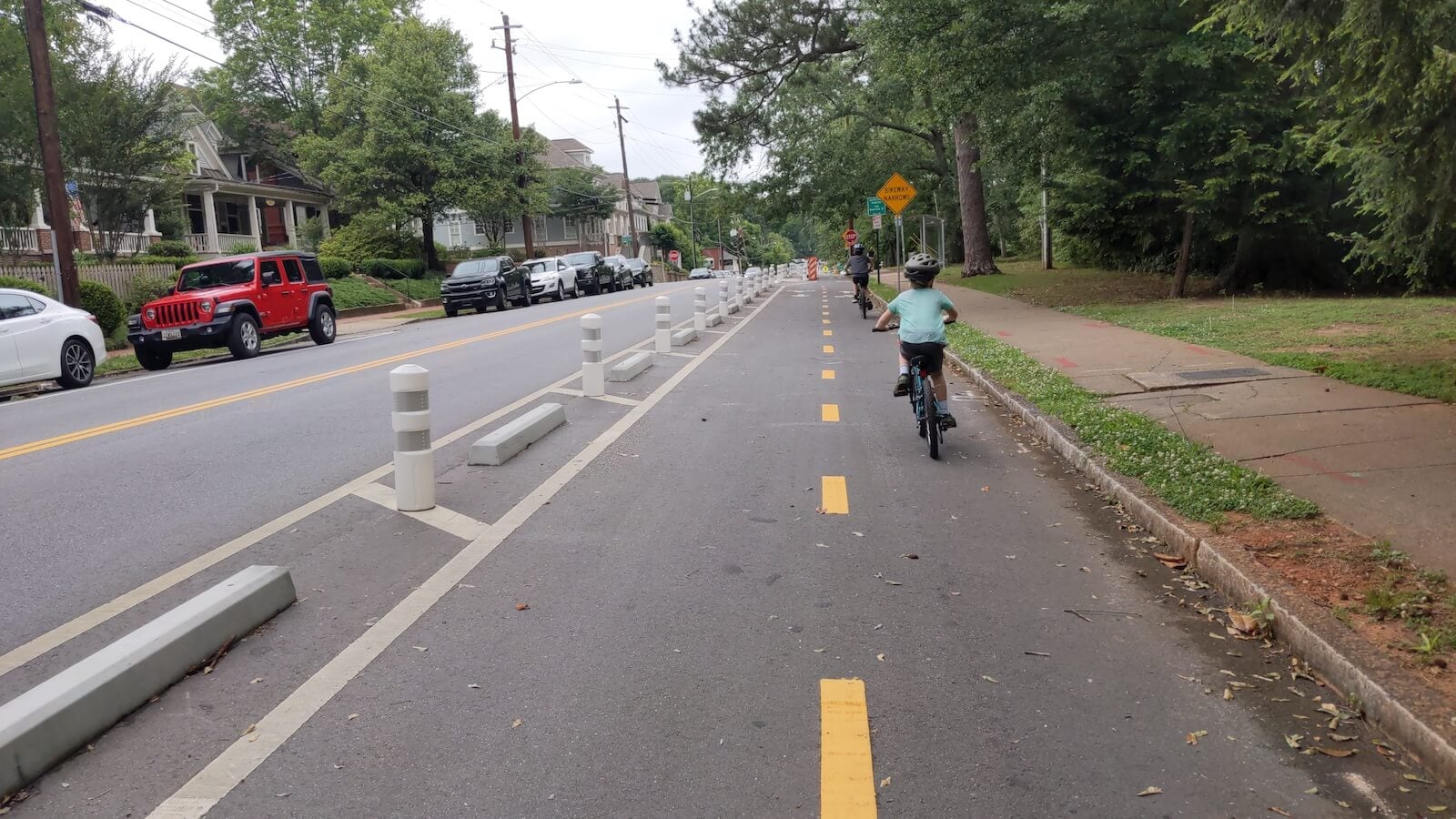
A protected cycleway or the Atlanta BeltLine is obviously ideal. You don’t have to think about potholes or cars or people turning in front of you.
But even a strip of paint for a bike lane makes a real difference.

And the large-scale stuff – the BeltLine, or Atlanta’s cycle tracks on Memorial Dr, Cherokee Ave, 10th St, MLK Dr, and Central Ave – is absolutely mind-blowing. The cortisol disappears.
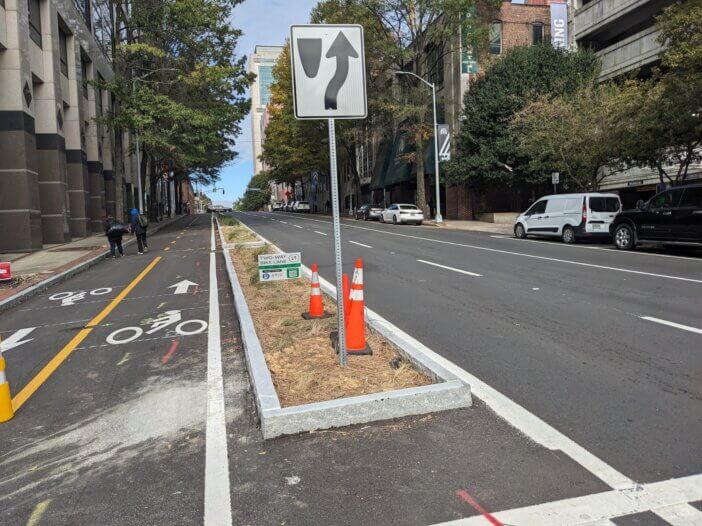
Moving through the air and through the world, daydreaming on a bike…it’s a true joy.
What Still Stinks
Biking for transportation isn’t all joy. A few things still bug me.
- Rain. Light rain is fine. A summer thunderstorm on the way to a meeting is not.
- Humidity. Showing up somewhere in an Atlanta August means showing up sweaty.
- Hills. Atlanta is way hillier than people expect.
- Flats & theft. Both happen at the worst possible time.
- Hauling stuff. A week of groceries or anything awkwardly shaped still pushes me toward the car.
None of these are dealbreakers, but they’re real. Most of them get solved with a little planning – and a few non-negotiables: front and rear lights, a real lock, and a rack or bag so you’re not riding with a sweaty backpack. (Or, increasingly, with an e-bike.)
Biking Isn’t an Identity
Lastly, I’ve learned that biking is not a commitment or a lifestyle or an identity. It can be. But literally, it’s just swapping one mile in a car for one mile on a bike. It doesn’t have to be hardcore.
When I started, the idea of bike commuting in Georgia – with the hills and the heat – was daunting. A lot of folks assumed you had to be a hardcore bike guy to do it.
That’s why the most exciting thing I’ve seen in recent years is the rise of affordable e-bikes. E-bikes dramatically reduce not only the demands of hills and heat, but also the level of commitment you need. My family and our neighbors own one, and it’s made biking more accessible for everyone in the family.
And the opportunity is huge. According to the National Household Travel Survey, 40% of all trips in the US are 2 miles or less – and half are 3 miles or less. Those are e-bike trips.
If even a slice of them get swapped – no commitment, no identity, no lifestyle – that’s just making smarter transportation choices. And that hope is probably the biggest lesson I’ve learned from 18 years of riding.
Wrap-Up
When I was 8, a bike was simply how I got around. It took me a couple decades and a 1.5-mile commute to rediscover that.
Biking gets you farther than you think, saves a ridiculous amount of money, sneaks exercise into your day, and makes those days richer. It’s not perfect – drivers, weather, and hills are all real. But it’s way above average on nearly everything that matters day to day.
If you’re curious, don’t overthink it. Pick one short trip this week and ride it instead.
Get Posts Automagically
…also via RSS or Fediverse – just copy link & paste in your favorite reader :)