7 Notes on Visiting Mt Rushmore National Memorial

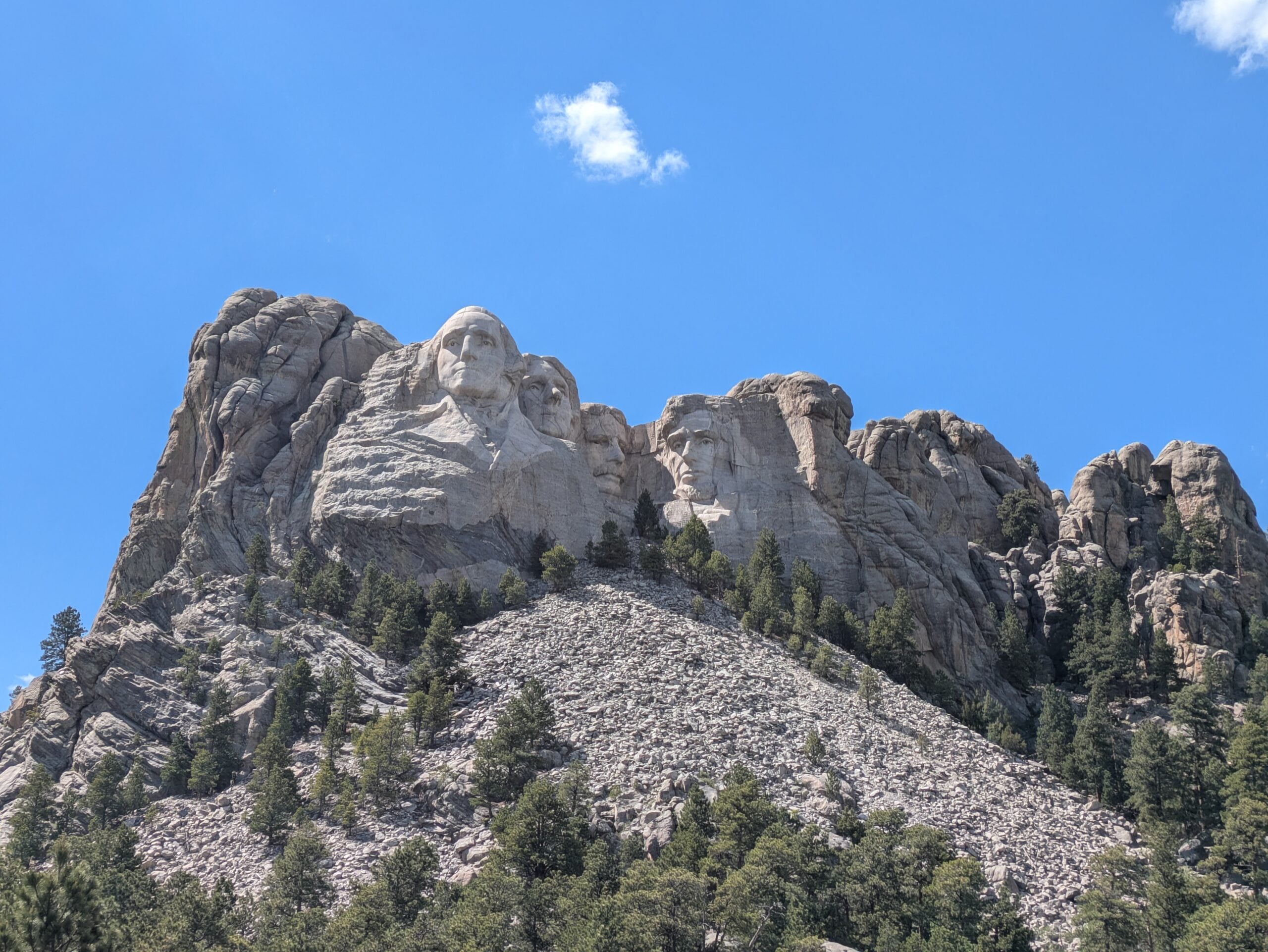
This past summer, my family and I did a road trip through the Dakotas. The centerpiece was the national parks – Theodore Roosevelt National Park, Badlands National Park, and Wind Cave National Park – along with several national grasslands and the Black Hills.
Mount Rushmore was not on the must-see list. But our route went literally right past it. So even though we were all a bit skeptical, we felt like we should go ahead and stop in.
I had always put Mount Rushmore in the bucket of tourist sites that are so well-known and so well-photographed that the real thing has to be a letdown. The Eiffel Tower. The Statue of Liberty. The Pyramids. You’ve seen them so many times in pictures that you already know them…almost too well.
Mt. Rushmore was not a letdown. But I also won’t be back and I don’t really recommend it either. It was also a lot more complicated than I expected. Here are my seven notes.
1. It Is Definitely All That
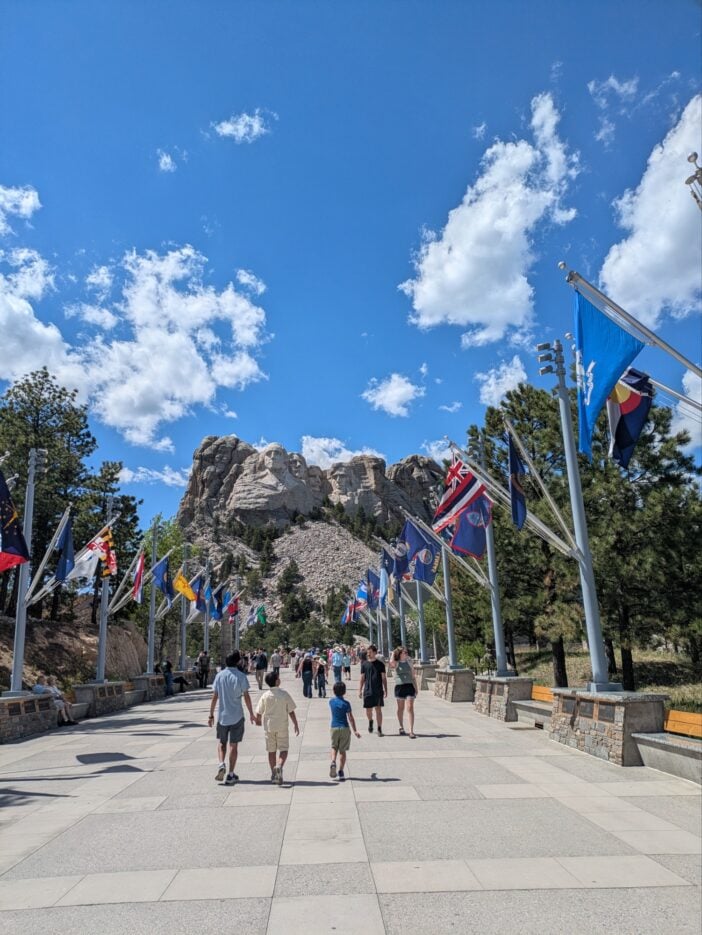
The site is not quite as big as I had imagined. But the carving, the spectacle, and the imagery are all that.
What Gutzon Borglum and his crew pulled off between 1927 and 1941 is an incredible physical and artistic achievement. Four presidents – Washington, Jefferson, Theodore Roosevelt, and Lincoln – chosen to represent the birth, growth, development, and preservation of the country. Each face is around 60 feet tall, blasted and chiseled out of a granite mountain.
I come from Georgia, where we have Stone Mountain. One common reaction to the Stone Mountain carving – controversial as it is – is that it’s kind of a sad letdown.* It gets swallowed up by the mountain and is almost easy to miss. It’s like…”that’s it?…hmm, ya’ll Lost Cause people need something better to occupy your time with”.
Mount Rushmore is not easy to miss. And a lot of that comes down to how the National Park Service has framed the site. From the walk in to the viewing terrace, they know exactly what they’re doing.
2. It Should Not Have Been Built (The Treaty)
The Lakota claim to the Black Hills is not a fringe argument or a matter of interpretation. It’s settled. The Supreme Court has ruled on it.
I live in Georgia, where the Trail of Tears began. So I know that the relationship between the US government and American Indian nations has a long, complicated, difficult history. And I think you can separate the disagreements into two categories: moral and legal. They overlap, but they’re not the same thing.
With some nations, what happened may not have been moral – but treaties were signed and, legally, they were followed. We can debate those. With others, it was morally wrong and legally wrong. Rather than using the federal government to uphold the treaties it signed, we used the force of the federal government to actively break them.
The Black Hills are the second kind.
In the Fort Laramie Treaty of 1868, the US government recognized the Black Hills as part of the Great Sioux Reservation. You don’t need to be a lawyer to read it. And the Lakota didn’t sign it from a position of weakness. It came at the end of Red Cloud’s War, which the Lakota largely won. They negotiated from strength, with eyes wide open.
Then in 1874, Custer’s expedition found gold in the Black Hills. By 1877, Congress had simply taken the land – treaty or no treaty.
In 1980, the Supreme Court ruled in United States v. Sioux Nation of Indians that the Black Hills had been taken illegally and awarded compensation. The Sioux nations refused the money. They wanted the land back, not a check. That money has sat in a trust account ever since, and with interest, it’s now well over $1 billion. Still untouched to uphold the principle that the land was illegally taken.
And the specific mountain that became Mount Rushmore was sacred to the Lakota, who knew it as the Six Grandfathers.
So, no. Mount Rushmore should not have been built. At least not there, and not that way.
*I’m not a lawyer or a historian – if I’ve gotten anything wrong here, please let me know…**
**but also, these are well-documented facts that I got from the Park Film.
3. It’s Also in the Wrong Place
Even setting the treaty aside, Mount Rushmore is in the wrong place.
When I first saw it, what came to mind was Theodore Roosevelt – one of the four faces up there – on his first visit to the Grand Canyon in 1903:
“Leave it as it is. You cannot improve on it. The ages have been at work on it, and man can only mar it.”
If you cover up the monument and look off to the right, the Black Hills are iconic. They’re rare geologically. They’re rare geographically. They’re mysterious and intriguing.
They’re truly where East meets West on the American continent. Western species that made it over the Rockies hang on here before the grasslands take over. Eastern species that belong in the eastern woodlands somehow stumbled their way over and found a home. It’s an incredible place.
We should have just left it alone.
It made me think of tattoos. Tattoos can be beautiful. They can be true works of art. Stone carvings can be too. But you get to tattoo your own body. The Black Hills weren’t the government’s body to tattoo. They were Lakota land – and even once they were taken, they became public land held in trust for all Americans. And the government’s decision was…let’s carve it up.
If we wanted a monument, we should have built one the way we do in Washington, DC – on a site built for monuments, not carved into a beautiful mountain as a marketing gimmick for South Dakota.
It reminded me so much of Stone Mountain. Stone Mountain is an incredible granite dome rising out of the Georgia Piedmont. It’s beautiful. It’s interesting. And then there’s the carving of Confederate leaders on its face.
It’s awful to permanently honor Confederate generals who committed treason to expand the practice of enslaving Americans. But even setting that absurd justificaton aside, it just looks bad. It looks like a bad tattoo that we as a country kind of regret. Even the people who don’t regret it – for whatever reason – look at that mountain and think…why did we deface this?
4. It’s Become More Than a Monument
Here’s the problem with everything I just said.
Mount Rushmore has become way more than a monument.
Nations, companies, religions, sports teams, etc – any abstract thing that people want to rally around – need symbols. And Mount Rushmore has become one of the big ones. It’s up there with the American flag. That was obvious from the people visiting and from the stories the National Park Service tells about it.
So even though it should not have been built, it’s here. It’s impressive. And it’s become a Thing – a real symbol that Americans default to when asked for a list of our big symbols.
I think that fits the American story kind of perfectly. We’re here, it’s here…so we might as well keep trying to make a more perfect, however imperfect things may be.
5. The National Park Service Is a Treasure
The National Park Service is an absolute treasure of an agency.
They take their mission seriously. They manage property held in trust for all Americans – present and future – and their job is to preserve it for everyone, whether those Americans are alive yet or not. They do a fabulous job.
I loved the park film. It’s so value-neutral. It’s basically: this is a thing the American people decided to set aside. Here’s what it is. Here’s how it got here. Here’s the story we all tell about it. Go look at it and decide for yourself how you see it.
It’s professional. Everything is clean and well-organized. The NPS should continue to be well-funded. And honestly, it should be insulated from politics and budget fights – an island that just gets to keep doing what it does so well.
6. Geology Is Underrated
Before I visited, I assumed that with enough hard work, you could carve something like this into just about any mountain.
Nope.
You need a very specific type of rock, formed in a very specific way. Mount Rushmore is fine-grained granite that erodes incredibly slowly – roughly an inch every 10,000 years. But it’s also shot through with cracks and veins of pegmatite. The rock has almost a wood grain to it, and you have to carve with that grain in mind. Blast in the wrong spot and the face shears away. Carve a bit lower on the mountain and the whole thing could have fallen apart.*
*again, not a geologist. I got this from the Park film and then quickly fact checked while writing this down.
The best example is Jefferson. He was originally carved on Washington’s other side. After a couple of years of work, the rock there turned out to be too fractured. So they blasted Jefferson off the mountain entirely and started over on the other side of Washington – where he is today.
Learning how they worked with the raw material was one of the most interesting parts of the visit.
7. It’s a Checkbox, Not a Destination
I do think Mount Rushmore is worth seeing. But for me, it’s a checkbox, not a destination.
For some people – veterans especially based on who all I saw deeply enjoying their visit – it could absolutely be a destination. But it’s a small piece of land, and it holds more symbolic meaning than physical meaning.
Practically speaking, the monument itself is free. The parking is not. We watched the park film, looked at the monument, and that was about it. We didn’t stay long or watch any of the spectacle-type events like the evening lighting ceremony. There are a few short hikes, but the hiking is better elsewhere in the Black Hills.
*Aside on Crazy Horse Memorial. It’s about 17 miles away and has been under construction since 1948, when sculptor Korczak Ziolkowski started it at the invitation of Lakota elder Henry Standing Bear. It’s on private land and funded with private money. That, to me, is how Mount Rushmore should have been done. If a private group wants to buy a mountain and carve it, that’s their call. Public monuments on public land with public money should be held to a different standard.
Wind Cave National Park and Custer State Park are both nearby, and for me, they were much more interesting and much more memorable. They’re a destination. Rushmore is a check mark.
Wrap-Up
Mount Rushmore is going to keep existing. And it’s a good example of why it’s sometimes worth seeing something in person, even when you think you already know it.
Symbols loom larger than the real thing…and the real thing is always more complicated than the symbol.
Get Posts Automagically
…also via RSS or Fediverse – just copy link & paste in your favorite reader :)