6+ Favorite Books on Personal Finance and Investing (So Far!)


Here is a roundup of my favorite books on personal finance and investing (so far!). I hope you find something interesting & a little different.
-
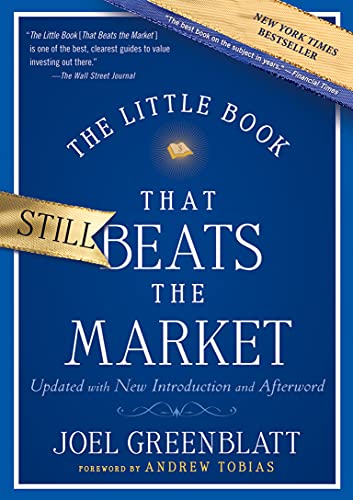
 $12.97In The Little Book That Beats the Market, Joel Greenblatt offers a straightforward guide for investors looking to outshine the market averages using a simple formula. I appreciated how accessible the book was, breaking down key concepts like earnings yield and return on capital. However, I felt Greenblatt oversold his model, which seemed odd given the market's tendency to eliminate public advantages. Essentially, while the book gives a solid framework for evaluating stocks, the promise of consistent outperformance may not hold up in reality compared to just investing in the market as a whole.Buy Now Read My ReviewPros:
- The book provides a good starter framework for evaluating individual companies.
- It's clear and accessible.
- It offers useful takeaways on evaluating stocks and implementing a mathematical formula.
Cons:- He overpromises the specific model rather than selling it as a practice example.
- The market quickly prices in any public advantage.
- There is no advantage to the model compared to just buying the whole market.
I earn a commission at no cost to you when bought via this link. Also check your local library. Thank you!
09/29/2026 12:47 am GMT -
$21.87In The Little Book of Common Sense Investing, John Bogle champions the power of index funds over actively managed funds, highlighting their lower costs and better long-term performance. He breaks down the differences clearly, making a strong case for why most investors should stick to broad market index funds. I really admire Bogle’s straightforward approach and find this book to be a must-read for anyone looking to navigate the investment world without getting lost in complexity. Honestly, I didn’t find anything to dislike—it’s a brilliant guide for everyday investors.Buy Now Read My ReviewPros:
- Advocates for low-cost index funds over expensive actively managed funds
- Provides simple, idiot-proof advice for investors at all levels
- Explains complex concepts in very simple language
Cons:- Nothing!
I earn a commission at no cost to you when bought via this link. Also check your local library. Thank you!
09/29/2026 12:12 am GMT -
$21.60In Stocks for the Long Run, Jeremy Siegel provides a thorough look at investing in the stock market, emphasizing the long-term benefits of stocks over other assets like bonds and real estate. I really enjoyed this book because it highlights the excitement of investing in people and innovation, backed by solid data. However, I did find it a bit on the academic side and longer than necessary. Overall, if you're looking to grow your wealth and understand the stock market better, this book is a solid choice, despite its few drawbacks.Buy Now Read My ReviewPros:
- Comprehensive guide to investing in the stock market
- Covers basic principles and successful trading strategies
- Data-backed arguments for investing in stocks over other assets
Cons:- It's a bit academic and long.
I earn a commission at no cost to you when bought via this link. Also check your local library. Thank you!
09/27/2026 12:28 am GMT -
$31.93In Enough: True Measures of Money, Business, and Life, John Bogle offers straightforward insights into business and investing that I wish I had discovered earlier. The book, published in 2009, emphasizes the importance of building true wealth over mere riches, highlighting the dangers of greed and blind ambition. Bogle’s call for a cultural shift in business resonates deeply, especially as I reflect on my experiences in the industry. His principles are clear and practical, making this a quick yet impactful read. Overall, I found it refreshing and thought-provoking—definitely a book worth picking up.Buy Now Read My ReviewPros:
- The book is concise and well-organized, making it a fast read.
- It presents a powerful message that resonates with real-world business experiences.
- The author, John Bogle, is credible and has firsthand experience in the financial industry.
Cons:- There weren't many negatives; anything I didn't like seemed minor and didn't detract from the overall quality of the book.
I earn a commission at no cost to you when bought via this link. Also check your local library. Thank you!
09/26/2026 12:28 am GMT -
$10.99In Common Sense, Joel Greenblatt shares his views on creating an economy that benefits everyone, but it's more about policy than investing. He proposes bold ideas on immigration and education, emphasizing the importance of skilled immigration and advocating for public charter schools to help children in low-income areas. While he presents some interesting policy suggestions, I found many of his arguments lacking depth and overly complicated. Instead of straightforward solutions, he often opts for convoluted approaches. Greenblatt shines as an investor but doesn't quite hit the mark as a public policy writer.Buy Now Read My ReviewPros:
- The book presents well-argued policy ideas.
- The author offers a lively and provocative perspective.
- It highlights the importance of skilled immigration for economic growth.
Cons:- The book is only peripherally related to investing.
- Many arguments fall flat or misframe the issue.
- The solutions proposed are overly complicated and not straightforward.
- The author is a great investor, but a mediocre public policy writer.
I earn a commission at no cost to you when bought via this link. Also check your local library. Thank you!
09/29/2026 12:42 am GMT -
$10.99In The Psychology of Money, Morgan Housel explores the intricate relationship between our minds and our finances. I found his writing engaging and relatable, making complex ideas easy to grasp. While the book isn't a step-by-step guide to managing money, it emphasizes understanding our behaviors and emotions around wealth. Housel’s anecdotes and insights resonate, reminding us that financial success is less about numbers and more about mindset. My only concern is that some readers might expect a traditional how-to approach. Overall, it’s a thought-provoking read that encourages a healthier perspective on money and investing.Buy Now Read My ReviewPros:
- Morgan Housel is an excellent writer with engaging stories.
- The book is easy to read and accessible to a general audience.
- The author shares personal money management experiences, highlighting hypocrisy in personal finance.
- Charts and statistics support the stories without overwhelming the reader with numbers.
- The book emphasizes the truth in cliches, which are often dismissed.
Cons:- Some readers may expect a How To guide rather than a What and Why book.
I earn a commission at no cost to you when bought via this link. Also check your local library. Thank you!
09/29/2026 12:43 am GMT -
$13.99
Nick Maggiulli's The Wealth Ladder organizes personal finance around a simple but overlooked idea: the right money moves depend entirely on which wealth tier you're currently in. From stabilizing basics to building assets to owning businesses, each tier demands a different strategy — and what got you to one level won't get you to the next. Short, plainly written, and genuinely useful. The best personal finance book I've read in years.
Buy Now Read My ReviewPros:- Tier-based framework meets you where you actually are financially, making the advice immediately actionable
- Short, tightly written, and clearly the work of someone who actually thinks about this stuff every day
- Reframes the whole game: behaviors that work at one level become liabilities at the next
Cons:- Higher-tier advice (businesses, ownership) is necessarily less detailed given the book's concise format
- Readers already deep into investing may find the early tiers cover familiar ground
I earn a commission at no cost to you when bought via this link. Also, check your local library. Thank you!
09/27/2026 12:28 am GMT