The Woman Behind The New Deal by Kirstin Downey

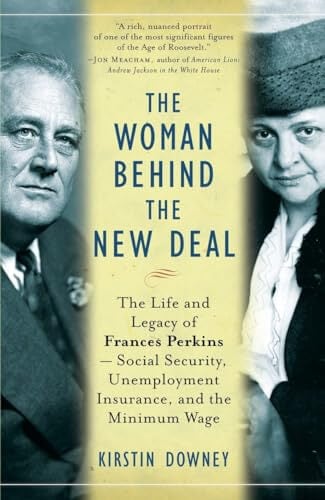
I picked this one up knowing almost nothing about Frances Perkins beyond the basic footnote version: Franklin Roosevelt’s Secretary of Labor, first woman in a U.S. Cabinet, and something to do with the New Deal.
That was a serious underestimate.
Perkins may have had more direct impact on the everyday lives of ordinary Americans than almost anyone else in the 20th century. The 40-hour work week. The minimum wage. Social Security. Child labor laws. Unemployment insurance. These aren’t abstractions — they are the literal architecture of how Americans work, save, retire, and survive hard times. Frances Perkins built most of that architecture.
Her Story
Perkins grew up in comfortable circumstances in Massachusetts and, by chance, was in New York City on March 25, 1911 — the day of the Triangle Shirtwaist Factory fire. She watched 146 garment workers, mostly young immigrant women, die because the exits were locked. It became her obsession and her purpose.
From that moment forward, she dedicated her life to a single mission: make America’s economy and society care about workers. Move the poor, the elderly, and the sick from the randomness of one-off charity — where people fell through the cracks constantly — to something systematic, disciplined, and governed.
She spent the next two decades building toward that goal, even when the moment wasn’t right. And then history opened a door. The Great Depression created the conditions, and Franklin Roosevelt handed her the keys. She walked in ready.
What strikes me most about her life — and what Downey captures really well — is that Perkins didn’t just have opinions. She had a vision, and she knew how to execute it in the real world. That combination is genuinely rare. A lot of people care deeply about something. Very few understand both the long game and the mechanics of how change actually happens.
The Personal Cost
Downey doesn’t just give you the policy wins. She gets into the full human picture, and that’s where the book becomes something more than a history lesson.
Perkins was operating not just in a man’s world, but in an extraordinarily bruising, openly sexist one. She wasn’t just expected to be competent — she was expected to be so far above and beyond competent that no one could touch her. That pressure shaped everything: her marriage, her family life, her friendships, even which political candidates she chose to support (not always her personal preference, but whoever could best advance her goals).
She had plenty of weaknesses. She made plenty of difficult choices. Downey doesn’t flinch from any of it, and the book is better for it.
What I Liked
The writing is fast-paced and readable without being dumbed down. Downey clearly did deep research, but it never feels like a lecture. The biography moves.
More importantly, it’s grounded in the full human being — not just the historical figure. The details of Perkins’ personal life don’t feel like filler. They make the policy story richer and more meaningful.
The central theme — someone who picks one thing they care deeply about, spends a lifetime preparing, and then seizes the moment when history finally opens up — is genuinely inspiring without being saccharine. It’s not a fairy tale. It’s a long, hard slog that happened to work.
What I Didn’t Like
Honestly, not much. If I had to flag something: the sheer density of New Deal policy detail in the middle section can slow things down if you don’t already have some background context. A reader coming in cold on 1930s labor politics might need to pause and reorient a few times.
Who Should Read This
Anyone interested in American political history, labor history, or women’s history — obviously. But also anyone who’s ever wondered how big, structural change actually gets made. Perkins’ story is a pretty clear-eyed answer to that question.
I’d also strongly recommend pairing it with The Woman’s Hour by Elaine Weiss, which covers the final push for women’s suffrage. The two books complement each other well and share a similar theme: what it looks like to fight for something that may not happen in a single lifetime — and to stay in it anyway.
Highly recommended. Pick it up from your library, local bookshop, or Amazon.
- Fast-paced and readable without sacrificing depth or research
- Covers the full human picture — personal costs, difficult choices, not just policy wins
- The central theme of long-game vision meeting a historical moment is genuinely inspiring
- Dense New Deal policy detail in the middle may disorient readers without background context
- Supporting cast of political characters can be hard to track

Quotes
In 1901 the Socialist Party platform included many ideas deemed dangerous by conservatives: an eight-hour workday, the right to organize labor unions, establishment of free employment offices, and the creation of public parks and children’s playgrounds.
p. 13
In June 1905, near the end of her first year, Frances rejected her family’s faith and left the Congregationalist Church. She was confirmed at a fledgling Episcopalian church just up the hill from campus. Instead of the simple Protestant churches she knew in her childhood, the Episcopalians built grand religious edifices. Her new house of worship, the Gothic-inspired Church of the Holy Spirit, was consecrated on the day she joined.
She did not make the change lightly. She sought a more structured religion with a more formal ceremony. Indeed, the Episcopalian faith she embraced came very close to Catholicism. She reveled in its elaborate and archaic rituals. They helped her remain serene and centered at times of stress. The church’s teaching also gave her substantive guidance about the right path to take when confronted with decisions, and the hopeful message of Christianity helped her retain her optimism. Her devotion waxed and waned over the years, but nonetheless served as a bedrock and a way to seek meaning in life when so much seemed inexplicable. These religious leanings became progressively more pronounced over time. When friends once questioned why it was important to help the poor, Frances responded that it was what Jesus would want them to do.
p. 18
“In those days, nothing upset us. We didn’t get upset about anybody’s ideology… You didn’t get upset because people had funny ideas. That was America.”
p. 26
Frances, in fact, already had written a five-page resignation letter. She asked to be relieved of duty on inauguration day. She outlined her accomplishments over twelve years, which she noted represented a “turning point in our national life-a turning from careless neglect of human values and toward an order (voluntarily established by the people through representative government) of mutual and practical benevolence within a free competitive industrial economy.”
She reminded FDR of her role in the Civilian Conservation Corps, the Public Works Program, and the labor aspects of the National Industrial Recovery Act. She reminded him that he had entrusted her with the research, legislative program, popularization, and establishment of unemployment insurance, old-age pensions, and the welfare program. She described how she had reduced child labor in America, minimized workplace accidents, and converted the Bureau of Labor Statistics into a “trusted” source of information. The Fair Labor Standards Act brought about the minimum wage, the concept of the forty-hour workweek, and paying for overtime. She greatly expanded the U.S. Conciliation Service in dealing with strikes. She dealt with many labor questions during the war, when skilled manpower was vital and women moved into formerly male jobs.
“I have recited all these items in the hope that the recollection of them will convey to you the reason for my deep appreciation for your vision and leadership and for the opportunity which you have given me to share in this service to the people of our country,” she wrote. “With one major exception all the items we discussed as ‘among the practical possibilities’ before you took office have been accomplished or begun,” she wrote. The one thing left undone was health care assistance for the ill and jobless.
She ended the letter, saying: “I hope this will be upon your agenda for the near future.”
p. 337
Frances also worried about the growing secularization of America, which she viewed as the antithesis of what made the country great. The country had prospered, she thought, because it encouraged faith-based utopian visions that brought communal thinking, planning for the good of the majority, to people who would otherwise revert to a selfish individualism. She deeply resented what she called the “ranting” of “third-rate minds,” people who wanted all traces of religion removed from popular culture and public life. She thought people banning the Lord’s Prayer and Bible reading from the school represented only a small percentage of a population with deeply religious roots, and should not have been allowed to reshape public discourse.
“What they have done is bring about the glorification of secularization, which I think is terrible,” she said. “The founding fathers of this country founded it under God. In God We Trust’ they put on the coinage. They began their Declaration and their Constitution with references to Almighty God. They jolly well knew they served God and not man, and that they had no hope of success with any nation so conceived if they didn’t do it under the will and under the rule of God.”
It was incomprehensible to Frances to think of excluding religion from public life altogether, for it was her religious motivation-to do what Jesus would want one to do-that drove her and fueled all that she had done.
p. 393
In the the spring of 1965, Frances told friends she planned to visit one of her Telluride students in Barcelona. At eighty-five, the product of a long-lived family, she considered herself invincible.
Her energy was inspirational. Christopher Breiseth, now a Cornell graduate teaching history at Williams College, told Frances she inspired him to conquer his own fatigue to accomplish more.
“You’re wrong to do that,” she replied. “The young must rest for they must conserve their energy for the many things they have to do. The old have nothing to rest for. If they do not keep pushing they will give up.”
p. 395
The secret of Frances’s success was that she had done what she did selflessly, without hope of personal gain or public recognition, for those who would come afterward. It was a perpetuation of the Hull House tradition of the old teaching the young how to advocate for the yet-unborn.
It is a great historic irony that Frances is now virtually unknown. Factory and office occupancy codes, fire escapes and other fire-prevention mechanisms are her legacy. About 44 million people collect Social Security checks each month; millions receive unemployment and worker’s compensation or the minimum wage; others get to go home after an eight-hour day because of the Fair Labor Standards Act. Very few know the name of the woman responsible for their benefits.
p. 397