Nickel and Dimed by Barbara Ehrenreich

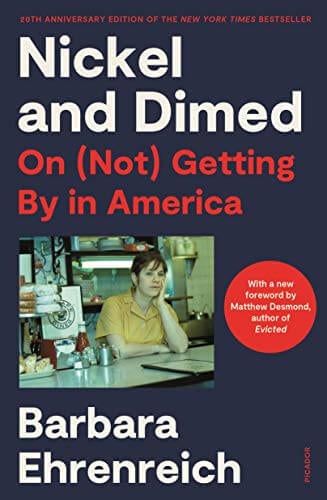
I read Nickel and Dimed by Barbara Ehrenreich in the mid-2000s, a few years out of college. It’s one of those classic works of on-the-ground sociology that sticks with you.
For those unfamiliar, Ehrenreich spent time working undercover in low-wage jobs across America—waitressing, housecleaning, working at Walmart—to document what it’s actually like to be working poor in the richest country on Earth. The result is a book that digs into the experience of poverty in America in a way that’s hard to capture otherwise.
What I Liked
The book’s core insight is brilliant and counterintuitive: poverty is expensive in America.
There are all these compounding costs that hit you when you’re poor. Overdraft fees at banks. Buying small quantities at the Dollar Store instead of bulk at Costco. Not being able to afford the deposit on an apartment, so you end up paying more for a weekly motel. Every little thing adds up, and the system is designed to hustle you at every turn.
What’s weird about poverty in America versus elsewhere is this strange duality. On a global basis, being poor in America means you’re still wealthy compared to much of the world. But on the other hand, it’s more demeaning. The experience of being poor in public spaces—spaces that already aren’t really public—is uniquely American in how it compounds the struggle.
Ehrenreich captures these complexities and contradictions really well. It’s a mirror held up to America, showing us a reality that doesn’t match the story we tell ourselves about opportunity and the American Dream.
What’s Changed (And What Hasn’t)
Reading this book now, post-Obama, post-Biden, and post-Trump’s first term, there’s reason for both hope and frustration.
Some of the specific issues Ehrenreich documented have actually been addressed. The Consumer Financial Protection Bureau helped rein in some of the worst predatory practices. Medical debt is handled differently now. Obamacare made healthcare more accessible. The Earned Income Tax Credit got topped up. The expanded Child Tax Credit (before it expired) made a real difference for working families.
These aren’t small things. Real policy can solve real problems.
But sometimes it feels like pushing down on a waterbed—you solve one problem and another pops up somewhere else. And the big problem we still haven’t solved? Housing.
Housing is still the massive, unsolved issue in America. We don’t build enough. We don’t build in the right places. We don’t maintain what we have. And because so much American wealth is tied up in housing, there’s enormous political resistance to doing anything that might lower home values.
This creates cascading effects on everything else. If the book were written today, I think it would be almost completely focused on rent and the housing crisis, because that’s where so much of the financial strain on working people is concentrated now.
What I Didn’t Like
The specific details are dated. Wages, prices, and policies have all changed since the book was published. Some of the most egregious practices she documents have been somewhat addressed (though new ones have emerged).
But that’s not really a criticism of the book—it’s sociology, not prophecy.
Why It Still Matters
Despite the dated details, Nickel and Dimed still holds up. The core dynamic hasn’t changed: our society makes it difficult to be poor, and by making it difficult to be poor, we undermine equal opportunity.
We’ve solved some problems while creating others. We’ve moved issues around without addressing the fundamental ways that American systems extract from those who can least afford it.
The book remains valuable because it shows how the reality of working poverty contradicts the narrative we still tell ourselves about meritocracy and the American Dream. That gap between story and reality? Still there.
If you want to understand the lived experience of economic inequality in America, this is still the best-in-class example of the genre. The details may be outdated, but the insight remains sharp.
Nickel and Dimed by Barbara Ehrenreich documents the author's undercover work in low-wage jobs across America. The book's core insight—that poverty is expensive in America—remains sharp despite dated details. While some issues she documented have been addressed through policy changes, the fundamental dynamic persists, especially around housing. It's still the best example of on-the-ground sociology exploring working poverty in America.
- Brilliant core insight that poverty compounds through systemic costs (overdraft fees, inability to buy in bulk, etc.)
- Captures the unique contradictions of American poverty—globally wealthy but locally demeaning
- Best-in-class on-the-ground sociology that shows the gap between American Dream narrative and reality
- Specific details are dated (wages, prices, policies have changed since publication)
- Would need major updates to reflect current issues, particularly the housing crisis
- Some documented problems have been addressed while new ones emerged