Arctic Traverse by Michael Engelhard

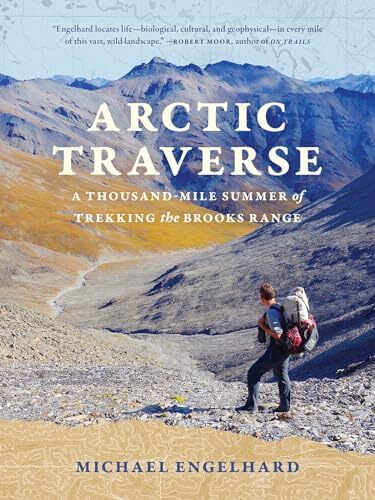
Northern Alaska is possibly the most sublime landscape on Earth. The sheer wild expanse and bigness is transcendent. And thanks to the harshness of the environment, luck, history, the dedication of the generations of individuals who live there, and the farsightedness of so many individuals in the conservation & public lands movements – most all of it is preserved as it has been for tens of thousands of years.
There are very few good travelogues about the region. And that is for the better! There is this tricky balance between raising awareness as a call to protect and raising awareness to exploit (even with good intentions). All that to say – I’m glad this book exists. As far as I can tell, it’s the only published travelogue since Bob Marshall (along with Andrew Skurka’s magazine pieces).
The actual book is pretty straightforward. It recounts a 58-day solo journey across Alaska’s Brooks Range—roughly 990 miles from the Yukon border to Kotzebue on the Bering Sea. He backpacked and floated through remote Arctic terrain, following caribou trails across challenging tussock-studded tundra and paddling rivers in an inflatable canoe. He weaves in explorations the region’s geology, wildlife, and human history – and his own personal history with the region as a guide & researcher.
What I Liked
I love the landscape descriptions and the details of actually traveling through the terrain. I also love that the book exists – this kind of trip is insane to pull off, much less write about.
What I Did Not Like
I did not love the writing style at all. I do appreciate that the author is an anthropologist by training, but some chapters read like an academic journal combined with a William Faulkner novel (i.e., (dense, stream-of-consciousness prose). The whole book needs a Bill Bryson-style edit.
The Brooks Range in Alaska is near and dear to me, so I love that this book even exists. The Brooks Range is one of the most special landscapes on Earth, not just because of the landscape itself, but also because the United States has decided to permanently protect most of it. I love that this book exists, because there's not many people who could pull off a trip like this, much less document it. That said, I do wish the author had an editor to polish the writing.
- The setting is unsurpassed
- There are not that many people who could even write this book - the accomplishment is insane
- Love the landscape descriptions
- The writing is confusing
- Needs an editor

Quotes
On planning trips…
Quick trips into arctic parks and preserves are my least favorite trips to guide, since they involve repeated moves with piles of gear and much time spent sitting on those, waiting for bush planes. Such three-for-ones feel rushed and superficial, and sometimes it surprises me when clients get bored already the day after their arrival. For these few travelers, it’s as if once an item has been checked off a bucket list, they’re eager to vamoose.
The late Richard Nelson, an anthropologist-turned- nature-writer who taught at my alma mater, the University of Alaska Fairbanks, had something to say about conspicuous geographic consumption: “There may be more to learn by climbing the same mountain a hundred times than by climbing a hundred different mountains.”
Or, as Marcel Proust put it, “The real voyage of discovery consists not in seeking new landscapes, but in having new eyes.” But then, questioning lifestyles or acquiring a deep knowledge of places never topped our society’s list of priorities. Where a tourist wants the glittering skin, a true traveler pines for the bones, the structure that holds all together and determines appearances.
On the character of the Brooks Range mountains…
“For all of their ruggedness,” he writes, “these mountains are neither precipitous nor overwhelming, and to those who know them best, they are possessed of a stately but uniquely human scale.” Time may have filed down most of the fangs, but they still can deliver a bite.
On actually traveling through the Northern Alaska Wilderness…
They remind me of guiding my brother and his betrothed on their honeymoon on the John River. As we hiked southwest from Anaktuvuk Pass into Gates of the Arctic National Park… at one point she sat down on a hummock and cried. “I want trails. I want trees. I had no idea what wilderness means.”
On tussocks…
Negotiating tussocks, also known as doing the tussock two-step, is a contact sport that combines aspects of mudwrestling and tae kwon do. Step on the grassy columns, a balancing act upon camel humps, as they bend underfoot and you may twist an ankle. Step between them, scrunch, and their mushrooming caps entrap your foot. Pulling out, slurp, takes as much effort as freeing your boot from the morass the hollows often contain. To one Canadian naturalist, fields growing this crop exclusively are “almost as regular as textured wallpaper.” Why do these speed bumps slow you always at the end of the day, when you’re fried and pining for a dry, level campsite-surprisingly rare in such wide, open country.