Dopamine Nation by Anna Lembke

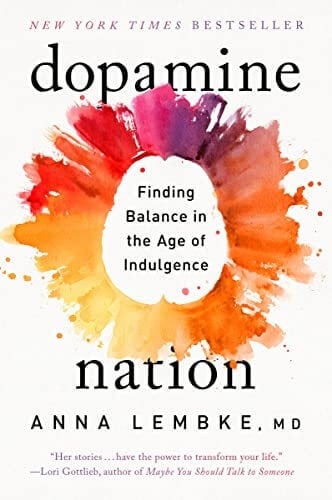
I picked up Dopamine Nation after finding myself in yet another cycle of checking my phone every 3 minutes, refreshing email for no reason, and feeling vaguely anxious despite having nothing particularly wrong in my life.
The book is by Anna Lembke, a Stanford psychiatrist who runs an addiction clinic. And her thesis is pretty simple: we’re all basically addicts now, just not in the traditional sense. We’re addicted to our phones, to Netflix binges, to the dopamine hit of likes and notifications and Amazon deliveries.
The book argues that our brains weren’t designed for the modern world. We evolved in an environment of scarcity, where pleasure was rare and hard to come by. Now we live in what Lembke calls a “dopamine tsunami” – unlimited access to anything that feels good, all the time, right at our fingertips.
The Pleasure-Pain Balance
The core idea is that pleasure and pain work like a seesaw in your brain. When you get a dopamine hit from something pleasurable, your brain immediately starts working to bring you back to baseline. It does this by tipping the balance in the opposite direction.
This is why the high from any pleasurable activity is always followed by a low. You binge-watch a show all weekend and feel empty on Monday. You crush it on social media engagement and feel deflated when the notifications slow down. Your brain is literally counterbalancing the pleasure with pain.
The problem is that when we’re constantly hitting ourselves with dopamine – checking social media, eating processed food, shopping online, whatever – our brains are in a constant state of compensation. The baseline shifts. You need more and more stimulation to feel normal, and you feel worse and worse when you’re not getting it.
I found this framework incredibly useful for understanding my own behavior. Like why I feel weirdly wanting when I can’t check my phone, even though rationally I know nothing important is happening.
Addiction Is Bigger Than We Think
Lembke makes a compelling case that addiction isn’t just about drugs and alcohol. The same neural pathways that drive substance addiction also drive behavioral addictions.
And she’s not talking about extreme cases. She’s talking about normal people who can’t stop checking their email, who scroll TikTok for hours, who have a shopping problem they don’t want to admit is a problem.
She includes case studies from her practice – people addicted to romance novels, to exercise, to videogames. The common thread is that they’ve lost control. They’re doing something compulsively even when it’s making their lives worse or just not doing what they say they want to do with their lives.
The Dopamine Fast
The book’s solution is essentially strategic deprivation. Take breaks from whatever you’re addicted to. Let your brain reset.
Lembke recommends 30 days of complete abstinence from your drug of choice. For a lot of her patients, that’s alcohol or pills. For the rest of us, it might be social media, or our phones, or Netflix.
The idea is that after 30 days, your brain’s reward system recalibrates. Things that used to feel boring or unrewarding – like reading a book, or having a conversation, or going for a walk – start to feel pleasurable again.
I haven’t done a full 30-day fast from anything, but I have noticed that when I take even a few days off from the news, forums, etc, I come back to it feeling less compulsive about it. The pull isn’t as strong.
Pain as Medicine
The book’s most counterintuitive claim is that seeking out discomfort can actually make you feel better.
Lembke talks about activities that are initially unpleasant but lead to lasting satisfaction – cold showers, hard exercise, fasting, that sort of thing. The theory is that when you voluntarily tip the pleasure-pain balance toward pain, your brain compensates by tipping it back toward pleasure afterward.
She calls this “hormesis” – the idea that small doses of stress can be beneficial.
I’m skeptical of some of this. There’s a lot of bro-science & puritan asceticism around cold exposure and voluntary suffering, and I think it can veer into macho nonsense pretty quickly. But I do think there’s something to the broader point that modern life is too comfortable, and that comfort isn’t making us happy. It’s the ironic flip where if there isn’t enough challenge / struggle…there’s no achievement payoff. So it’s like there’s no dopamine “hit” for doing stuff that matters…so we sort of veer into searching mode.
What I Liked
The book is really well-researched. Lembke is an actual practicing psychiatrist, not a self-help guru, and it shows. The neuroscience is explained clearly without being dumbed down.
I appreciated that she includes her own struggles with addiction. She talks about her romance novel habit, which gave the book more credibility than if she’d positioned herself as someone who has it all figured out.
The case studies were fascinating. Real patients (anonymized) dealing with everything from porn addiction to compulsive running. These stories made the abstract neuroscience concrete and relatable.
The writing is accessible. Not overly academic, not overly pop-psychology. Just clear explanations of complex ideas.
What I Didn’t Like
Some of the solutions feel extreme and impractical. A 30-day complete abstinence from your phone? For most people with jobs and families, that’s simply not realistic. It’s not the 30 day fast part…it’s from the phone / computer / etc. I think there are more elegant & nuanced ways to add friction (such as app blockers, etc). But more so, I prefer Charles Duhigg’s methods from The Power of Habit where the key is not so much abstinence – it’s substitution after a trigger. Notice the trigger, add friction to the bad habit, and add convenience to the good habit.
The book could have used more nuance around the difference between use and abuse. Not everyone who enjoys social media is addicted to it. Not every pleasurable activity is pathological. There’s a tendency to pathologize normal behavior…or even go all in asceticism for no real reason.
I also wish there had been more about structural issues. The book focuses heavily on individual responsibility – you need to fix your relationship with dopamine. But it barely touches on the fact that billion-dollar companies are specifically engineering products to be as addictive as possible. That seems like it deserves more than a passing mention.
The sections on radical honesty and telling the truth felt like a detour. I get that honesty is part of the recovery process for addicts, but it didn’t connect as clearly to the dopamine thesis.
What I’m Actually Doing With This
I’ve been more intentional about my phone use since reading the book. Not perfect, but better. I’ve deleted a few apps that I was compulsively checking. I try to have at least a few hours each day where I’m not constantly reaching for my phone.
I’m also paying more attention to the pleasure-pain balance in my own life. When I notice that I’m chasing a dopamine hit – whether it’s checking analytics obsessively or refreshing my inbox – I try to catch myself and ask if this is actually serving me.
I haven’t done a full dopamine fast, but I’m more convinced that periodic breaks from high-stimulation activities are probably necessary for maintaining any kind of mental equilibrium in modern life.
The book isn’t going to solve anyone’s addiction problems by itself. But it provides a useful framework for understanding why we feel so restless and dissatisfied despite having more comfort and convenience than any humans in history.
If you find yourself constantly reaching for your phone, or scrolling for hours, or generally feeling like you can’t quite relax anymore – this book is worth reading. Even if you don’t follow all of Lembke’s advice, the underlying neuroscience helps explain what’s happening in your brain.
And honestly, just understanding the pleasure-pain balance has been helpful for me. It makes the compulsive behavior feel less mysterious and more like a predictable response to living in a world of infinite dopamine hits.
Stanford psychiatrist Anna Lembke argues we're living in a dopamine tsunami where constant pleasure-seeking has rewired our brains. The book explains how our reward systems are overloaded by phones, social media, and instant gratification, leaving us anxious and dissatisfied. Her solution: strategic deprivation and embracing discomfort to reset our brains' pleasure-pain balance.
- Well-researched by an actual practicing psychiatrist with real neuroscience
- Clear framework for understanding compulsive tech/behavior patterns
- Practical case studies make abstract concepts relatable
- Solutions feel extreme and impractical for modern life (30-day phone abstinence?)
- Lacks nuance between normal use and addiction
- Barely addresses how companies engineer addictive products

Quotes
The Internet promotes compulsive overconsumption not merely by providing increased access to drugs old and new, but also by suggesting behaviors that otherwise may never have occurred to us. Videos don’t just “go viral.” They’re literally contagious, hence the advent of the meme.
Human beings are social animals. When we see others be- having in a certain way online, those behaviors seem “normal” because other people are doing them. “Twitter” is an apt name for the social media messaging platform favored by pundits and presidents alike. We are like flocks of birds. No sooner has one of us raised a wing in flight than the entire flock of us is rising into the air.
On how humans copy each other – even in harmful behaviors
The reason we’re all so miserable may be because we’re working so hard to avoid being miserable.
On how the dopamine balance creates a vicious cycle
We’ve all experienced craving in the aftermath of pleasure. Whether it’s reaching for a second potato chip or clicking the link for another round of video games, it’s natural to want to re-create those good feelings or try not to let them fade away. The simple solution is to keep eating, or playing, or watching, or reading. But there’s a problem with that.
With repeated exposure to the same or similar pleasure stimulus, the initial deviation to the side of pleasure gets weaker and shorter and the after-response to the side of pain gets stronger and longer, a process scientists call neuroadaptation. That is, with repetition, our gremlins get bigger, faster, and more numerous, and we need more of our drug of choice to get the same effect.
Needing more of a substance to feel pleasure, or experiencing less pleasure at a given dose, is called tolerance. Tolerance is an important factor in the development of addiction.
On the cycle of addiction
Neuroscientist Nora Volkow and colleagues have shown that heavy, prolonged consumption of high-dopamine substances eventually leads to a dopamine deficit state.
On how dopamine creates addiction
The paradox is that hedonism, the pursuit of pleasure for its own sake, leads to anhedonia, which is the inability to enjoy pleasure of any kind. Reading had always been my primary source of pleasure and escape, so it was a shock and a grief when it stopped working. Even then it was hard to abandon.
My patients with addiction describe how they get to a point where their drug stops working for them. They get no high at all anymore. Yet if they don’t take their drug, they feel miserable. The universal symptoms of withdrawal from any addictive substance are anxiety, irritability, insomnia, and dysphoria.
A pleasure-pain balance tilted to the side of pain is what drives people to relapse even after sustained periods of abstinence. When our balance is tilted to the pain side, we crave our drug just to feel normal (a level balance).
The neuroscientist George Koob calls this phenomenon “dysphoria driven relapse,” wherein a return to using is driven not by the search for pleasure but by the desire to alleviate physical and psychological suffering of protracted withdrawal.
Here’s the good news. If we wait long enough, our brains (usually) readapt to the absence of the drug and we reestablish our baseline homeostasis: a level balance. Once our balance is level, we are again able to take pleasure in everyday, simple rewards. Going for a walk. Watching the sun rise. Enjoying a meal with friends.
On the cause & possibility of recovering
Gambling disorder highlights the subtle distinction between reward anticipation (dopamine release prior to re- ward) and reward response (dopamine release after or during reward). My patients with gambling addiction have told me that while playing, a part of them wants to lose. The more they lose, the stronger the urge to continue gambling, and the stronger the rush when they win-a phenomenon described as “loss chasing.”
I suspect something similar is going on with social media apps, where the response of others is so capricious and unpredictable that the uncertainty of getting a “like” or some equivalent is as reinforcing as the “like” itself.
On gambling addiction
The phylogenetically uber-ancient neurological machinery for processing pleasure and pain has remained largely intact throughout evolution and across species. It is perfectly adapted for a world of scarcity. Without pleasure we wouldn’t eat, drink, or reproduce. Without pain we wouldn’t protect our- selves from injury and death. By raising our neural set point with repeated pleasures, we become endless strivers, never satisfied with what we have, always looking for more.
But herein lies the problem. Human beings, the ultimate seekers, have responded too well to the challenge of pursuing pleasure and avoiding pain. As a result, we’ve transformed the world from a place of scarcity to a place of overwhelming abundance.
Our brains are not evolved for this world of plenty. As Dr. Tom Finucane, who studies diabetes in the setting of chronic sedentary feeding, said, “We are cacti in the rain forest.” And like cacti adapted to an arid climate, we are drowning in dopamine.
The net effect is that we now need more reward to feel pleasure, and less injury to feel pain. This recalibration is occurring not just at the level of the individual but also at the level of nations. Which invites the question: How do we survive and thrive in this new ecosystem? How do we raise our children? What new ways of thinking and acting will be required of us as denizens of the twenty-first century?
On an analogy of our current situation
D = Data
O= Objectives
P = Problems
A = Abstinence
M = Mindfulness
0 = Insight
N = Next steps
E = Experiment
The author’s steps to end addiction
Lessons of the Balance
- The relentless pursuit of pleasure (and avoidance of pain) leads to pain.
- Recovery begins with abstinence.
- Abstinence resets the brain’s reward pathway and with it our capacity to take joy in simpler pleasures.
- Self-binding creates literal and metacognitive space between desire and consumption, a modern necessity in our dopamine-overloaded world.
- Medications can restore homeostasis, but consider what we lose by medicating away our pain.
- Pressing on the pain side resets our balance to the side of pleasure.
- Beware of getting addicted to pain.
- Radical honesty promotes awareness, enhances intimacy, and fosters a plenty mindset.
- Prosocial shame affirms that we belong to the human tribe.
- Instead of running away from the world, we can find escape by immersing ourselves in it.
The key takeaways from the end of the book
As Immanuel Kant wrote in The Metaphysics of Morals, “When we realize that we are capable of this inner legislation, the (natural) man feels himself compelled to reverence for the moral man in his own person.”
Binding ourselves is a way to be free.
On the freedom of self-control via “binding”
Please don’t misunderstand me. These medications can be lifesaving tools and I’m grateful to have them in clinical practice. But there is a cost to medicating away every type of human suffering, and as we shall see, there is an alternative path that might work better: embracing pain.
Clarifying the good uses of drugs vs. preemptive treatment
When the people around us are reliable and tell us the truth, including keeping promises they’ve made to us, we feel more confident about the world and our own future in it. We feel we can rely not just on them but also on the world to be an orderly, predictable, safe kind of a place. Even in the midst of scarcity, we feel confident that things will turn out okay. This is a plenty mindset.
When the people around us lie and don’t keep their promises, we feel less confident about the future. The world be- comes a dangerous place that can’t be relied upon to be orderly, predictable, or safe. We go into competitive survival mode and favor short-term gains over long-term ones, independent of actual material wealth. This is a scarcity mindset.
An experiment by the neuroscientist Warren Bickel and his colleagues looked at the impact on study participants’ tendency to delay gratification for a monetary reward after having read a narrative passage that projected a state of plenty versus a state of scarcity.
One of my personal sayings is that “scarcity makes us stupid” – seems like the author agrees
The question is, why do so many of us living in rich nations with abundant material resources nonetheless operate in our daily lives with a scarcity mindset?
As we have seen, having too much material wealth can be as bad as having too little. Dopamine overload impairs our ability to delay gratification. Social media exaggeration and “post-truth” politics (let’s call it what it is, lying) amplify our sense of scarcity. The result is that even amidst plenty, we feel impoverished.
Just as it is possible to have a scarcity mindset amidst plenty, it is also possible to have a plenty mindset amidst scarcity. The feeling of plenty comes from a source beyond the mate rial world. Believing in or working toward something outside ourselves, and fostering a life rich in human connectedness and meaning can…
The author’s larger take