The Philosophy Book: Big Ideas Simply Explained by DK

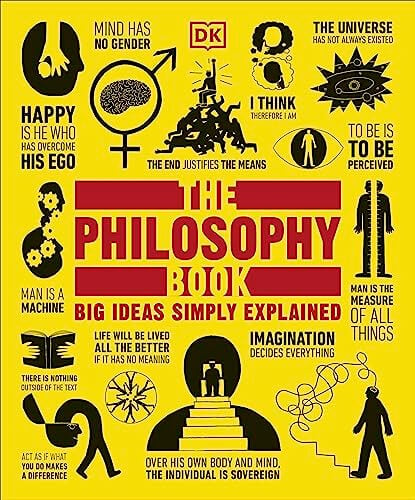
The Philosophy Book: Big Ideas Simply Explained goes chronologically through 2,500 years of philosophical ideas & concepts, breaking down complex concepts into digestible pieces. Like other books in the series, visual-infographic style guides maps the evolution of philosophical thinking from ancient Greece to contemporary debates about artificial intelligence and environmental ethics.
The book divides philosophy into distinct historical periods, making it easier to understand how ideas developed and influenced each other. Each section begins with historical context, showing how social and political circumstances shaped philosophical discourse during different eras.
In addition to different ideas, there are also sections focused on major philosophers each get their own spreads that highlight key contributions. For example, there are sections on Socrates’ method of questioning, Descartes’ radical doubt, Nietzsche’s will to power, and de Beauvoir’s existential feminism explained in clear terms.
I like how the book doesn’t just cover Western philosophy. It includes significant sections on Eastern philosophical traditions, showing how Buddhist, Taoist, and Confucian ideas parallel and differ from Western thinking.
It goes pretty far into debates happening right now. The final sections cover modern philosophical problems like consciousness in AI, environmental ethics, and the role of truth in the digital age.
What I Liked
The visual explanations are brilliant. Many philosophical problems are not especially difficult per se…
What I Did Not Like
Nothing from the content. However, it is a large, heavy book with lots of colors and large layout pages. It’s not exactly a book to browse at the beach or carry as an eBook.
The Philosophy Book: Big Ideas Simply Explained goes chronologically through 2,500 years of philosophical ideas & concepts, breaking down complex concepts into digestible pieces. Like other books in the series, visual-infographic style guides maps the evolution of philosophical thinking from ancient Greece to contemporary debates about artificial intelligence and environmental ethics.
- Perfect for discovering ideas that you don't know that you don't know
- Visual infographics make it much simpler to understand argument flows
- All the benefits of a reference book with none of the downsides
- It's still a pretty big, heavy, coffee table style book, so there's no relaxed porch reading
- I haven't tried the eBook, only because I can't imagine it possibly working well (too many colors and large layout pages)