Books Read In 2024


This year was a pretty random year with what I read. It was purely driven by interests at the moment rather than any plan or queue.
The Casebook of Sherlock Holmes is the last collection of detective stories written by Arthur Conan Doyle. The stories all have a different feel than the Adventures & the Return, but are fun in their own way. There's a lot more technology and new forms of crime than in previous collections. Holmes is more empathetic and Watson is not as present in several.
- Among the best detective fiction ever
- Different types of stories vs. Adventures & Return
- Easy To Read & Follow
- Free & Public Domain
- None!

Useful Not True by Derek Sivers argues that the stories and frameworks humans create — even ones that aren't literally true — can be enormously useful. Through examples like time zones, memory, and online personas, Sivers makes the case that useful fictions are how individuals and civilization actually function. It's short, dense, and worth keeping as a reference. Highly recommended for anyone who thinks carefully about mindset and self-presentation.
- Concise and dense — no filler, every idea earns its place
- Genuinely counterintuitive premise that's easy to remember and immediately applicable
- Sivers writes with clarity and humility, not to impress
- Short enough that you'll want more development on several ideas
- Self-published, so less discoverable than a traditionally published book

Thoreau's 1849 book "A Week on the Concord and Merrimack Rivers" chronicles a boat journey with his brother. Though it sold poorly initially, the work offers modern insights into grief, spirituality, and humanity's connection with nature. The book pioneered mixing travel writing with social commentary, notably documenting early industrial impacts on New England's waterways. While the detailed descriptions can become tedious, making the book somewhat long-winded, it provides a rare glimpse into 19th-century American camping and exploration.
- Pioneered travel writing mixed with social commentary
- Early documentation of industrial impacts on New England waterways
- Unique perspective on 19th century American wilderness exploration
- Overly long and meandering narrative structure
- Tediously detailed descriptive passages

The Brooks Range in Alaska is near and dear to me, so I love that this book even exists. The Brooks Range is one of the most special landscapes on Earth, not just because of the landscape itself, but also because the United States has decided to permanently protect most of it. I love that this book exists, because there's not many people who could pull off a trip like this, much less document it. That said, I do wish the author had an editor to polish the writing.
- The setting is unsurpassed
- There are not that many people who could even write this book - the accomplishment is insane
- Love the landscape descriptions
- The writing is confusing
- Needs an editor

Stanford psychiatrist Anna Lembke argues we're living in a dopamine tsunami where constant pleasure-seeking has rewired our brains. The book explains how our reward systems are overloaded by phones, social media, and instant gratification, leaving us anxious and dissatisfied. Her solution: strategic deprivation and embracing discomfort to reset our brains' pleasure-pain balance.
- Well-researched by an actual practicing psychiatrist with real neuroscience
- Clear framework for understanding compulsive tech/behavior patterns
- Practical case studies make abstract concepts relatable
- Solutions feel extreme and impractical for modern life (30-day phone abstinence?)
- Lacks nuance between normal use and addiction
- Barely addresses how companies engineer addictive products

I picked up MacCulloch's massive history of Christianity expecting to skim a giant tome, but found it surprisingly readable. He starts 1,000 years before Jesus to show how Greek and Jewish ideas shaped the religion, then traces its development across 3,000 years. What stood out was how diverse Christianity has always been - there's no single "traditional" version, even if there are core beliefs. MacCulloch writes as both an insider (former Anglican deacon) and objective historian, which gives him a unique perspective. While some sections on church politics drag a bit, his friendly style and fascinating stories kept me engaged through all 1,016 pages. If you want to really understand how Christianity became what it is today, this book is worth a read.
- The book makes a massive topic approachable and readable
- The author's background as a former deacon provides unique insights with balanced perspective
- Full of entertaining anecdotes, characters, and historical events
- Comprehensive framework helps other books & articles about Christianity make more sense
- Perfect balance of scholarly rigor with friendly, understanding tone
- Does justice to Christianity's global history beyond Western focus
- Makes brilliant connections across centuries of history
- Physical book is awkwardly large and difficult to hold while reading
- Chapters on Eastern Orthodox Church become dense with dates and names
- Some sections drag with political infighting details

- In-depth exploration of Atlanta's sports history
- Engaging microcosm of broader American trends
- Fascinating background for residents of Atlanta
- Some sections could be cut for general readership
- A bit repetitive
- No significant cons noted.

- Offers unique insights into contemporary Chinese society through personal stories
- Engages with a diverse range of individuals, highlighting the human impact of rapid change
- Effectively explores the complex contradictions within Chinese culture and governance
- Can be confusing with many interviewees and characters
- Some sections could have benefited from editing
- No other cons noted

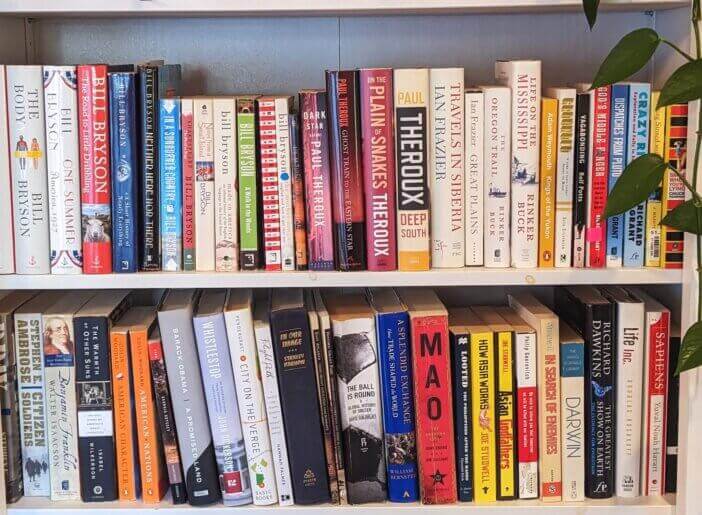
- The book covers many National Parks.
- The commentary highlights America's weirdness and imperfections.
- It sparked an interest in reading similar works by Bill Bryson and Paul Theroux.
- The writing style is too fast-paced and lacks depth.
- There is insufficient context and background information.
- I wish it had been longer and more detailed.

- Unique twist on the coming-of-age genre
- Well-written with vivid details
- Creative structure and character development
- Humorous and insightful portrayal of fatherhood
- Nothing.

- Engaging narrative structure that thoughtfully addresses complex issues
- Empathetic author who considers human emotions in the context of science
- Comprehensive footnotes and global perspective enhance understanding
- The book may age quickly due to its specific focus on a changing moment in time.

- Newport challenges modern workplace norms and promotes a more thoughtful approach to work.
- The book offers excellent stories and tangible examples.
- It provides useful takeaways for improving productivity without burnout.
- The book has a narrow focus on knowledge workers.

Running an agency can be a self-imposed prison with all the "freedom" that comes with constant client demands. This book looks at how to shift an agency to a professional services business with standardized processes, products, and people that allows the owner to actually operate an asset instead of constantly fighting fires.
- Fresh, direct, and draws on real experience
- Looks at business as a whole - not just a P&L exercise
- Fast-paced writing
- Actually implementing the ideas is the truly difficult part
- It takes cashflow and commitment to truly breakaway from the standard agency model

- Engaging travel memoir that captures the essence of old-fashioned travel
- Excellent writing style with a lovely turn of phrase
- Nostalgic and charming exploration of the world without flying
- Nothing - great travel book.

- The book provides nuanced insights into the housing crisis and blighted properties.
- Stagmeier uses real-life examples and personal experiences to illustrate her points.
- The book emphasizes the importance of collaboration between public and private sectors for community revitalization.
- It offers a holistic approach to addressing both physical decay and social revitalization.
- The author effectively presents real numbers to discuss costs and fairness in real estate.
- The focus on a specific property provides a pragmatic view of affordable housing issues.
- A few chapters could use editing.
- The author leans heavily into the success of her model, which may not be universally applicable.

- The book is a practical guide with success stories and strategies.
- It provides a clear framework that is consistently used throughout.
- It highlights universal problems in schools that are solvable.
- It shows how increased involvement can create a positive cycle.
- The book is long, dense, and can be boring.
- It presents a daunting amount of work needed for a welcoming school atmosphere.

- Creative and fascinating setting in Reconstruction-Era Texas
- Rich and beautiful descriptions of Texas and the hill country
- Well-developed relationship between the main characters
- Unique focus on the profession of a News Reader
- Insightful commentary on the nature of news and entertainment
- Not a whole lot; it was a lovely, nice novel.

- Beautifully written with rich, descriptive language
- Effective use of land to observe change over time
- Unique New England setting with a believable cast of characters
- Disjointed structure, feeling more like a series of short stories
- Confusing literary devices and points of view
- Some chapters were tedious and slow

- The book is engaging and entertaining.
- It provides practical insights applicable to various projects.
- The author's expertise and data-driven approach enhance credibility.
- The structure and stories make it memorable and useful.
- The last chapter effectively summarizes key takeaways.
- I would have liked a few photos or illustrations.

- The author is knowledgeable and experienced in wildlife observation.
- The book provides a useful framework and specific tactics for observing wildlife.
- The format is engaging, mixing narrative with useful sidebars.
- It emphasizes ethics and self-awareness in wildlife interactions.
- The book encourages understanding wildlife without intrusive interaction.
- There are ethical concerns about seeking out wildlife interaction.
- The argument exists that the book's premise might not justify its publication.

- The book is well-organized and well-written.
- It combines the best aspects of a hiking guide and a naturalist's guide.
- It provides specific locations to observe various natural communities.
- I wish there were more hikes in North Georgia.

- Groundbreaking approach to business strategy
- Emphasizes value innovation effectively
- Offers practical takeaways for market differentiation
- It's a bit fluffy in parts.

- The book effectively combines scientific literature with relatable stories.
- It provides a nuanced understanding of human social dynamics.
- The exploration of status games offers valuable insights into human behavior.
- There are no cons.

- Engaging memoir that combines personal experience with natural history
- Vivid and poetic writing that brings the Altamaha River ecosystem to life
- Interesting structure with a mix of travelogue and topical essays
- Some sections felt disjointed and lengthy; could have benefited from more editing