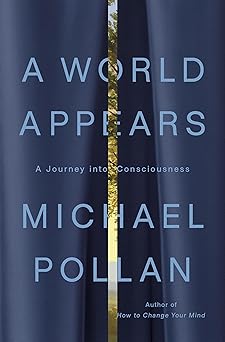
A World Appears by Michael Pollan

I’ve been fascinated with consciousness for a long time — not the hardcore neuroscience, and not quite pure philosophy, but that strange middle territory where they overlap. The field sometimes called cognitive science, sometimes phenomenology: how do we actually experience the world?
I’ve taken a few runs at it over the years. I Am a Strange Loop by Douglas Hofstadter got me thinking hard about where the sense of “I” even comes from. Robert Sapolsky’s Behave walked through the specific chemistry of what’s firing in the brain moment to moment. I’ve read David Chalmers on the hard problem of consciousness and David Dennett pushing back on it.
And I’ll be honest — I can’t say I truly understood all of it. I’m not a scientist. I didn’t study any of this in college. It’s just a problem I can’t stop poking at.
So when I found out Michael Pollan had written a book about exactly this topic, I was genuinely excited.
Why Pollan Is the Right Person for This
Pollan has a rare talent. He goes beyond journalism into something harder to name — a deep, patient synthesis of science, history, and lived experience that makes even the most tangled topics feel useful and graspable. He did it with food in The Omnivore’s Dilemma. He did it with drugs. And A World Appears is him doing it with the biggest, strangest question of all: what is it actually like to have a mind?
The book covers the science, the history, and the philosophical frameworks that have built up around one central puzzle — when you open your eyes, a world appears. How does that happen? How is it that we all seem to experience the same world, yet each from a slightly different inside?
And more fascinatingly: what about everything else that’s alive?
The Ladder of Consciousness
The part of this book I’ll be thinking about for years is the framework Pollan builds — not exactly levels, but something like a ladder of what it means to be aware.
It starts somewhere you wouldn’t expect: plants.
A plant is not conscious the way a human is, obviously. But it’s also clearly not a rock. A plant knows where the sun is. It knows where nutrients are in the soil. It responds to threats. It doesn’t plan, exactly — but it registers its environment and acts on that registration. Something is happening there. What is it?
Move up the ladder to insects and reptiles. What is it like for an alligator when an elephant walks past versus a rabbit? Something changes in it. It’s not just a switch flipping — it responds, it evaluates, it positions itself. There’s a felt quality to threat and opportunity, even if we can barely imagine it.
Then come mammals and birds, and here the examples get harder to dismiss. I was looking at a blue jay out the window while thinking about this book, watching it carry a stick to build a nest. Crows use rocks as tools. Wolves coordinate across vast distances to move prey into position. That’s not reflex. It’s not quite planning in the way we mean it — and yet it kind of is. What is that?
And then you get to the great apes. I live close to Zoo Atlanta, and I’ve stood in front of the orangutans more times than I can count. There’s something that happens when one of them makes eye contact. You can feel that there is an individual in there — that they know they are an individual, that they can register that you are one too. It’s not imagination. It’s something.
What Pollan argues — and what makes the book so good — is that humans have added one more layer on top of all this. Not just a self, but an awareness of the self. We don’t just exist; we think about the fact that we exist. We model our own needs from the outside, the way our body models itself as both part of us and separate from us. It’s all the same system, and then suddenly it gets weird.
The AI Wrinkle
Pollan also digs into what current AI tells us about consciousness — and his argument is quietly significant. The more human-like AI becomes, the clearer it is that something is still missing. Not intelligence. Not the ability to generate language or solve problems. Something harder to name: embodiment, subjectivity, the sense of what it is like to be something.
Consciousness, he suggests, may be fundamentally biological — something that builds and grows over a lifetime, not something that can be assembled from the outside in. That’s not a settled scientific conclusion, but it’s a serious one, and the AI moment we’re living through makes it more urgent than ever.
What I Liked
Everything. I’m not being lazy — this book is that good.
The structure is elegant. The writing moves. Pollan talks to the right people and synthesizes their ideas without either oversimplifying or disappearing into jargon. He’s honest about the limits of what’s known. And he never pretends the hard problem of consciousness has been solved, because it hasn’t.
The further you push into this subject, the more it starts to feel, as Pollan himself acknowledges, a little woo-woo. That’s not a failure of the science — it’s just where the question leads. And he earns the right to go there, because he’s done the work.
What I Didn’t Like
Nothing. I genuinely have no complaints. My only note is that this book will need to be revisited and rewritten in five or ten years — not because it’ll be wrong, but because this field moves fast and the questions only get bigger. That’s not a criticism. That’s a sign you’re reading something at the edge of real knowledge.
What I Learned
- Plants aren’t passive. There’s something happening in them that deserves a better word than “awareness” but we don’t quite have one yet.
- The homunculus — the little person we intuitively imagine running things inside our heads — doesn’t exist on any brain scan. And yet the feeling of it is undeniable. That gap is the whole problem.
- The AI comparison is the clearest mirror we’ve ever had for what consciousness actually is. We built something that looks like a mind and it clarified, better than anything, what a mind is not.
Bottom Line
A World Appears is on the same level as The Omnivore’s Dilemma — which is about as high as I can put something. If you’ve ever found yourself curious about what it actually means to be conscious, or what the difference is between a rock and a plant and a crow and you, this is the book. Pollan is exactly the right writer for exactly this question, and I’m glad he went and did it.
Michael Pollan brings his signature gift for synthesizing science, history, and big ideas to the biggest question of all: what does it mean to be conscious? A World Appears builds a fascinating ladder from plant awareness up through animal cognition to human self-reflection, with a sharp detour into what AI reveals about the limits of mind. It's as good as The Omnivore's Dilemma. Highest recommendation.
- Elegant structure that makes an genuinely difficult topic accessible without dumbing it down
- Pollan's animal examples — from plants to orangutans — make abstract philosophy feel vivid and real
- Honest about the limits of what science actually knows, which makes the book more trustworthy, not less
- The AI section, while interesting, feels slightly underdeveloped relative to the rest of the book
- This field moves fast enough that parts will need revisiting in five to ten years