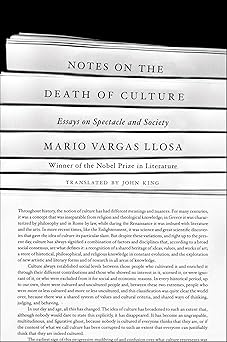
Notes On The Death of Culture by Mario Vargas Llosa

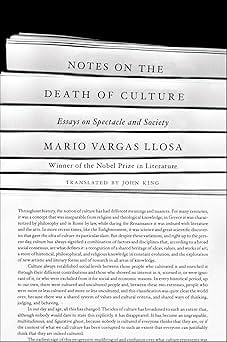
I pulled Notes on the Death of Culture by Mario Vargas Llosa off a library shelf somewhat serendipitously after reading Dubord’s The Society of the Spectacle. It had also been sitting on my reading list for a long time, so it felt like a good topic cluster read.
The timing felt right for another reason. There’s been no shortage of highbrow hand-wringing lately about the state of culture. Music isn’t as good as it was in the 60s. Literature peaked in the 20s. Everything is dumbed down, flattened out, optimized for clicks. You’ve heard it. I’ve heard it. It gets exhausting.
Vargas Llosa — a Nobel laureate with a classically liberal outlook that is, to put it mildly, not especially fashionable at the moment — basically pushes back on the doom. His argument isn’t that the critics are wrong exactly. It’s that they’re misreading what’s actually happening.
The Argument
Culture isn’t dying. It’s transitioning.
The technology we use to create and distribute art is shifting dramatically, and we haven’t figured out the new forms yet. We’re somewhere in the messy middle of that process — which looks a lot like collapse from the inside, but probably isn’t.
On top of the technology shift, money has taken over institutions that were never supposed to be primarily about money. Universities. Sports. Art markets. Even the definition of what counts as “culture.” Marx’s concept of exchange value — what something is worth in a transaction versus what it’s actually worth to a human being — is drowning out everything else. Netflix will greenlight a prestige film here and there to earn some cultural credibility, but its core job is to make the culture that makes money. That’s a different thing than making culture.
Vargas Llosa is clear that the tension between artistic freedom and patronage has always existed. Artists have always had to deal with the people holding the purse strings. But he argues that the tilt toward pure commercial value has never been this extreme or this total.
The hopeful part — and there is one — is that we’ve made it through transitions like this before. The printing press. Radio and television. Each time, the existing cultural forms looked threatened, and eventually new ones emerged. The most important variable, he argues, is whether enough individuals continue to value things other than money. If they do, the balance shifts back.
What I Liked
It’s a short, readable book — more of an extended essay than a dense academic text. Vargas Llosa writes with the clarity of someone who has spent a lifetime thinking carefully about ideas and also knows how to tell a story. The argument is structured without being rigid.
I also appreciated that he resists pure doomerism. There’s a version of this book that just marinated in despair — and given the material, that would have been easy to write and probably more popular. Instead, he lands on something more honest: things are bad, the forces distorting culture are real and powerful, and also humans have navigated this kind of disruption before.
What I Didn’t Like
The historical grounding felt thin in places. When he argues that we’ve survived cultural transitions before, I wanted more specifics. Which transitions? What did the messy middle actually look like then versus now? A few more concrete examples would have made that argument much more persuasive.
I also wanted a sharper take on what “enough people valuing something other than money” actually looks like in practice. It’s a hopeful note to end on, but it’s vague enough to feel like a shrug.
What I Learned
Mostly, it gave me a useful frame for something I had been feeling but couldn’t articulate. The frustration with modern culture isn’t necessarily that things are worse — it’s that the incentives structuring what gets made and what gets rewarded are more distorted than they’ve been in a long time. That’s a solvable problem, in theory, but only if individuals push against it deliberately.
It’s a good book. I don’t know that I’d re-read it, but I’m glad I grabbed it off the shelf.
Mario Vargas Llosa's Notes on the Death of Culture is a short, readable pushback against cultural doomerism. His argument: culture isn't dying, it's transitioning — and the real problem is that commercial incentives have never been more dominant over artistic ones. Hopeful without being naive, it's a useful frame for anyone frustrated with modern culture. Worth reading once, probably not twice.
- Short, readable, and clearly argued — more extended essay than dense academic text
- Resists pure doomerism and lands on a genuinely hopeful (if vague) conclusion
- Puts a useful framework around a frustration that's hard to articulate
- Historical examples of past cultural transitions feel thin and underdeveloped
- The call to action — individuals valuing things other than money — is too vague to be satisfying
- Readers unsympathetic to his classically liberal outlook may find the framing grating
Quotes
It would be wrong to attribute identical functions to science and to the arts. It is the very fact that we have forgotten how to distinguish between them that has added to the current confusion in the field of culture. The sciences progress, like technology, wiping out whatever is old, antiquated or obsolete; for them the past is a cemetery, a world of dead things that have been surpassed by new dis-coveries and inventions. Literature and the arts are revital. ized but they do not progress, they do not obliterate their past, but rather build on it, they draw sustenance from the past and sustain it, so that despite being so distinct and distant, Velázquez is as alive as Picasso and Cervantes is as contemporary as Borges or Faulkner.
Ideas of specialization and progress, which are insepa-rable from science, are inappropriate to the arts, which does not mean, of course, that literature, painting and music do not change and evolve. But one cannot say of them, as one can say of chemistry and alchemy, that the latter replaces and supersedes the former. A literary and artistic work that achieves a certain level of excellence does not die with the passing of time; it continues living and enriching new generations and evolving with them. That is why, until recently, literature and the arts were the common denominator of culture, the space where com-munication between human beings was possible despite differences in language, traditions, beliefs and eras, because people who today are moved by Shakespeare, who laugh with Molière and are dazzled by Rembrandt and Mozart, maintain a dialogue with those who read them, listened to them and admired them in the past.