I love reading all of Trung Phan’s work. He’s got a humorous and keen eye on the business news cycle. But this section on the compounding benefits fo reading something I want to just keep coming back to…
The #1 Buffett lesson I’ll share with my kid is find an insurance company and invest the premiums in profitable manner with smart underwriting so you have juicy float the Oracle’s lifelong commitment to reading.
“Read 500 pages like this every day,” Buffett once told a class of students. “That’s how knowledge works. It builds up, like compound interest. All of you can do it, but I guarantee not many of you will do it.”
I don’t know what speed-reading sorcery Buffett used to get to 500 pages a day.
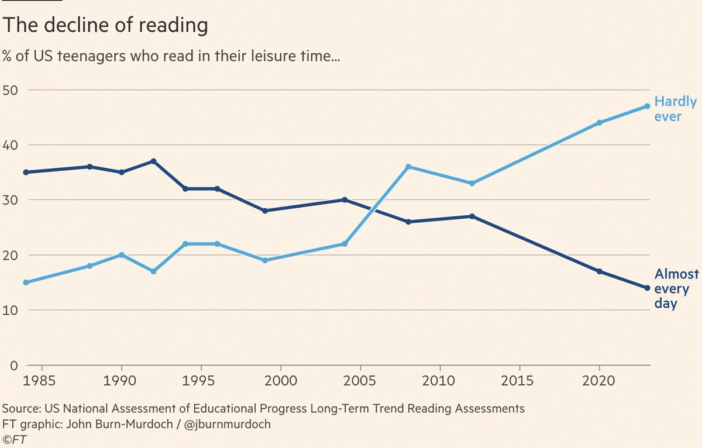
But based on this chart of teenage reading trends, someone can build a durable advantage by knocking off 50-100 pages a day consistently.
On that note, I just got my kid his first Kindle and — for the first time ever — I’m OK with my credit card popping off with “AMZN Mktp” charges. Don’t worry, he’s not downloading books on value investing…yet. We still rolling with “Dog Man” and “Who Would Win? Great White Shark vs. Orca”.
I just want my kid dedicating time to reading and thinking instead of getting short-form AI-video slopped.
Marc Andreessen: “I’ve really readall the time since I was a little kid, it’s been a lifelong thing. It’s basically trying to fill in all the puzzle pieces for the big discrepancies. A great term is ‘sense-making’. Essentially, ‘what the hell is happening and why?’ The world is an incredibly complex and erratic place and trying to figure that out …is kind of a lifetime occupation.”
Charlie Munger: “In my whole life, I have known no wise people — over a broad subject matter area — who didn’t read all the time. None. Zero. You’d be amazed at how much Warren reads and how much I read. My children laugh at me. They think I’m a book with a couple of legs sticking out.”
Howard Marks: “I think it helps to read broadly, what good does it do to know everything about one little thing if you don’t know how it fits into the world, and how the world is going to affect it.”
Seth Klarman: “Never stop reading. History doesn’t repeat but it does rhyme.”
Sam Zell: “I’ve said it before and I’ll underscore it here: I am a voraciousconsumer of information. I have honed my ability to digest a lot of information, sift out what’s potentially relevant, retain it, and then recall it when it’s useful. I read at least five newspapers every day, and five business magazines a week. I remember all of it, or at least everything relevant. I also like to readescapist fiction — mystery novels, spy thrillers — and I go through about one book a week. I usually remember nothing about them. Unless all of a sudden something becomes relevant.”
Warren Buffett (You May Have Heard Of Him): “The advice I would give is to read everything in sight. And to start very young. It’s a huge advantage in almost any field to start young. If that’s where your interest lies, and you start young, and you read a lot, you’re going to do well.”
To be sure, “read a lot” is reasonable advice but also incredibly generic.
Take another piece of generic advice: “get 30 minutes of exercise a day”. This practice is certainly beneficial, but its effects are diminished if your diet is crap and (like me) have an urge to buy a Spicy Chicken burger whenever you are within five square kilometers of a Wendy’s.
A follow-up question for advice about reading is, “Are you in a position to do anything with the hard-earned insights you have gained from your reading efforts?”
Frederik Gieschen has a great piece called “The Reading Obsession” that looks critically at Buffett quip, “I just sit in my office and read all day”. This work routine may be true in his 80s and 90s but the Oracle of Omaha was doing a lot more than just reading in his early career. He was travelling, hobnobbing, networking and spending thousands of dollars on long-distance phone calls. Buffett got to the point where he could read all day because he spent decades building an insane Rolodex, which was undoubtedly boosted by the fact his father was a Congressman.
Buffet was also exceptionally good with numbers…doing 35-year discounted cash flow calculations in his head before cutting 9-figure deals with a spit and handshake. All while drinking 5 Cherry Cokes and housing a cheeseburger for lunch everyday (not health or investment advice).
The GOAT.
Anyway, it is easy to see the benefits of reading for investors. Good investors combine unique insights with capital to unlock profitable trades. And you don’t need many unique insights to have an incredible investing career.
In 2017, Buffett’s long-time colleague and BFF Charlie Munger (RIP) gave a talk at the Daily Journal Annual Meeting and talked about how he had read the finance magazine Barron’s for 50 years and only ever got one investment idea from the publication.
Stemming from a single article, the investment idea would earn him $500m:
“I talked about patience. I read Barron’s for 50 years. In 50 years, I found one investment opportunity in Barron’s. I made ~$80m with almost no risk. I took the ~$80m and gave it to [Himalaya Capital’s] Li Lu, who turned it into $400-500 million. So I have made $400-500 million from reading Barron’s for 50 years and following one idea.”
The pipeline from reading-to-investing is easy to visualize.
But what about other ventures? Can a single insight from an article or book blurb change the trajectory of a business?
Yes, it can.
Since reading about the Munger / Barron’s story a few years ago, I tuned my information-gathering antennae to find stories of entrepreneurs who read a single article (or blurb) that unlocked something for their businesses or careers.
Here are a few that I have collected:
Joe Coulombe built the Trader Joe’s brand to appeal to educated shoppers who wanted international cuisines after reading two magazine articles. The first one was from Scientific American, which discussed the increasing percentage of the US population with a college degree. The second was an article from the Wall Street Journal that talked about the launch of Boeing 747s, which would reduce the cost of international travel.
Jeff Bezos decided to found Amazonafter reading on a news website that the internet was growing at a rate of 2,300% per year.
Morris Chang laid the seeds for Taiwan Semiconductor Manufacturing Company (TSMC) after discovering an insight in a graduate-level textbook called Introduction to VLSI Systems. The textbook excerpt explained why it made economic sense for the design and manufacturing of microchips to take place at different companies, instead of being totally integrated in one organization (e.g. Intel).
Elon Musk’s first steps towards creating SpaceX began when he visited the NASA website and was surprised to find the agency had no schedule or plan to go to Mars.
Airbnb co-founders Brian Chesky and Joe Gebbia got the idea for their platform because they wanted to attend a design conference in San Francisco. When they checked the conference’s website, they found that all the recommended hotels were sold out. So, they figured they could rent out the extra space in their apartment and use the funds to buy tickets to the conference.
Sara Blakely gave her shapewear company a perfect name (Spanx) after researching why Coca-Cola and Kodak were so well-known. She discovered that the Kodak founders liked the sound of the letter “K” and made it the first and last letters of the company name. Blakely then chose Spanks, but then changed it to Spanx (with an “x” instead of “ks”) because she found that “made-up words work better for products than real words do, and they are also easier to trademark.”
Dietrich Mateschitz tried an energy drink in Thailand and realized that it was a huge business opportunity after reading that the country’s top corporate taxpayer sold the drink. His idea: add carbonated water and sell the drink in Europe. We know it as Red Bull.
Bill Gates saw a Popular Mechanics magazine issue about the ALTAIR 8800 in 1975 that he said “stopped me in my tracks”. It convinced him and Paul Allen to write a version of BASIC for the machine, which laid the foundation for the PC revolution.
Wide and random reading on its own is beneficial. The practice nurtures the mind and is a good antidote for digital dopamine distractions. When you combine that with hard-earned expertise and skills…the results can be very very real.
Joe Coulombe’s insight was so impactful because he used it to augment 10+ years of running retail stores.
Sara Blakely’s insight was so impactful because she used it to augment years of perfecting a textile product.
Morris Chang’s insight was so impactful because he used it to augment decades spent building expertise at Texas Instruments and in the semiconductor field.
Chip Wilson’s insight was so impactful because he used it to augment 18 years of building a previous sportswear brand called Westbeach.
The insights for Elon and Bezos were so impactful because they combined them with capital and a decade of work (Zip2 and PayPal for Elon; the D.E. Shaw hedge fund for Bezos). Separately, Elon’s rocket education for early SpaceX days began with 4 textbooks, which he read to build a knowledge base.
There are countless examples in the creative fields (which will have to be its own piece).
The ability to combine insights from reading with other skills reminds me of a concept from cartoonist Scott Adams, who passed away last week at 68.
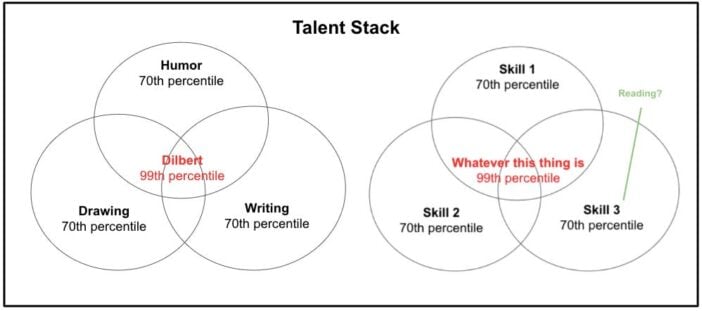
One of his concepts completely changed the way I viewed work: the “Talent Stack”, which started as a blog post but became a key part of his best-selling book “How to Fail at Almost Everything and Still Win Big”.
Did Adams create one of the most popular (and highly syndicated) comics ever by being the best — or a 99th percentile — artist? No. He says he was probably in the 70th percentile when it came to drawing. But he was also in the 70th percentile for humor and 70th percentile for business writing (from his experience in the corporate world).
An important kicker: getting to 70th percentile at any skill is way way way less time-consuming than getting to the 99th percentile.
I’ll throw some numbers out there that feel directionally correct. You could probably get to 70th percentile drawing skill with one year of dedicated practice. But to break into the top 1% would take decades…and that may not be enough (there are just some naturally talented people in any skill).
But for his specific Venn diagram of skills — drawing, humor, and business writing (aka his “Talent Stack”) — Adams was in the 99th percentile.
Reading and comprehension are skills. In an increasingly digitally distracted world, fewer and fewer people are honing these skills. This presents a huge opportunity for those who want to build a niche 99th percentile talent stack by combining reading — and the insights gained from the experience — with a few other skills.
As we discussed earlier, the bar is actually very low to be considered a top-percentile reader.
A Pew survey conducted in 2021 found that 23% of Americans hadn’t read a single book in the past year and the average amount of time spent on leisure reading was only 16 minutes a day. Comparatively, people spend over 2 hours a day on social media (granted, some of that time is spent reading but it is not the best medium for it and short-form video consumption obviously pales in comparison to deep reading).
Reading 1-2 hours a day (50-100 pages) for leisure puts you in the upper upper echelon of the skill.
It is obviously good to curate your reading diet — as in what are you actually reading — but that step follows just reading more, period.
“It almost doesn’t matter what you read,” says investor Naval Ravikant. “Eventually, you will read enough things (and your interests will lead you there) that it will dramatically improve your life. Just like the best workout for you is one you’re excited enough to do every day, I would say for books, blogs, tweets, or whatever — anything with ideas and information and learning — the best ones to read are the ones you’re excited about reading all the time.”
Take out a few glances at social media or YouTube rabbit holes or Slack check-ins.
Put in reading apps and you’ll get dozens of extra pages done a day.
Video and audio just can’t compare to the written word for sustained thinking, ideating and comprehension.
Let’s go back to Munger’s story about reading Barron’s for 50 years.
The single insight he found was for an auto-parts manufacturer called Tenneco. After making $80m (~10x return) he gave the money to investor Li Lu. For the uninitiated, Lu was one of the leaders of the student protests during the Tiananmen Square crisis in 1989. He fled to America and then attended Columbia University (BA, MBA, JD) before launching his own hedge fund in 1997.
Lu was able to turn Munger’s $80m into $500m based on only a few bets, including a big one into Chinese electric-vehicle maker BYD (in 2008, Berkshire itself invested ~$230m in BYD and exited the position at $9B by Q3 2025 a gain of 39x).
In 2023, Munger told CNBC, “I have never helped do anything in Berkshire that was as good as BYD.”
Said it was a once-in-a-lifetime bet (even preferring it to when he convinced Buffett to invest in Costco, where Munger joined the board in 1997; Berkshire never built a meaningful position in Costco and has since exited).
Munger said the only other Berkshire investment with a comparable ROI was when “we paid an executive recruiter to get us an employee and he came up with Ajit Jain…the return that Ajit has made us [running insurance arm] is the best investment at Berkshire.”
During a lecture at the Columbia Business School in 2006, Lu shared thoughts on lifelong reading and learning that are relevant to this article (Lu was talking about his own portfolio, not anything specific to what he did with Munger):
You go through your life and you may not have more than five or ten insights which you develop over many, many years of study. Fifteen years ago I studied an American company and now I find the Asian counterpart and I find the valuation that I like. I can bet on it now but I studied that business for 15 years in between. I know everything about that industry and what really makes that business tick. An opportunity like that doesn’t come very often, so when it comes you have to seize it.
You need to have that kind of insight in order to really swing with conviction and if you cannot do that either psychologically or because you’re ill-prepared, you just will never really make any real amount of money [in investing].
How do you really build that insight? There is no other way than continuous curiosity, intense curiosity, continuous studying for your whole life.
The things about this approach is you progressively get better and better and better, to the point that you read a page and it only takes you a couple minutes to tell right away whether something jumps out. You can smell it when you see something.
The truth is that no one knows when the reading will pay off, but as the saying goes, “Luck is when preparation meets opportunity”.
Let me pump the brakes a bit and answer a question I’m sure some of you have asked, “Trung, wait hold on. Can’t I just read for the sake of reading? What’s all this ‘pay off’ talk. Reading is the payoff.”
I think humans are wired to create. We can’t just consume. The nourishment we get from deep reading is an input into our personal, professional and creative lives. We still have to do something with it.
One of Buffett’s last major investments is a perfect example of his reading habit becoming an input for his trade. Back in 2019, Berkshire invested >$10B for 8-9% of the 5 trading houses and position is now worth over $30B. During the 2025 Berkshire annual general meeting, Buffett says he found them reading through a book of 3,000 Japanese companies and references Robert Caro’s “turn every page” philosophy on the research process:
It’s amazing what you can find when you just turn the page. We showed a movie last year about turning every page [HBO’s documentary about Robert Caro “Turn Every Page”]. I would say that turning every page is one important ingredient to bring to the investment field. Very few people do turn every page and the ones who turn every page aren’t going to tell you what they’re finding. So, you got to do a little of it yourself.
There’s always alpha in this world from deep reading.
Casual Viewing: Why Netflix looks like that is a absolutely brilliant, deep-dive into how business model incentives drove every cycle of media into…not what we all wanted.
Derek Thompson interviewed Agnes Callard about the idea of the unicontext. I thought it was a useful framework for thinking…
Hol’ Up…You Want More Email?* Seriously?
*like, sometimes I publish…a lot :O – though you can pick what categories you want.
Follow on the Fediverse
Ahh…I see you’re up for some extra inconvenience. Some Type 2 Internet Fun, if you will. Well then! Follow me with your favorite Fediverse app or server (e.g., Threads, Mastodon, Pixelfed, etc).
I’m Nate Shivar from Atlanta, Georgia, USA. I love nature, public lands, Atlanta, books, and the old-school Internet.
1,669 posts
41 followers
Follow Nate Shivar
My Profile
Paste my profile into the search field of your favorite open social app or platform.
Your Profile
Or, if you know your own profile, we can start things that way! Why do I need to enter my profile?
This site is part of the ⁂ open social web, a network of interconnected social platforms (like Mastodon, Pixelfed, Friendica, and others). Unlike centralized social media, your account lives on a platform of your choice, and you can interact with people across different platforms.
By entering your profile, we can send you to your account where you can complete this action.