6+ Favorite Books on Modern China (So Far!)


Here is a roundup of my favorite books on modern China (so far!). I hope you find something interesting & a little different.
-
 $7.32In Mr. China, Tim Clissold shares his experiences as an American businessman investing in China during the 1990s. The book highlights his struggles to adapt to a culture steeped in thousands of years of history while trying to modernize business practices. Clissold's stories are rich with detail, showcasing the complexities of navigating China's unique landscape, including cultural clashes and corruption. I found the book to be an incredible mix of business insights, travel tales, and personal reflections—truly captivating. Honestly, I can't say I disliked anything about it; it's just an amazing read!Buy Now Read My ReviewPros:
- Engaging storytelling that blends business, travel, and memoir.
- Vivid details that showcase China's rich culture and history.
- Insightful exploration of the challenges faced in doing business in China.
Cons:- Nothing - amazing book.
I earn a commission at no cost to you when bought via this link. Also check your local library. Thank you!
03/20/2026 02:00 pm GMT -
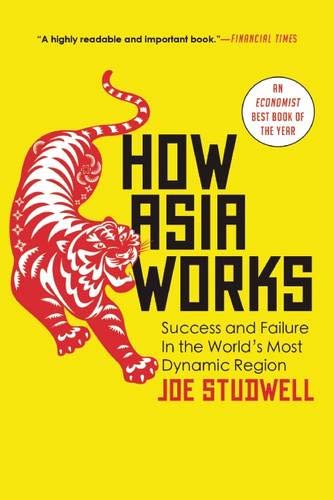
$11.89In How Asia Works, Joe Studwell takes a close look at the economic development of several Asian countries, including Japan, Korea, and China. He argues that land reform, smart manufacturing policies, and effective finance have been key to their success. I found his insights about household farming and the importance of a structured approach to economic growth really engaging. Having grown up in Southeast Asia, I appreciated how this book connects historical context with actionable lessons. Honestly, I couldn't find anything to criticize—it's straightforward and easy to digest, making it a great read for anyone interested in global economics.Buy Now Read My ReviewPros:
- In-depth analysis of economic development in Asia
- Focuses on key economies like Japan, Korea, and China
- Offers useful takeaways for developing countries
Cons:- Nothing - it's very accessible, even for a niche global affairs book.
I earn a commission at no cost to you when bought via this link. Also check your local library. Thank you!
03/20/2026 11:04 pm GMT -
$11.97In Asian Godfathers, Joe Studwell explores the influential tycoons shaping Southeast Asia's economies. He argues that these billionaires thrive on greed and corruption, which contributed to the Asian Financial Crisis. The book contrasts the successful manufacturing-focused North-East Asian countries with South-East Asia's reliance on outsourcing, leading to a fragile economic facade. I found it an eye-opening read, especially since I grew up in the region; it connected many dots for me. While the topic might seem niche, it’s a worthwhile look at business and power dynamics that many can appreciate.Buy Now Read My ReviewPros:
- Super-smart and accessible writing
- Fascinating insights into Southeast Asia's economies
- Helpful for connecting disparate pieces of knowledge
Cons:- It's a bit niche and specific in topic
I earn a commission at no cost to you when bought via this link. Also check your local library. Thank you!
03/20/2026 11:04 pm GMT -
$14.69In Mao by Jung Chang, the focus is on the life of Mao Zedong, from his early days to his rise as a ruthless leader of China. The book paints a stark picture of Mao as a power-hungry dictator, responsible for the deaths of millions through his disastrous policies like the Great Leap Forward and the Cultural Revolution. I found this biography incredibly compelling; it captures the complex and dark nature of Mao's rule while serving as a chilling study of power and manipulation. Honestly, I couldn't find anything I disliked—it's a captivating read that really brings Mao's impact to life.Buy Now Read My ReviewPros:
- One of the best biographies I've ever read
- Captures the awfulness and complexity of Mao's life
- Textbook study on power, manipulation, and evil
Cons:- Nothing - it's a fascinating read.
I earn a commission at no cost to you when bought via this link. Also check your local library. Thank you!
03/20/2026 10:00 pm GMT -
$12.70In Lost On Planet China, Maarten Troost shares his amusing and insightful adventures in China, blending humor with observations about the country's rich culture and history. I found his writing style engaging, filled with funny anecdotes that are respectful and thoughtful. While he touches on serious topics like politics and the treatment of Tibet, the heart of the book is his travel experiences. However, I felt this was his weakest work since he’s just visiting rather than immersing himself in the culture like in his other books. Still, it’s an entertaining read worth picking up!Buy Now Read My ReviewPros:
- Troost's writing style is witty and engaging.
- The book provides humorous anecdotes with context.
- It covers a range of topics about Chinese culture, history, and cuisine.
Cons:- This is Troost's weakest book compared to his others.
- The focus is more on travel experiences than on living in China.
I earn a commission at no cost to you when bought via this link. Also check your local library. Thank you!
03/20/2026 11:03 pm GMT -
$11.46In In Spite of the Gods, Edward Luce explores India's remarkable economic and political transformation since 1991. I appreciated how he focused on this journey, presenting clear, concise chapters that highlight the country's unique contradictions—like its booming middle class existing alongside widespread poverty. Though some parts, especially on modern politics, got a bit dense, Luce’s insights into India's diverse landscape kept me engaged. Despite being published in 2007, the book feels relevant today. If you're curious about India's rise or global economics, this is definitely worth a read.Buy Now Read My ReviewPros:
- The book has a clear focus on India's economic and political rise post-1991.
- Chapters are concise and informative, showcasing Luce's journalistic background.
- Despite being written in 2007, the content remains largely relevant to current trends.
- Luce incorporates diverse sources from across India, highlighting its vastness and complexity.
Cons:- The section on modern Indian politics and Hindu Nationalism is dense and challenging to follow.
I earn a commission at no cost to you when bought via this link. Also check your local library. Thank you!
03/20/2026 02:01 am GMT