A Voyage Long and Strange by Tony Horwitz

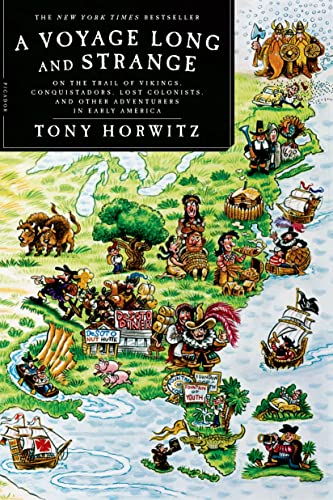
A Voyage Long and Strange by Tony Horwitz is a history travelogue that focuses on the nearly 300 years between Columbus’s discovery of America and the Declaration of Independence.
I was definitely a history kind of student in school, but even with that background, I think most Americans seriously underestimate how much time passed and how much happened between Columbus and the Declaration of Independence. And how varied and diverse the history of the continent actually was.
Here’s the mind-blowing part: there’s more time between Columbus and the Declaration of Independence than there is between the Declaration of Independence and now.
Even though it’s all well documented, there’s just not much popular history written about this era. We jump from 1492 straight to 1776 in our minds, skipping nearly three centuries of incredibly rich history.
What I Liked
I really love this format and genre of using a travel book to explore history. It’s been done excellently by Rinker Buck with The Oregon Trail, by Bill Bryson in At Home, The Road to Little Dribbling, In a Sunburned Country, and A Walk in the Woods. Tony Horwitz does an excellent job with this approach as well.
He packs in a lot of contemporary travel experiences as a way to explore the history of that time period. It makes the history feel immediate and relevant rather than distant and academic.
The book really reminded me that America didn’t have a single founding. It was founded by lots of different cultures and lots of different settlers. We have so many of these distinct streams, especially in the Southwest, in Florida, and throughout the Caribbean. Even among the 13 colonies, each one was very, very different from the others.
I really appreciate how Horwitz weaves all these different threads together into a coherent narrative.
What I Did Not Like
The book is a little bit denser than I would have expected. It’s still very readable and very worthwhile, but it requires more attention than a typical Bill Bryson travel book. You can’t just breeze through it.
What I Learned
This book is a good way to understand why America is the way it is today. So much of our regional differences, our cultural quirks, and our ongoing tensions trace back to these multiple foundings that we barely learn about in school.
Understanding that the Spanish were exploring and settling the Southwest while the English were still getting established on the East Coast, or that there were thriving Caribbean colonies while the Pilgrims were landing at Plymouth Rock—all of this context makes modern America make a lot more sense.
It’s also a reminder that this history is still worth exploring even today. These places still exist, and you can still visit them and connect with this overlooked period of American history.
A Voyage Long and Strange by Tony Horwitz is a history travelogue exploring the nearly 300 years between Columbus and the Declaration of Independence—a longer span than from the Declaration to now. Horwitz uses contemporary travel experiences to examine this overlooked era, revealing how America had multiple foundings by different cultures. The book is denser than typical travel histories but worthwhile for understanding why America is the way it is today.
- Uses engaging travel narrative format to make history accessible and immediate
- Reveals the diverse, multiple foundings of America often skipped in traditional education
- Provides valuable context for understanding modern American regional differences and cultural tensions
- Denser and requires more attention than comparable travel histories by Bill Bryson
- Covers a lot of ground which can feel overwhelming at times
- Not as breezy or quick-reading as other books in the genre

Quotes
So my first few days followed a dispiriting routine. My hotel room in the Zona fronted on a narrow street where buses with pneumatic horns set off car alarms, jolting me awake at dawn. I’d take a cold shower, chill-dry myself before a wheezing air conditioner, spray. paint my entire torso with Arrid Extra Dry, and go downstairs to sweat into a strong cup of café con leche. Then I’d start working the hotel’s crackly phone line. If I was lucky enough to reach someone, I’d hop in a taxi and sit in heavy traffic, haggling over the fare until I reached an office where the person I’d come to see wasn’t there. Then I’d take a taxi back to the Zona, drink more café con leche, and walk around until the caffeine and my sweat glands gave out.
p. 74 on Santo Domingo, or every developing country city in the tropics
The Rock was another fixture of his childhood in Plymouth, and one he regarded as instructive. “Growing up here, we were given a useful distinction between symbol and reality,” he said. “The Rock, like many icons, is important not because it’s big and impressive, but because of what it represents.”
As Gomes paused to add more meat to his bowl, I asked him the question I’d put to others in Plymouth. Setting aside local pride, why elevate the Pilgrims to iconic status and ignore all the others who came to America before them?
Gomes responded by telling me about his appearance, some years ago, in a television debate with the owner of Berkeley Plantation in Vir-ginia. Not only had Jamestown preceded Plymouth, the Virginian ob-served; documents showed that in 1619, colonists landing at nearby Berkeley had designated their arrival date a day of annual thanksgiving.
“This man was energetically anti-Yankee,” Gomes recalled. “So I decided magnanimity was the best response. I said, ‘Of course, the gentleman from Virginia is quite correct. But it doesn’t matter. Ameri-cans love us.”
I wasn’t sure I followed his argument. “So you’re saying we should honor myth rather than fact?” I asked.
“Precisely.” The reverend smiled benignly, as I imagined he might at a bewildered parishioner. “Myth is more important than history. History is arbitrary, a collection of facts. Myth we choose, we create, we perpetuate.”
He spooned up the last of his succotash. “The story here may not be correct, but it transcends truth. It’s like religion-beyond facts.
Myth trumps fact, always does, always has, always will.”
…
Gomes had articulated a thesis I’d been groping toward during the course of my travels, but had kept resisting. Now, shivering beside Plymouth Rock, it seemed inescapable. I could chase after facts across early America, uncover hidden or forgotten “truths,” explode fan-tasies about the country’s founding. But in the end it made little differ. ence. Myth remained intact, as stubbornly embedded as the lump of granite in the pit before me.
Maybe I’d gone about my research all wrong. Instead of combing history’s fine print, like an investigative journalist, I should have studied the Greek classics, or anthropology, or elementary psychology. Myth didn’t grip only modern Americans; it had possessed the long-ago Eu-ropeans I’d been traipsing after.
A shortcut to Cathay, cities of gold, Norumbega, Columbus’s ter-restrial paradise-these were visions I’d dismissed as medieval super-stition. But they’d driven Europeans all over the Americas, with unintended and shattering consequences. Even Bartholomew Gos-nold, searching for a tree that would cure syphilis, helped set in train the events that led to Squanto’s kidnapping, his assistance to the Pil-grims, and their successful settlement of the shore I was standing on al-most four centuries later. Myths didn’t just trump fact; they helped create it.
The modern map of America ratified ancient mirages. Rhode Is.
land, which is not an island, got its name from a geographic mixup with Block Island, which Giovanni da Verrazzano thought resembled the Greek isle of Rhodes. “California” is believed to derive from Calafia, queen of the tall, black Amazons whom sixteenth-century Spaniards conjured as occupants of today’s Golden State. And two continents bore the name of Amerigo Vespucci, who penned fantasies about lands he never saw. All these names were now fixed, and likely to remain so.
As a fact-bound journalist, I’d dutifully recorded the legends lit-tering my path across America. But I’d failed to appreciate why these myths persisted. People needed them. In St. Augustine, I’d doubted that many of my fellow visitors to the “Fountain of Youth” really be-lieved Ponce de León found an elixir, or that the sulphur water they quaffed from plastic cups would roll back the years. But it was harm-less fiction, so why spoil the fun with facts?
Like everyone else, I’d tossed the water down with a smile, even with the faint hope that the foul-tasting minerals might do some good, like cod liver oil or vitamin C. Anyway, the fountain was the rare chapter of the conquistador story that offered hope and renewal and a little comedy, rather than conquest and cruelty. Was it so surprising that visitors preferred the fountain myth to the grim reality on display nearby, of Indians exterminated by European contact?
At St. Augustine, and at the Florida history fest where tourists steered clear of my conquistador armor, I’d sensed something else. Americans didn’t so much study history as shop for it. They did this at Plymouth, too, ticking off sites like items on a grocery list: the Rock, the Mayflower, Pilgrim Hall, Plimoth Plantation.
The past was a consumable, subject to the national preference for familiar products. And history, in America, is a dish best served plain.
The first course could include a dollop of Italian in 1492, but not Spanish spice or French sauce or too much Indian corn. Nothing too filling or fancy ahead of the turkey and pumpkin pie, just the way Grandma used to cook it.
p. 388 on the facts vs myths of America’s origin