Courage To Be by Paul Tillich

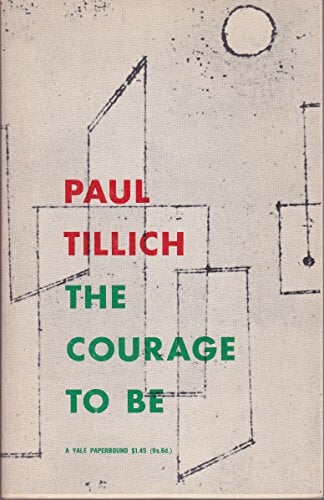
Sometimes a name shows up everywhere in the same week. That happened to me with Paul Tillich.
His name popped up in John Green’s Crash Course Religions on YouTube. Then in The Atlantic. Then in Diarmaid MacCulloch’s excellent Christianity: The First 3,000 Years, where he’s described as one of the most pivotal theologians of the 20th century. Three different sources, totally different contexts, same name.
Maybe it’s Baader-Meinhof but that kind of thing gets my attention. So when I found three of his books at my favorite local Atlanta used bookstore for three or four dollars each, I grabbed The Courage to Be and Dynamics of Faith for a crash course in what this guy was actually about.
He’s about a lot. And The Courage to Be is the best entry point.
What It’s Actually About
The book is short — but genuinely dense. Tillich is wrestling with a deceptively simple question: what does it mean to exist as a self in the modern world, especially after the horrors of World War II and the Holocaust? How do you affirm your own being when anxiety — about death, meaninglessness, guilt — is a permanent feature of being human?*
*and yes, it reminds me of Michelle Obama’s quote – “I’d say Barack’s taste in movies is ‘everybody is sad, then they die,’” she said.
Either way, his answer is right there in the title. The courage to be is the act of affirming your existence in spite of all the forces that threaten to negate it. That courage takes two forms: the courage to be yourself (individuation) and the courage to be part of something (participation). And for both, you need the ability to say yes and the ability to say no.
Simple framing. A lot of weight behind it.
What I Liked
There are some genuinely innovative ideas packed into this slim book.
Ultimate Concern is probably his most famous concept — the idea that every person and every society has some overriding concern that drives all the other concerns. It’s basically an Aristotelian telos or a North Star: the thing underneath all the status games, the ambitions, the rituals. What is the thing that everything else is ultimately for? Worth mulling over.
The Ground of Being is harder to explain — and honestly, I’m not sure anyone has fully cracked what Tillich meant by it. But the gist is that human language, and really any theology or philosophy that tries to describe the transcendent, is fundamentally incapable of doing so directly. So we create symbols instead. We talk about the thing rather than of it. It’s a radical move that undercuts a lot of confident theological (and anti-theological) claims in one shot.
The Protestant Principle is the one I keep thinking about. Despite the name, it applies well beyond Christianity. The idea is that any human group or project is finite — it has a lifespan, it has limits, it can become corrupt. And the moment a leader or a culture starts claiming that this finite thing is forever, is an ultimate value, is beyond question — any individual has both the right and the obligation to raise their hand and say: this is a finite project, and it’s not what I signed up for. Walk away.
That’s a clean, useful rule of thumb for organizations, movements, churches, companies — anything built by humans.
What ties all of this together is the historical moment Tillich is writing from. He’s squarely in the company of thinkers trying to figure out what to do after Nazism — a grab bag that includes Abraham Maslow, Erich Fromm, Rollo May, Viktor Frankl, and Hannah Arendt, among others. Psychologists, existentialists, philosophers, therapists — all circling the same questions about meaning, freedom, and what kind of human life is worth building in the ruins of World War II.
Unlike a lot of American Christian theologians of the era who were either retreating into their own world or trying to turn back the clock, Tillich went headlong into it. The Courage to Be is one of those books that tries to figure it out. He picks up where Kierkegaard left off and takes the existentialist tradition somewhere more grounded and, frankly, more useful.
What I Didn’t Like
Not much, honestly. I was very pleasantly surprised.
Look, it’s a niche book. Bring it up at a backyard party and you’ll get some “wth” looks. But if you took a couple extra philosophy classes in college, or you subscribe to a podcast like Philosophize This, you’ll find it genuinely worthwhile.
I’ll also admit that I finished the book slightly unsure what exactly I loved about it — which is an odd thing to say about something I’d recommend. It’s more that the ideas kept surfacing in my thinking for weeks afterward. That’s usually a good sign.
Who Should Read This
If you’re drawn to mid-20th century philosophy — the post-WWII wave of existentialist and humanist thinkers trying to rebuild a framework for meaning — The Courage to Be belongs on your list. You don’t have to be religious or even interested in theology. Tillich is really doing philosophy with theological vocabulary, and a lot of his ideas translate cleanly into secular contexts.
Pair it with Dynamics of Faith, which builds out more of his philosophical system and gives more context for how his concepts fit together. Reading both back to back is worth the effort.
- Three genuinely original ideas that stay with you long after you finish
- Accessible to non-religious readers despite the theological framing
- Pairs well with Dynamics of Faith for a fuller picture of Tillich's system
- Dense and niche — not a casual read
- The "Ground of Being" concept remains frustratingly slippery even after multiple passes
- Hard to recommend to anyone not already interested in philosophy or theology