Superbloom by Nicholas Carr

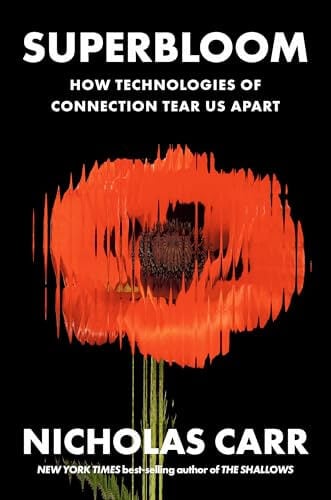
Superbloom by Nicholas Carr is the latest book from the author of The Shallows and The Glass Cage. It’s about how technologies of connection tear us apart—or more precisely, how they scale up both the best and worst of human nature to unprecedented heights.
I initially picked this up skeptical. It seemed like yet another entry in the tired genre of tech pessimism, where someone brilliant spends 300 pages explaining why your smartphone is ruining civilization. But Carr surprised me. This isn’t a simple “technology bad” manifesto. It’s something far more nuanced and interesting.
What I Liked
Carr has a gift for phrases that stick in your mind. “Virtual crowding.” “The prison of the hyperreal.” These aren’t just clever turns of phrase—they capture something real about how constant connectivity creates a paradoxical sense of both connection and isolation.
The historical depth is excellent. Carr doesn’t just focus on social media and smartphones. He reaches back to the telegraph and telephone, exploring how those technologies fundamentally restructured society. He spends significant time on Charles Horton Cooley, a philosopher from the early 1900s who wrote extensively about how the telegraph and telephone were changing the structure of society and what humans could accomplish together.
Cooley understood that these technologies would allow millions and billions of humans to collaborate on things that were previously impossible. But he also saw how they could accelerate our worst impulses faster than ever before.
That historical perspective gives the book real weight. The anxieties we feel about TikTok and Twitter aren’t new. They’re the same anxieties people felt about the telephone. And in some cases, those earlier fears were justified—those technologies did change us in ways we didn’t anticipate.
The central argument is compelling: Communication technologies don’t just connect us. They scale up our cognitive biases to unimaginable heights. The cognitive bias that helps us create community can also create tribalism. The drive to seek out novelty and new knowledge can lead us to conspiracy theories and misinformation. Everything is a two-sided coin, and communication tools amplify both sides to billions of people simultaneously.
Carr argues we need friction—not a lot, just enough to slow things down so that human etiquette and culture can catch up to the technology. When we adopt new communication tools too quickly, we lose the social guardrails that help us use them wisely.
What I Didn’t Like
The book can feel repetitive at times. Once Carr establishes his central metaphor about scaling up human nature, he returns to it again and again from different angles. It’s effective, but I occasionally found myself thinking “yes, I get it, we’ve covered this.”
There’s also not much in the way of practical solutions. Carr is excellent at diagnosis but less helpful with treatment. He gestures toward the need for friction and for cultural adaptation, but doesn’t offer much concrete guidance on what that looks like in practice.
What I Learned
The book crystallized something I’ve felt but couldn’t quite articulate: simply having these communication tools changes us whether we want them to or not. You don’t have to be active on social media for social media to affect your life. The existence of these technologies reshapes culture, politics, and human interaction for everyone.
I also learned to be less dismissive of tech pessimism. There’s a knee-jerk tendency—especially among people who work in tech or grew up online—to roll our eyes at concerns about new technologies. “Old people always fear new things.” But that dismissiveness misses something important. Yes, we typically figure out how to adapt to new technologies. But we also genuinely do change in the process, and not always for the better.
The telegraph and telephone did change us. They made possible new forms of human coordination and new kinds of communities. They also made possible new forms of manipulation and new kinds of isolation. Both things are true.
Wrap-Up
Superbloom is worth reading, especially if you want something more nuanced than the usual “social media good” or “social media bad” takes. It’s not a simple book with simple answers. It’s an exploration of how communication technologies—all of them, from the telegraph to TikTok—reshape human nature by amplifying it.
Highly recommended for anyone interested in technology, culture, or why the internet feels increasingly exhausting despite being more “connected” than ever.
- Historical depth connecting past technologies (telegraph, telephone) to present anxieties
- Compelling central argument about how communication tools scale human cognitive biases
- Nuanced perspective that avoids simple "technology bad" narratives
- Can feel repetitive once the central metaphor is established
- Light on practical solutions or concrete guidance
- Limited actionable takeaways for readers wanting to address these issues

Quotes
But in broadening spheres of influence, writing had another, countervailing effect. It gave people, at least those who could read, far greater exposure to the thoughts of others. Once printing presses began making books commonplace, every literate person could, as Cooley writes, “form his own environment by retaining what suits him from a variety of materials, and by opening communication with congenial minds in remote times and places.” By freeing the reader from his physical surroundings and local social group, the written word not only hastened the spread of knowledge; it fueled the rise of individualism. The reader, withdrawing into the solitary act of read-ing, could chart the path of his own intellectual growth. The book may have been “the first product of mass production,” as McLuhan wrote, but it “isolated the reader in silence and helped create the Western ‘I.’ “
On how communication created individualism
The openness of the network felt liberating. The operators’ abil. ity to project their voice, or at least their code, across hundreds of miles gave them a feeling of freedom and independence. It inspired a sense of personal agency at a time when industrialization and urban-ization were imposing conformity and regimentation. “The ama-teurs, writes historian Hugh Slotten, “tended to view the spectrum as a new, wide-open frontier, akin to the American West, where men could pursue individual interests free from repressive authoritarian and hierarchical institutions.
The amateur operators-adolescent boys, many of them-played a crucial role in the development of radio. They didn’t just “adopt” the new technology, explains media scholar Susan Douglas; “they built it, experimented with it, modified it, and sought to extend its range and performance. They made radio their own means of expression. Most of the “radio bugs” used their sets responsibly. But some, in another foreshadowing of the net, were bent on mis-chief and mayhem. Shielded by the medium’s anonymity, they would transmit rumors and lies, slurs and slanders. The U.S. Navy, which relied on radio to manage its fleet, was a prime target. Officers “com-plained bitterly,” Slotten reports, “about amateurs sending out fake distress calls or posing as naval commanders and sending ships on fraudulent missions. Particularly irksome to the brass was the fact that the amateurs’ homemade radios were often more sophisticated than the military’s expensive kits.….
The Titanic tragedy changed everything. The public was out-raged, and the press demanded immediate government action. “The recent disaster to the Titanic points with terrible and fateful directness to the absolute necessity of a controlling power to regu-late wireless telegraphy,” declared the popular magazine Electrical World in an editorial. “No measures of repression are too severe.47 Four months later, Congress passed the Radio Act of 1912. Among the law’s provisions were requirements that all radio operators be licensed by the Department of Commerce, that senders of malicious messages be prosecuted and fined, and that transmissions by ama-teur operators be restricted to the less desirable shortwave band of the spectrum-an “ethereal ghetto,” as one historian would describe it. Radio’s Wild West days were over.
…
Within two years, more than five hundred commercial stations were operating across the country, and radios had become the new centerpieces of American living rooms. Their broadcasts gave daily testimony to the miracles of science and technology. “Even in an age of marvels,” wrote one Ohioan, “there is something awe-inspiring about the radio. Through the radio the throbbing present may be brought home to us and the dead past made to live again.” Radio sets were changing, though. While hobbyists, or “hams,” continued to buy or build transceivers, most of the models sold to the general pub-lic lacked the capacity to send out signals. They could only receive them. Radio, it was now clear, would be a centralized medium, its programs and its influence flowing out in a single direction: from the broadcaster to the masses, from the one to the many.
On the early days of radio and the crisis that started regulation and commercial incumbents
With the outbreak of World War II, the fears intensified. Nazi sympathizers in the United States began to use the airwaves to spread fascist ideas. The weekly broadcasts of the rabble-rousing, pro-Hitler “radio priest,” Charles Coughlin, drew tens of millions of listen-ers. As the country prepared to enter the conflict, Turner reports, policy makers grappled with two questions: “First, how could they convince democratic Americans to go to war without turning them into the sort of unthinking authoritarians they would be trying to defeat? And second, what kinds of media could they use to do it?”
The questions inspired a few dozen prominent intellectuals, includ-ing anthropologist Margaret Mead, psychologists Gordon Allport and Erich Fromm, pollster George Gallup, and art historian Arthur Upham Pope, to form, with the Roosevelt administration’s backing, the Committee for National Morale. The goal was to examine the connections between communication, individual personality, and national character, with a view to undertaking a radical restructuring of media to make it less likely to serve as an arm of tyranny. If existing mass media, built on the one-to-many model, tended to produce an “authoritarian personality,” couldn’t a new form of mass media, built on a many-to-many model, produce a “democratic personality”?”
During the war, members of the committee, notably Mead and her third husband, Gregory Bateson, a British anthropologist who had a sideline as an American spy, began to sketch out what such a communication system might look like. They imagined an immer-sive, interactive multimedia environment. Information in all forms-text, image, sound, motion picture-would be presented to an active, engaged audience of citizens. No traditional editors or pro-ducers, no government bureaucrats or propagandists, would script the experience; people would be free to choose what to look at and listen to at any given moment. Most important, the medium would erase the divide between creators and consumers. People wouldn’t have to resort to the mail to make their feelings known. Everyone would have the tools and the network access needed to express them-selves through the system. Everyone would have a voice. Informa-tion would flow in all directions at once. The Committee for National Morale shared Charles Cooley’s faith in the rationality and goodwill of the public. An unconstrained, decentralized flow of information would open people’s minds and arouse, as Cooley had put it, their “higher sympathetic and aesthetic impulses.”On the first visions of a many to many media environment
The death was foretold by the German social critic Theodor Adorno. In his 1951 book, Minima Moralia, he wrote of his sense that the industrial “spirit of practicality” was expanding from the realm of business into that of everyday social relations. An efficiency-minded approach to communication was beginning to warp the way people spoke to each other:
If time is money, it seems moral to save time, above all one’s own, and such parsimony is excused by consideration for others. One is straightforward. Every sheath interposed between men in their transactions is felt as a disturbance to the functioning of the apparatus, in which they are not only objectively incorporated but with which they proudly identify themselves.
The discursive, unhurried style of the personal letter, Adorno feared, was giving way to the blunt style of the bulletin. “The straight line is now regarded as the shortest distance between two people, as if they were points.On predicting the death of letters and relaxed communication in 1951
The Norton group pointed out that trait-based experiments like the ones they conducted do a good job of replicating how we actually learn about people today. Rarely do we form impressions of others simply by chatting with them on a sidewalk or a stoop. We gather discrete bits of information about them from many sources through our phones and computers. We google them. We look at their social media profiles. We scan their posts and comments. We glance at their selfies and other photos. We check out their follower lists and their likes and shares. We parse their texts and other messages. Digital data-gathering is how we size up strangers and new acquaintances, and it’s how we keep tabs on people we already know, including long-standing friends. We’ve gotten used to interpreting people as assem-blages of traits, as patterns of data.
On how we treat people today – as patterns of data
But social media’s benefits, as real and welcome as they are, shouldn’t blind us to the deeper ways that digital technology is changing social dynamics. The discoveries that psychologists and sociologists have made about the fraught nature of human relationships-about environmental spoiling and dissimilarity cas-cades, about the slow and fragile unfolding of relationships, about the tension between disclosure and privacy-reveal how ill-suited the human psyche is to our new media environment. As connections multiply and messages proliferate, relationships get stretched thin. Mistrust spreads. Antipathies mount. That’s the tragedy of commu-nication. When there’s too much of it, a reversal takes place. It begins to undermine the very social and personal qualities we look to it to foster. To put it in the language of economics, communication dis-plays diminishing returns to scale-and eventually the returns turn negative. Communication subverts itself. That’s what Harold Innis was getting at when, in his 1947 lecture, he suggested that more com-munication means less understanding.
On the tragedy of over-communication
A related line of research into how people form political opin-jons and cast votes has reached similar conclusions. Looking back on more than a half century of opinion surveys and voter research in their 2016 book. Democracy for Realists, the political scientists Christopher Achen and Larry Bartels report that the “folk theory” of democracy, which “celebrates the wisdom of popular judgments by informed and engaged citizens,” has long been contradicted by the facts. “The political ‘belief systems’ of ordinary citizens are generally thin, disorganized, and ideologically incoherent.” Giving another nod to Lippmann, they conclude that “conventional democratic ideas amount to fairy tales.7
As for the rather small set of voters who spend a lot of time read-ing, thinking, and talking about politics, the research reveals that their heightened engagement rarely broadens their minds. They’re actually the ones most inclined to narrow and fervent partisan-ship. The more news they gobble up, the more convinced they are that they’re right and anyone with a different view is wrong. As Zac Gershberg and Sean Illing report in their 2022 study, The Para-dox of Democracy, “the most knowledgeable voters, the ones who pay the most attention to politics, are also the ones most prone to biased or blinkered decision-making. A similar effect is seen with educational achievement. The more educated people are, the more distorted is their understanding of the views of their political oppo-nents. That seems to be particularly true of Democrats, according to an extensive 2019 study of American political polarization. The apparent reason is that well-educated Democrats go to great lengths to avoid fraternizing with Republicans. “As Democrats become more educated, their friend groups become less politically diverse,” the authors of the study write. They restrict their social set to versions of themselves. In sum, “the most highly engaged, active and educated people are least accurate in their views of those they disagree with.”
Well before the net came along, the psychological and psepho-logical evidence was telling us that flooding the public square with more information from more sources was not going to open people’s minds or engender more thoughtful discussions. It wasn’t even going to make people better informed. Despite the revolutionary expan-sion in the public’s access to information of all sorts, contemporary surveys clearly show that, as the political scientist Donald Kinder puts it, “Americans are no better informed on public affairs than they were a generation or two ago. So what exactly was media democra tization going to accomplish, in terms of the country’s political life? We now know the answer: it was going to widen the gap between the pseudo-environments in which people think and the real envi-ronment in which they act. This helps explain, among many other things, how a bare-chested man with a horned fur hat, a painted face, and a spear came to be bellowing on the floor of the U.S. Senate on the afternoon of January 6, 2021.On the myth of educated voters
Mechanisms of communication, as Cooley understood, don’t change our nature, but they do accentuate certain aspects of it while damp-ening others. A computer network exists to maximize the speed of data transfer and processing, to shorten the delay between input and output. The more we rely on computers to mediate what we say and see and think about, the more we have to adapt our thought, speech, and behavior to their characteristics and requirements. “Repeated exposure to computing alters human sense-making,” explains com-munication scholar Brian Ott. “As humans try to speed up their information-processing and decision-making capabilities, they are less careful and rational and more impulsive and affective, which-paradoxically-undermines the quality of their decision making. When shunted into a computer network, thought and expression become virtual goods optimized for rapid exchange. The internet is not broken. It’s operating as it was designed to operate. It’s suc-ceeding in making our dream of perfect communication-efficient, unfettered, immersive-a reality, even as it reveals the dream to have been a delusion all along.
On how technology only speeds up human nature, it does not change it
All mammals are seekers. The urge to explore every facet of an environment-“from nuts to knowledge,” as the late neuroscientist Jaak Panksepp put it-is crucial to survival in the wild. Fueled by the pleasure-producing chemical dopamine and involving neural path-ways that crisscross the brain, the seeking instinct is, as Panksepp wrote in his classic treatise, Affective Neuroscience, the most insatia-ble of all drives, outstripping even lust. If you place a rat in front of a lever wired to send an electric pulse through the seeking circuit of its brain, the rodent will eagerly press the lever “until physical exhaus-tion and collapse set in. We humans put rats to shame. As cogni-tively gifted mammals who crave mental stimulation and as socially obsessed mammals who crave connection and status, we are raven-ous for new information and new experiences. We’re always on the hunt for fresh inputs to feed into our nervous system.
…
The media business has always sought to indulge and capitalize on the human passion for searching out new information and expe-riences. Television tore down the walls of the living room, bringing a steady rotation of interesting people and exotic scenes into every home. It gave us a simulated world teeming with audiovisual stimula-tion. We didn’t even need to get off the couch to exercise our seeking instinct. Still, there were limits. We couldn’t actually enter the simu-lation; our social lives were not part of the broadcast. And when we left the living room, we also left the simulation and its stimulations.
It was the net that brought us inside the simulation, made us part of the show. With social media, we became active participants in media productions rather than mere observers of them. And then the smartphone told us we never had to leave the simulation. The over-riding goal of social platforms has from the start been to find new and more efficient ways to feed us novelty. The major design innova-tions that have shaped the social media interface-the pull-to-refresh function, the infinite scroll, the multidirectional swiping, the auto-play routines-are all intended to make seeking easier and more effi-cient. Our compulsion to discover new stuff once required us to go out and walk around. Now it’s gratified with a flick of a finger. And the algorithms make sure our seeking is always productive. Even if we’re not looking for anything in particular, we’re always finding what we want. As we acclimate ourselves to a more intense level of stimulation, we yearn, like gamers, to level up again. Stimulus infla-tion becomes self-reinforcing. The seeker is never satisfied.On the fact that we want & enjoy our media
But while frictional design may help curb certain well-defined types of undesirable online behavior, it is likely to prove as futile as Frank Walsh’s gunplay when it comes to changing how social media operates. Unlike traditional time, place, and motion laws, which don’t affect the day-to-day lives of most people, changes to the basic workings of social media would affect pretty much everyone all at once. Although the frictional design proposals focus on regulating how technological systems work rather than on what people say, they would still raise free-speech and free-press concerns. Many people, even among the growing number who would like to see stiffer con-trols placed on platform companies, would rebel against what they’d see as patriarchal overreach or nanny-state meddling. Others would object to the government imposing a single set of values on the gen-eral public’s means of communication and entertainment. Many would ask whether politicians and bureaucrats can be trusted to meddle with software without mucking everything up. Would every shift in the political winds bring sudden and confusing alterations to the way apps work?
The biggest obstacle to adding friction to communication, though, is likely to be the habits of social media users themselves. The history of technological progress shows that once people adapt to greater efficiency in any practice or process.On how it’s the us not the companies to hold the power
Brooks’s research points to something elemental about intelli-gence, its formation, and its tight connection to nature:
The world is its own best model. It is always exactly up to date. It always contains every detail there is to be known. The trick is to sense it appropriately and often enough.
That’s the trick for us humans as well: to sense the world appropri-ately and often enough. It’s a trick we’ll need to relearn if we hope to escape imprisonment in the hyperreal. Despite our love of or at least infatuation with the easy stimulations of the virtual, we can never make a true home there, at least not without sacrificing the qualities of sense and sensibility that make us most ourselves. Live in a simula-tion long enough, and you begin to think and talk like a chatbot. Your thoughts and words become the outputs of a prediction algorithm.
To argue for a more material and less virtual existence is not to make a case for materialism alone. As the ambitions of Andreessen, Zuckerberg, and the other evangelists of virtual reality make clear, it’s virtuality that reduces all concerns to the materialistic. Hyperreality is all surface and no depth. Beyond the simulation lies nothing at all, as Baudrillard saw. Any attempt to transcend reality, intellectually, artistically, or spiritually, has to begin from within reality, bounded by constraints of time and space. You can only get beyond the mate-rial by going through the material, by suffering and surmounting its frictions. And that becomes harder and harder to accomplish or even to imagine the more that life is mediated by mechanisms of commu-nication.On how the key is not to defeat online media, but to fall in love and replace it with offline media
Maybe salvation, if that’s not too strong a word, lies in personal, willful acts of excommunication-the taking up of positions, first as individuals and then, perhaps, together, not outside of society but at society’s margin, not beyond the reach of the informational flow but beyond the reach of its liquefying force. The superbloom gave us a metaphor for the entrancing, fleeting stimulations of the screen. We might borrow Dr. Johnson’s rock as a counterweight-an emblem of stability, solidity, resistance. If you don’t live by your own code, you’ll live by another’s.
On playing your own game
tk – insert Don Drapers department betold