Useful Not True by Derek Sivers

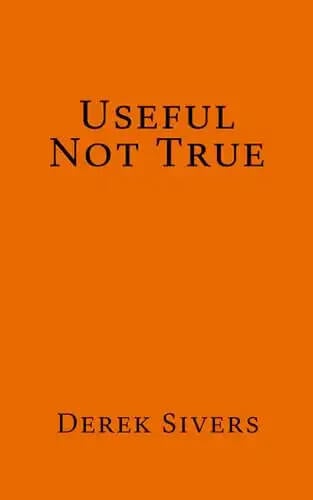
I picked this one up because Derek Sivers has a talent for packaging a simple, counterintuitive idea and making it feel obvious in hindsight. Useful Not True is exactly that kind of book — and it delivers.
The core premise is straightforward: humans create stories and frameworks that aren’t literally true, but are still incredibly useful. Not useful in a “white lie” kind of way. Useful in a “this is how civilization actually functions” kind of way.
What the Book Is About
The clearest example Sivers uses is time zones. Time zones are, objectively, not true. Every single point on Earth has a slightly different relationship to the sun. There is no moment where it is simultaneously noon everywhere in a time zone. And yet, time zones are one of the most useful constructs ever invented — they make train schedules, global meetings, and basically all of modern commerce possible. The “truth” would be chaos. The useful fiction works.
The more personal examples are where the book gets interesting.
Our memories, for instance, are not reliable recordings of what actually happened. Our brains are genuinely bad at objective recall. But that’s not only a bug — it’s also a feature. You can consciously reshape the stories you tell around your memories to be more empowering and more useful than a strict replay of events. That’s not delusion. That’s agency.
The same idea applies to personas — the version of yourself you present in different contexts. The person you are at a big industry conference or on a public social media account isn’t a lie, exactly. It’s a constructed, useful version of you built for a context that your brain was never designed to handle. We weren’t built to interact in spaces that expose us to millions of strangers who share a narrow interest. Creating a persona or an “avatar” for those contexts is a completely rational adaptation — even if it doesn’t map one-to-one to who you are at the dinner table.
What I Liked
The conciseness. This is a short, self-published book and it reads exactly like one — in the best possible way. It’s dense without being exhausting. Every section earns its place. No filler, no padding to hit a word count.
The ideas are also genuinely easy to remember but hard to implement — which is the exact combination that makes a reference book worth keeping around. I’ve already thought about the time zone example twice since finishing it.
Sivers writes like someone who has thought hard about something and wants to share it clearly, not someone trying to impress you. That’s refreshing.
What I Didn’t Like
Not much. For a self-published book, it’s everything you’d want. The ideas are sharp, the writing is clean, and it doesn’t overstay its welcome.
If anything, I wanted more — more examples, more development of the personas idea in particular. But at this length and price, that’s a compliment, not a complaint.
Who Should Read It
Anyone who thinks a lot about how they present themselves — online, in business, in their own head. If you’ve ever wrestled with whether a mindset shift is “real” or just self-deception, this book gives you a useful framework for thinking about that question. It’s a fast read and worth it.
You can find it directly on Derek Sivers’ website.
Useful Not True by Derek Sivers argues that the stories and frameworks humans create — even ones that aren't literally true — can be enormously useful. Through examples like time zones, memory, and online personas, Sivers makes the case that useful fictions are how individuals and civilization actually function. It's short, dense, and worth keeping as a reference. Highly recommended for anyone who thinks carefully about mindset and self-presentation.
- Concise and dense — no filler, every idea earns its place
- Genuinely counterintuitive premise that's easy to remember and immediately applicable
- Sivers writes with clarity and humility, not to impress
- Short enough that you'll want more development on several ideas
- Self-published, so less discoverable than a traditionally published book