Beyond Belief by Nir Eyal

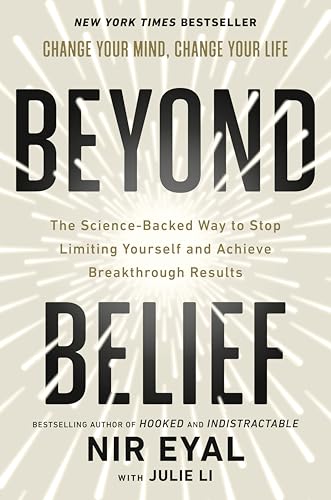
Beyond Belief: The Science-Backed Way to Stop Limiting Yourself and Achieve Breakthrough Results by Nir Eyal is a book about the science-backed version of positive thinking – the idea that your thoughts can create real-world effects.
I picked it up because I’ve read all of Nir Eyal’s books, especially Hooked and Indistractable. He has a keen sense for trending topics. But more importantly, he knows how to organize nonfiction information into a framework that is both usable and useful.
This is also one of those rare books that I bought instead of borrowing from the library, because I knew it would be a reference book. Fair warning – my Kindle highlights are longer than this review.
What the Book Is About
The short version is that, from what we understand from neuroscience, the brain is a simulation machine. It doesn’t have a direct line to reality. Its only connections are through the senses and the models it builds inside your skull. That’s where all kinds of cognitive biases come from.
But here’s the exciting part – you can actually hack some of those biases to create what are essentially self-fulfilling prophecies. When your brain truly believes something will happen, you take action to make it happen. You attempt things you previously didn’t believe you could do. And those attempts create real-world results more often than you’d expect.
The Rat Study
Eyal opens the book with a famous 1950s experiment by Curt Richter comparing wild rats to domesticated rats. The hypothesis was that wild rats were tougher and would be stronger swimmers. So researchers dropped both groups into water to see who could last longer.
Surprisingly, the wild rats drowned faster. Hypothesis busted.
Then they tried something different. Right before the wild rats were about to drown, researchers plucked them out, let them catch their breath, and put them back in.
The researchers expected a small bump – maybe a few extra minutes. Instead, the rescued rats swam for up to 60 hours, far outlasting the domesticated rats.
The only thing that changed was that the rats now had a reason to believe they might survive. It’s like the brain is naturally lazy. When it sees a drowning situation, it says, “There’s no hope, so why bother.” But a little bit of belief – grounded in something that actually happened – changed their mental model of reality. And that changed everything.
Underestimating vs. Overestimating Belief
Eyal extrapolates studies like these to show that we get belief wrong in both directions – as individuals and in groups.
We often underestimate belief because we don’t realize what we can actually do. But sometimes we overshoot and think belief is all it takes. And belief that doesn’t lead to action doesn’t lead to results.
That distinction is what separates this book from generic positive-thinking self-help. Belief is the trigger – not the whole mechanism.
What I Liked
It’s a fast read. Eyal keeps things moving with stories and studies without getting bogged down in the weeds.
More than anything, it’s everything I want nonfiction to be. Sure, you can get some of this from chatting with your favorite AI chatbot. But to me, this is the real strength of a nonfiction book – someone who can take a large body of knowledge and put it into a framework with stories that resonate. Stories that hook into your brain so the ideas are actually useful later.
What I Did Not Like
The religion section. I get what he was trying to do – build a bridge between positive thinking and religious ritual. But a lot of it came across as disingenuous.
I do want to give him the benefit of the doubt. And honestly, I wish more religious traditions were open to engaging with this kind of science. But this section just didn’t land for me.
Wrap-Up
Beyond Belief is a fast, useful, well-organized read. I highly recommend picking it up – especially if you’ve enjoyed Eyal’s other books.
Beyond Belief: The Science-Backed Way to Stop Limiting Yourself and Achieve Breakthrough Results by Nir Eyal is a book about the science-backed version of positive thinking – the idea that your thoughts can create real-world effects.
- Excellent stories, clear science
- Useful takeaways
- Memorable framework
- Not a whole lot - excellent nonfiction
- Get a bit disingenuous with religious practices

Notes
What I didn’t see then was that a belief can be helpful without being universal or even strictly true. My all-or-nothing mindset, the idea that a diet was either entirely flawless or completely worthless, kept me stuck in a loop of rigid conviction and total abandonment. The real breakthrough came later, when I stopped chasing the “perfect” plan and started to believe that consistent daily choices over time mattered more than giant overhauls.
It was that belief—not discipline or the particulars of the latest plan—is the real driver of sustained motivation.
Knowing what to do and why you should do it isn’t enough. If it were, we’d all follow through on everything we know is good for us.
We are better off understanding motivation as a triangle. One side represents the actions you must take: your behavior. One side stands for the benefit: the outcomes you desire. And the bottom of the triangle, connecting the other two sides together, is your belief: your conviction that those actions will lead to the desired results.
beliefs aren’t simply thoughts or feelings. They’re tools—working models we use to navigate reality when the truth isn’t fully knowable.
Choosing a belief is a strategic decision, not self-deception. Scientists use simplified models to understand complex systems because they’re useful for making predictions and guiding action. We can do the same with beliefs by adopting them to help navigate life’s challenges while remaining open to new evidence. Beliefs are tools, not (necessarily) truths. The real question isn’t “Is this belief true?” but “Does this belief serve me?”
This book is a staunch rejection of magical thinking and blinding denial. A belief is only a good tool if it holds up to real-world feedback, remains open to revision, and doesn’t require ignoring evidence to sustain it. If a belief makes you temporarily happier but leads you away from truth, healthy action, or growth, it’s not helping you—it’s harming you. Beliefs worth keeping must be both valuable and reality-tested, not just comforting.
an illusion can still keep its hold on you even when you know it’s an illusion.
we see reality as our beliefs tell us it should be.
they can also prompt us to see things that aren’t actually there and create problems where none exist.
Instead, they intuitively adjusted their definitions of “threatening,” “blue,” and “ethical” to align with their expectations.[7]
The same phenomenon explains why, even when conditions in society improve, we can fail to recognize that progress.
“When problems become rare, we count more things as problems.”[9]
While she couldn’t change what happened in that presentation, she could change how her brain interpreted it going forward.
Notably, while these insights originated in philosophical and spiritual traditions, their application requires no supernatural beliefs or religious affiliation. They represent practical, empirical approaches to perception.
To reshape our beliefs, we first need to recognize the judgment trap: a perceptual pattern that operates automatically and largely unconsciously in our relationships.
Once we start looking for evidence that someone is inconsiderate, uncaring, or disrespectful, we’ll continue to find it—even if the actual inconsiderate behavior decreases.
The quality of my relationships depends far more on my beliefs than on others’ behavior.
What beliefs helped you get where you are today? Which ones still open doors? Which might be quietly closing them? Where are you playing it too safe? Are you doing enough to “provoke luck”?
If attention shapes what we see in the present, anticipation shapes what we feel about the future.
The idea that the world is an illusion appears across cultures and throughout history. Hindu philosophy refers to it as māyā—the concept that what we perceive is a cosmic mirage, concealing a deeper reality. Buddhist teachings suggest that our everyday experiences are more akin to dreams created by our minds than accurate representations of what’s truly there.
Sometimes we discover this through direct experience, by trying something and finding that we love it. But more often, we steal our desires from others. We watch what makes people around us light up, what they pursue, what they celebrate. Other people’s behavior becomes our shortcut, a signal about what’s valuable, and therefore what we should want for ourselves.
This imitative response likely evolved from our ancestral relationship with scarcity. If your tribe suddenly showed interest in a resource—perhaps a rarely available food or a superior tool material—it signaled something worth pursuing. Our brains learned to act fast: When others desire something, assume it’s precious and act quickly to obtain it. In that environment, desires become contagious; the knowledge that others want something spreads far faster than any rational evaluation.
To succeed in business, you can either make what people want or make them want what you make.
This aligns with psychiatrist Scott Alexander’s suggestion that addiction might be understood as “what happens when you become hyper-aware of one particular facet of your normal motivation system.”[17] We anticipate irresistibility, our attention zeroes in on the craving sensation, and consequently we experience the chips as more compelling than they really are.
But isn’t this all just fancy deception? Not necessarily. When a brand makes a mundane experience fun or meaningful, that’s genuine value. Drinking water from a can branded with a message that resonates with you is more enjoyable than sipping from a flimsy bottle—the joy is real, even if it’s “all in your head.” As long as the company delivers on its basic promises (Liquid Death’s water is pure, refreshing, and not sold in plastic bottles), the extra enjoyment layered on through clever anticipation-building is a bonus, not a scam.
Here’s a useful self-check in these situations. Ask yourself: Is this belief serving me, or am I serving it? If a belief is serving you—by adding delight, motivation, focus, or connection—there’s no need to shatter it. You might be fully aware that much of the joy is in the belief, and that’s fine.
On the flip side, some beliefs actively drain us. If you’re exhausting yourself maintaining a perfect social media image or avoiding new opportunities because you “can’t handle change,” it’s time to question those assumptions. Your negative anticipation is sabotaging your actual experience.
Identify areas where your anticipatory beliefs might be limiting you. Negative emotions like dread, resentment, and prejudice can be red flags that a belief deserves examining.
The most important simulation you’ll ever design is your daily experience. Most of us let our anticipations run on autopilot, shaped by habit, environment, and unexamined beliefs. Understanding that our beliefs shape our experience gives us the power to transform mundane moments into meaningful ones, find joy in boredom, and discover opportunities in obstacles.
The effect wasn’t due to any change at the skin level: The brain itself interpreted the pain differently.
But what if our approach to motivation is fundamentally backward? We think we’re waiting for motivation. But motivation doesn’t show up first—discomfort does.
When we procrastinate—putting off exercise, difficult conversations, or challenging work—we’re not failing at finding motivation; we’re avoiding anticipated discomfort. Our brain predicts that the workout will hurt, the conversation will feel awkward, or the mental effort will strain us. This anticipation creates an immediate urge to disengage from the activity. Unfortunately, our predictions are often wrong. We tend to overestimate how long unpleasant sensations will last.[6] The more intense the anticipated discomfort, the less likely we are to engage, even when the actual experience proves far less unpleasant than expected. “Anticipatory anxiety is almost always worse than the thing itself,” according to researcher Ethan Kross.[7] We might think that anxiety prepares us to confront disaster, but in fact, “worst-case mental models…themselves become barriers to action.” Exaggerated predictions can keep us stuck.
Applying this insight to your own challenges means recognizing that discomfort isn’t something to be avoided, but just another belief to reconsider. The key to motivation is changing how you anticipate and interpret the inevitable discomfort that comes with growth.
I changed my relationship with it, viewing those feelings of resistance as signals that I was about to do important, meaningful work. This mental shift didn’t make writing effortless, but it made the struggle feel purposeful. It transformed my experience of the challenge, making it less painful, and I became more productive as a result. I only learned to manage procrastination when I learned to manage my pain.
Neuroplastic pain is the brain’s overfixation on what it believes is potential future damage. Those false alarms trap people in a pain-fear-pain cycle. Gordon explains it with stark clarity: “When we respond to pain with fear, it reinforces that it’s dangerous, and the pain persists. Fear is the fuel for the pain.” The result is a cruel loop. The anticipation of discomfort creates suffering by amplifying symptoms; avoidance only strengthens the cycle. Every time we retreat from pain, we reinforce the brain’s mistaken belief.
By observing sensations without catastrophic labels, reappraising their meaning, and pairing them with positive emotion, you can change what you anticipate—and with it, what you feel.
Just as someone can have a disease without feeling ill (like having early-stage cancer without symptoms), we can also experience illness (such as pain) without having any underlying disease.
Understanding these boundaries is crucial. While placebos can significantly reduce suffering, promoting them as replacements for evidence-based treatments for disease—rather than illness—crosses a line. But for those conditions in which subjective experience is the central problem, placebo responses can be remarkably beneficial. The optimal approach isn’t choosing between placebos and “real” medicine, but intelligently combining them to maximize benefit while minimizing suffering.
Recall that motivation requires three elements: belief (the conviction that something is possible), behavior (the actions taken), and benefit (the reward).
believed they were taking effective performance enhancers, anticipated improved strength and muscle gains, felt empowered to push harder in their workouts, and confirmed their expectations when they observed real improvements.
All these examples demonstrate a common point: When psychological constraints are removed or altered, anticipation can reveal capabilities we don’t know we possess, leading to fundamental shifts in what our bodies can accomplish.
Let’s return to Team Strong Silvers, the senior fitness enthusiasts from Singapore we met at the beginning of this chapter. Their rejection of conventional beliefs about aging has led them to maintain training routines that most people their age gave up long ago. Are they simply unusual individuals, or do they represent something more profound about how beliefs shape the aging process?
They discovered that those with more positive views of aging lived, on average, 7.5 years longer than those with negative views, even after controlling for health status, socioeconomic factors, and other variables.[22]
What do these pathways look like, and how do beliefs about aging affect them? Here’s an example: When people hold negative aging beliefs (“I might fall” or “I’m too old for this”), they’re more likely to avoid physical challenges. Avoiding challenges leads, over time, to actual physical deconditioning. The deconditioning makes activities more difficult and potentially more painful, which reinforces avoidance. Socially, this often leads to isolation, which increases stress and depression risk. The resulting chronic stress triggers inflammatory responses and disrupts hormone regulation, accelerating biological aging in measurable ways.
Helplessness isn’t learned at all. It’s our default. What we must learn is hope.
These neural circuits are strengthened through experience. Each time you successfully exert control in a challenging situation, you reinforce the brain pathways that can override your passive defaults—and activate what Seligman calls your “hope circuit.”[5] Over time, this creates what amounts to a new operating system for dealing with adversity, one that views problems not as threats to avoid but as challenges to engage.
life stands defiantly against this cosmic current. In every cell, in every organism, in every ecosystem, living things build islands of intricate order in an ocean of increasing chaos.
Think about your own body. Right now, trillions of cells are orchestrating an intricate dance, maintaining precise temperature controls, repairing microscopic damage, and transforming simple molecules into usable energy.[10] Every breath defies entropy. Every heartbeat is a rebellion. Every cellular response represents a tiny victory against decay. Eventually, when we die, our bodies return to stardust—the inevitable defeat of life’s 3.8-billion-year battle that sparked your existence.
To paraphrase Schrödinger, life is that which fights chaos. This perspective transforms how we might view our daily struggles. When your life feels chaotic, remember: Disorder isn’t a sign that you’re failing at life; it’s proof that you’re fully immersed in it. If things feel messy, it’s because you’re alive, and that’s an improbable, beautiful miracle. The goal isn’t to eliminate disorder (that’s impossible); rather, it is to develop a productive relationship with it.
Agency doesn’t mean controlling every variable. It means developing beliefs that support effective navigation of uncertainty.
This is the critical distinction between high and low agency. Someone with low agency sees obstacles as immovable barriers that signal, “Stop” (like the dogs that whimpered and gave up). Someone with high agency sees those same obstacles as navigation points that signal, “Adapt.”
The pattern is unmistakable: Maintaining a strong internal locus of control consistently predicts better outcomes, even when objective analysis suggests you lack control. This overturns the idea that action is only worthwhile when conditions are favorable. See the constraints clearly, then focus relentlessly on what you can influence.
Yet agency has its limits. Taken too far, it slips into the trap of naive omnipotence—the belief that sheer effort can bend any circumstance to your will. Research shows that those who ignore genuine constraints often end up frustrated, burned out, and disillusioned. Research from places like Japan and China suggests a more effective approach: Individuals who combine personal initiative with an acknowledgment of external forces, such as community and family, prove more resilient than those who cling to total self-determination.[21]
This moment captures a crucial truth about agency: Agency doesn’t mean having all the answers yourself. It means believing in your ability to find solutions and staying committed until you do.
Psychologists refer to these as optimal challenges. Even small wins—such as a daily ten-minute walk when strenuous exercise feels too overwhelming—can train your brain to believe that effort matters.
We become trapped in a false dichotomy: Either accept religious dogma with absolute certainty or abstain entirely.
However, when we engage deeply with ideas we find meaningful, whether we call them God, love, nature, or higher self, we tap into reservoirs of resilience that ordinary thought cannot reach. While such meditation doesn’t erase life’s inevitable pains, it equips us with internal resources to face difficulties with greater strength.
Prayer and ritual can serve as bridges—acts that help us engage life’s mysteries without demanding certainty.
Research by cognitive scientist Eleanor Schille-Hudson reveals that prayer functions as a structured form of thinking. When we pray, we naturally employ a four-step process: articulating the challenge clearly, formulating possible approaches, committing to action, and reflecting on outcomes. Unlike rumination’s circular worry, prayer creates what Schille-Hudson calls collaborative problem-solving, allowing us to focus on what we can control while delegating the rest to a higher power. Those who pray are left feeling more empowered and optimistic about change.[10]
On a residency form, there was a category I’d never seen before: free thinker.
When we gather in communal rituals, whether in churches, temples, or informal settings, we create what sociologists call collective effervescence, that electric feeling of connection that emerges when people unite in shared experience.[13]
Our nervous systems function more effectively in the presence of supportive others.[14] Our bodies respond to prolonged isolation with increased inflammation, compromised immune function, and heightened stress responses.[15]
Further research confirms that secular rituals can be just as effective as religious ones in reducing anxiety and enhancing performance, provided they incorporate similar structural elements, such as repetition, formality, and symbolic meaning.
However, rituals have also served another purpose: They bind groups together. This raises a dilemma facing many today: What should someone do when they want the benefits of ritual, prayer, and community, but struggle to find people who share their outlook? How do you connect without pretending to a certainty you don’t hold?
we might reimagine our relationship with existing institutions and explore better ways of engaging with them. This is where what I call constructive translation can be helpful. When the ice-challenge study participants substituted personally meaningful terms, such as “Mother Earth,” for “God,” they retained the benefits of the practice. Similarly, when I spoke with the swami and the Buddhist teacher, each revealed that what appeared to be polytheistic pantheons—statues of Shiva, Ganesh, or various fortune deities—actually represent ideas and attributes rather than literal beings. The “gods” are metaphors wrapped in stories pointing to more profound truths.
We can apply this principle to any place of worship. When others speak of God’s love, perhaps you hear it as universal compassion. When they reference divine will, you might understand it as the natural order or moral law. When they pray for guidance, you could be seeking wisdom from your highest self. With a bit of mental flexibility, participation becomes possible without dishonesty.
those engaging in constructive translation can respect the literal interpretations of others while holding their own beliefs.
- Hmm sounds highly disingenuous
The goal isn’t to convert anyone but to belong honestly, in your own way. In the end, perhaps the most genuine expression of being a free thinker isn’t standing apart from religious community but finding freedom within it—the freedom to interpret, to translate, and to belong without sacrificing intellectual integrity. After all, the human need for community transcends the specific beliefs that set us apart.
- But this is not truly a thing..? Needs serious consideration by author.
There’s a scientific term for what Mr. A experienced: the nocebo effect. While placebos harness positive expectations to heal, nocebos weaponize negative expectations to create suffering.[2]
We erect mental barriers for ourselves that limit what we think we can accomplish, thereby influencing what we actually achieve.
Over time, those self-imposed limits harden into reality; we really do become more sluggish in the morning or worse at learning names. Without realizing it, we imprison ourselves by surrendering to a single, underlying belief: “I’m not capable.”
While the client feels temporarily safer, their world becomes increasingly constrained. Each act of avoidance tells the brain, “That was unmanageable. We were right to escape.”
helplessness is not something we learn; rather, it is our default state. Agency, the belief that our actions count, must be built.
True healing comes not from endlessly excavating the past but from loosening our grip on those stories enough to create room for new ones. By reframing the stories we tell about our past and the meanings behind them, we open space to act in the present.
Skills become practices that endure long after the effects of the pill wear off. They also nurture a high-agency mindset, encouraging people to view challenges as opportunities for growth rather than permanent limitations that require chemical solutions.
We can do the same by examining the stories and labels we adopt and asking, “Does this belief expand or contract my capacity to act effectively?”
Behind the seductive promises lies an uncomfortable truth: Scientific research shows that positive thinking alone often fails to produce lasting benefits and may even backfire.[6]
It simply marks the difference between spiritual practices that build agency and those that erode it. Waiting for divine intervention while avoiding effort is just another way of surrendering control. Effective belief systems should inspire action, not replace it. As the saying goes, “God helps those who help themselves.”[10]
Similarly, the placebo effect demonstrates that expectations can significantly influence our perception of symptoms and side effects. But this doesn’t mean we can cure cancer through positive thinking or heal a broken bone with affirmations. The mechanisms are specific, limited, and thoroughly biological, not magical.
Fajgenbaum called it the “Santa Claus theory”—the comforting belief that answers already exist, and someone else will deliver them.[11] But this assumption came at a steep cost.
“The foremost expert in the world can only ever know as much as the accumulated knowledge in the world,” Fajgenbaum realized. “If the answers have not yet been uncovered, then the foremost expert couldn’t possibly know them.”
- re: AI
Unlike magical thinking, mental contrasting doesn’t indulge in perfect futures. It forces us to hold two things at once: the goal we desire and the barriers that make it difficult to achieve. Instead of indulging in fantasies of effortless success, our minds begin linking challenges with potential responses. Obstacles stop being reasons to quit; they become prompts for action.
What looks like a simple shift in thinking is actually a way of channeling the three powers that turn belief into action: Attention: Instead of filtering out obstacles, mental contrasting deliberately brings them into focus, creating a more complete and realistic picture of the challenge ahead. Anticipation: Mental contrasting creates expectations not just around success but also around the difficulties we’ll need to overcome, preparing our minds and bodies for the effort required. Agency: Mental contrasting builds conviction in our capacity to handle obstacles rather than avoid them, strengthening the neural pathways that enable effective action under pressure.
Remarkable lives aren’t built on grand declarations. They’re built on persistent efforts—actions that create evidence, evidence that strengthens belief, and belief that fuels more action until possibility itself expands.
Get Posts Automagically
…also via RSS or Fediverse – just copy link & paste in your favorite reader :)