TIL about America’s National Grasslands

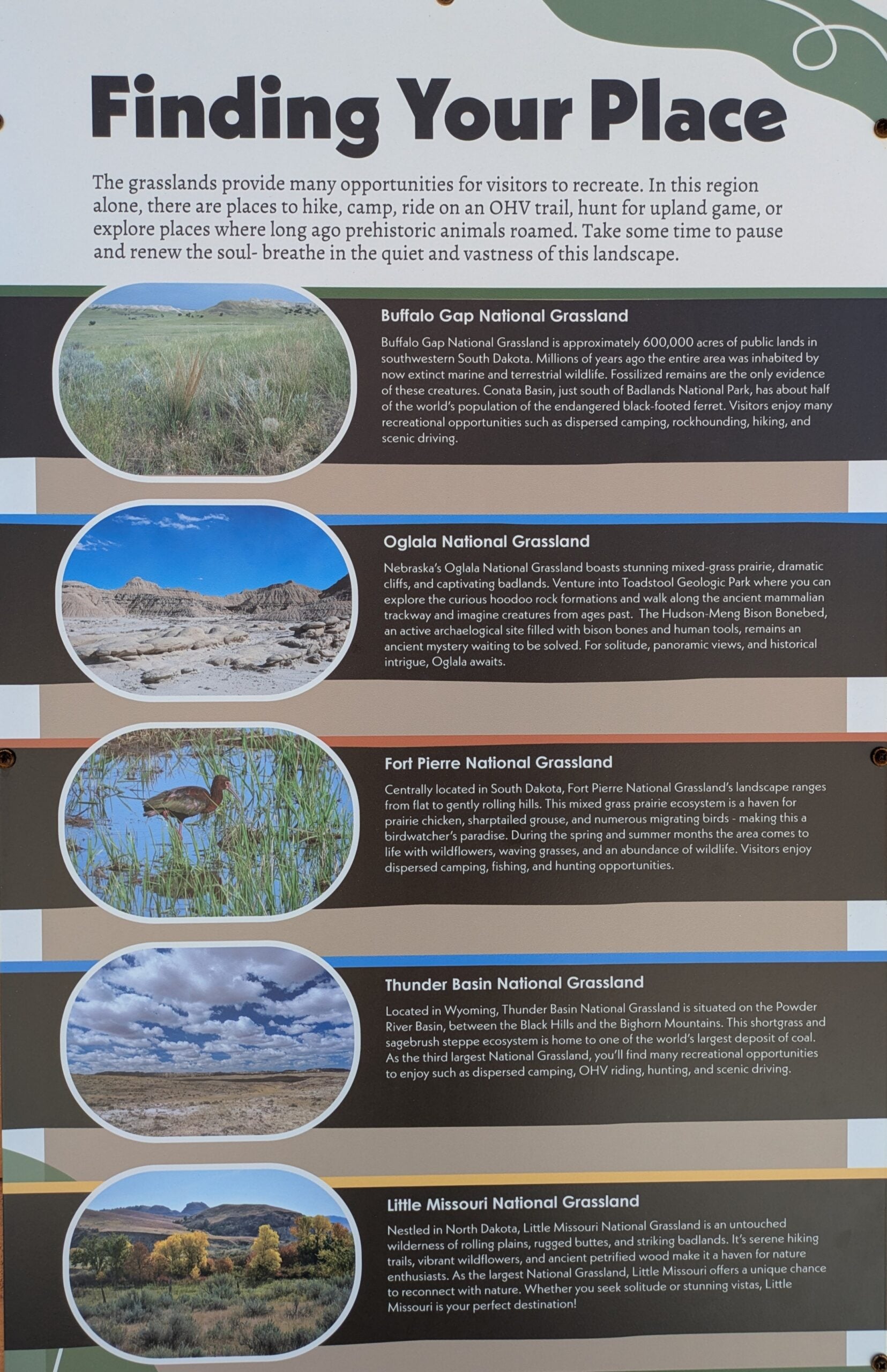
On my summer trip through the Dakotas, I stopped in Wall, South Dakota.
Most people know Wall for exactly one thing – Wall Drug. And yes, I stopped. And yes, it was terrible. It was so over-the-top, so relentlessly tacky, such a pure distillation of tourist trap that it looped all the way back around to awesome. It’s like Las Vegas – so trashy that you just have to respect it. I respect Wall Drug. It’s still terrible. It was exactly as Bill Bryson said in Lost Continent –
“It’s an awful place, one of the world’s worst tourist traps, but I loved it and I won’t have a word said against it.”
But! Wall, South Dakota has a much better reason to stop. It’s home to the National Grasslands Visitor Center.
America’s national grasslands are basically National Forests…but grasslands. They’re managed by the US Forest Service for multiple use – wildlife, recreation, grazing, scenery, and ecosystem services, but also mining, oil drilling, and gas production. They’re part of the National Forest System, which means they’re managed under a different mandate than most Bureau of Land Management land.
What really stood out at the visitor center was the scale. There are 20 national grasslands covering about 3.8 million acres. The biggest, Little Missouri in North Dakota, is over a million acres on its own – roughly the size of a typical National Forest.
And here’s the full list:
- Black Kettle National Grassland – Oklahoma & Texas
- Buffalo Gap National Grassland – South Dakota
- Butte Valley National Grassland – California
- Caddo National Grassland – Texas
- Cedar River National Grassland – North Dakota
- Cimarron National Grassland – Kansas
- Comanche National Grassland – Colorado
- Crooked River National Grassland – Oregon
- Curlew National Grassland – Idaho
- Fort Pierre National Grassland – South Dakota
- Grand River National Grassland – South Dakota
- Kiowa National Grassland – New Mexico
- Little Missouri National Grassland – North Dakota
- Lyndon B. Johnson National Grassland – Texas
- McClellan Creek National Grassland – Texas
- Oglala National Grassland – Nebraska
- Pawnee National Grassland – Colorado
- Rita Blanca National Grassland – Texas & Oklahoma
- Sheyenne National Grassland – North Dakota
- Thunder Basin National Grassland – Wyoming
The Forest Service also manages Midewin National Tallgrass Prairie in Illinois. It’s technically not a national grassland since it was created under different legislation, but it’s managed like one.
The other thing that surprised me was the diversity. I went in picturing a lot of very large fields. Instead, the grasslands include badlands, sand dunes, canyons, buttes, sagebrush, tallgrass prairie, and even a couple of Wild & Scenic Rivers in Oregon. They are much more unique than “a lot of grass.”
*Aside on why national grasslands exist. Most of them started as failed farms. During the Dust Bowl, the federal government bought back worn-out, blown-away farmland under the Bankhead-Jones Farm Tenant Act of 1937 and set to work restoring it. That land was handed over to the Forest Service in 1954 and officially designated as national grasslands in 1960. If you want the full, harrowing story of how that land got so wrecked in the first place, read The Worst Hard Time by Timothy Egan – here’s my review.
Compared to Wall Drug, the visitor center was refreshingly chill. Quiet, uncrowded, and genuinely interesting. If you’re driving I-90 or heading to Badlands National Park, it’s absolutely worth a stop.