The Society of the Spectacle by Guy Debord

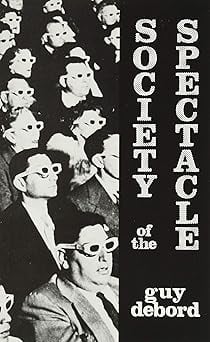
Guy Debord wrote The Society of the Spectacle in 1967. He was part of a cohort of media theorists — mostly French, though I’d throw Marshall McLuhan in there too — who looked at the world structure coming out of World War II and asked a genuinely interesting question: what happens when mass transportation and mass media exist at the same time?
The idea is that these two technologies — moving humans around the world and letting humans see anything, anywhere — would interact and define how our societies worked.
I grew up in school being told that these guys were ridiculous postmodern Marxist theorists who didn’t know what they were talking about.
But my goodness…they were actually right-on.
What the Book Actually Argues
Debord’s central argument is that the “spectacle” goes well beyond what most of us picture when we hear that word — the Super Bowl, the Olympics, a presidential election. He argues that any representation of the world that turns people into passive spectators qualifies.
And once you’re a spectator, authentic life gets replaced by a stream of images and media. Those images become commodities — things with exchange value rather than real, functional value. The bigger the spectacle gets, the more authentic life gets mediated, and the more everything just becomes a show to watch rather than something to actually engage with.
Here’s the part that stuck with me: there’s a self-reinforcing loop built into this. If you do engage, you just become part of the show — because everything is being mediated, everything you do has to be performative. Which leads to alienation. Which undercuts the whole point of the thing in the first place.
The Instagram Reel (and all ‘social media’) Is Just Distributed Television
The most clarifying idea in the book — even if Debord couldn’t have predicted the specific form it would take — is that social media is just media.
Instagram Reels, YouTube Shorts, TikToks, etc are distributed television. We don’t think of them that way because we associate broadcast television with the Super Bowl and a “silly Instagram reel” with someone goofing around in their backyard. But Debord would argue they’re the same thing. The moment there are spectators, and the moment the people in the world know they can be spectated, it becomes a spectacle by definition.
A blooper at the grocery store becomes a spectacle. A conversation between two friends becomes a podcast. A pickup basketball game becomes content. And once something becomes a spectacle, it can be commodified — which means the authentic part of the thing gets slowly drowned out.
The joke about the Super Bowl is that the ads have become more important than the game. The joke about the Olympics is that the celebrity drama matters more than the events. Those aren’t just jokes. That’s the mechanism Debord described in 1967.
Youth Sports Is the Clearest Example
I think you see this most clearly — and most depressingly — in youth sports.
When I was growing up, a youth sports league was a community thing. Your kids played. The adults stood around and chatted about the week. It was actual life.
Now, because youth sports has become a spectacle — not a Super Bowl spectacle, but a spectacle as Debord defined it, meaning it has spectators, whether that’s college scouts, social media strangers, or just a parent with an iPhone — it changes the nature of the thing. It’s no longer just a game. It’s a performance. And that shift is alienating in a way that’s hard to articulate but really easy to feel.
Being → Having → Appearing
This was my favorite insight in the book, and the most personally relatable.
Debord argues that human identity has shifted in stages. In agricultural and feudal societies, individuality was defined by being — who are you? I am the son of this person. I am the merchant in this town. I am the Duke of this land.
As industrial society took over, it shifted to having — where is your house? What do you own? What’s your position? Pierre Bourdieu mapped this out well: economic capital, cultural capital, credentials.
But Debord predicted — in 1967, before any of this existed — that it would shift again into a world defined by appearing. Not who you are, not what you have, but how you seem. How people perceive you. How you understand yourself in relation to spectators.
Good lord, is this true.
It’s not enough to be someone. It’s not enough to have something. What truly matters — in social currency, in politics, in everyday life — is how you appear. And that creates a very specific kind of conflict and anxiety that I think a lot of people feel but can’t quite name.
This book gives it a name.
Politics Is the Most Obvious Case
Politics has always involved spectacle — that’s not new. But there’s a version of American political history where things were different in degree.
Think about New England town halls, where you’d actually argue with your neighbors and figure things out together. Or a Congress where speeches were meant to persuade the people in the room — not to get clipped onto social media to enrage a different audience and raise money. Henry Clay wasn’t performing for a camera.
The shift from persuasion to performance is exactly what Debord was describing. And we’re living in the full-bloom version of it.
What I Liked
The book is short. Genuinely short. And it’s written in an aphoristic style — punchy, numbered theses — that I actually enjoyed. It moves fast for a work of French postmodern philosophy.
More than anything, it gave me a framework — a name for the unease a lot of us feel with what we call social media but is really just media. That’s not a small thing. Sometimes the most useful thing a book can do is put language around something you already knew was true.
What I Didn’t Like
It has all the problems of French postmodern philosophy. Debord is a full-on Marxist cultural critic, and that framework is woven into everything. You can’t fully separate the analysis from the ideology, and at times the jargon gets in the way.
My honest take: if you can hold the Marxist framework loosely — acknowledge it’s there, engage with the underlying observations, and not get too hung up on the scaffolding — you’ll get a lot more out of it.
The Bigger Takeaway
Debord apparently became pretty depressed when everyone dismissed his ideas. I get it. In 1967, a lot of this probably wasn’t obvious. In 2026, it reads like someone who just described the world with uncomfortable precision.
That’s why I keep coming back to books like this. The people who got the future right — really right — didn’t just make lucky guesses. They had a way of thinking about how technologies interact with human nature that let them extrapolate further than everyone else.
We’re still figuring out what smartphones have done to us. We’re even earlier in that process with AI. Reading Debord is a useful reminder that someone, somewhere, is probably writing that book right now — and most of us are going to dismiss it.
Highly recommended, with the caveat that you have to be willing to dig through some ideological underbrush to get to the good stuff.
Guy Debord wrote The Society of the Spectacle in 1967 and predicted — with uncomfortable accuracy — that modern life would shift from authentic experience to passive spectatorship, and that individual identity would move from being to having to simply appearing. It's a short, punchy read that puts a useful framework around the unease most of us feel about social media, politics, and youth sports without quite being able to name it.
- Short, aphoristic style makes it surprisingly readable for French postmodern philosophy
- The core framework — spectacle as passive spectatorship, commodification of authentic life, identity through appearance — feels like a precise diagnosis of 2026
- Gives language to something most people already feel but can't articulate
- Full-on Marxist framework is baked in and can't be fully separated from the analysis
- Jargon occasionally gets in the way
- The observations are so broad that concrete applications require work the book doesn't do for you