Soul Boom by Rainn Wilson

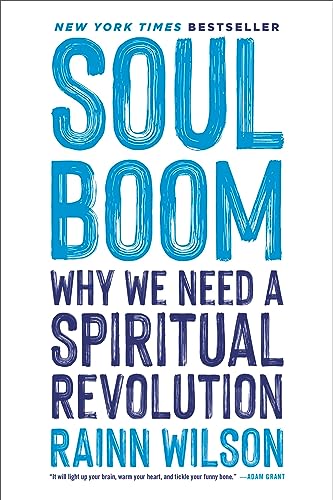
I stumbled across Rainn Wilson’s podcast Soul Boom the way I stumble across most things I didn’t know I was interested in — serendipitously. One episode led to another, and after just a few episodes I had a decent sense of what he’s been up to since The Office wrapped. The short version: he’s been on a genuine, years-long mission to make big philosophical and spiritual questions feel normal to talk about. Soul Boom is the book version of that mission.
What the Book Is About
Wilson’s central argument — his “soul boom” thesis — is that the world is experiencing a crisis of meaning, and that the antidote isn’t another political movement or productivity system. It’s a return to the kinds of deep personal questions that most of us quietly shelve: Why are we here? What do we owe each other? What does a good life actually look like?
He draws on his own spiritual journey, his Bahá’í faith, and a wide range of philosophical and religious traditions to make the case that these questions are worth asking out loud — and that more of us are hungry for that conversation than the internet’s current obsessions would suggest. He calls the people doing this work “Team Human,” a loose coalition of anyone trying to make the world a little more conscious and a little more compassionate.
It’s a genuinely worthwhile idea. And Wilson’s passion for it is completely authentic — this is clearly not a celebrity cash-grab book. The man has been doing this work for years, long before it was trendy.
What I Liked
Kudos to anyone willing to write a book like this. Philosophy, spirituality, and personal meaning are still surprisingly awkward topics in casual conversation. Wilson jumps in anyway, and he does it with humor and self-deprecation that keeps things from ever feeling preachy.
His “Team Human” framing is also genuinely useful — a way of talking about shared values across wildly different belief systems without flattening any of them.
What I Didn’t Like
Here’s the main downside part: Soul Boom reads exactly like a podcast episode. And not in a good way.
Wilson’s native format is audio and video — he’s relaxed, funny, and engaging when he’s just talking. But that oral style doesn’t fully translate to the page. The book feels loose in a way that a more tightly edited manuscript wouldn’t, and you’re left with the nagging sense that the content was written to be a book rather than because it needed to be a book.
Which raises the obvious question: if the book reads like a podcast, why not just listen to the podcast? You’ll probably get the same ideas, in the format they were designed for, for free.
The Verdict
If you’re already a fan of Wilson’s podcast or YouTube channel, there’s not a ton of new ground here. If you’re new to his work, the podcast is genuinely a better entry point.
That said — I’m glad I read it, and I’d have never picked it up through my usual channels. I grabbed it off the new arrivals shelf at the Fulton County Library on a whim, which turned out to be exactly the right way to find it. Sometimes the best thing you can do is step away from your systems and just see what’s there.
- Tackles personal philosophy and spirituality in an approachable, conversational way
- Wilson's passion for the project feels authentic, not celebrity-cash-grab
- Good entry point if you're new to his work and ideas
- Reads more like a transcribed podcast than a fully developed book
- The podcast or YouTube channel likely delivers the same content better in its native format
- Thin on substance for readers already familiar with these topics

When scholars of the positive psychology movement Christopher Peterson and Martin Seligman searched the major holy books and philosophical texts of humanity for universal virtues, one of the six they identified was transcendence. (The other five are wisdom, courage, love, temperance, and justice.) Those psychologists consider the basic human trait of transcendence to include the character strengths of spirituality (or sense of purpose), appreciation of beauty, gratitude, humor, and hope.
The yin to the yang of love is the Golden Rule, a simple yet profound teaching found in every religious tradition in the world.
Let’s look at a few:
AFRICAN TRADITION
One who is going to take a pointed stick to pinch a baby bird should first try it on himself to feel how it hurts.
-Yoruba proverb
BAHA’I FAITH
Lay not on any soul a load that you would not wish to be laid upon you, and desire not for anyone the things you would not desire for yourself.
-Baha’u’llah
BUDDHISM
Treat not others in ways that you yourself would find hurtful.
-The Buddha
CHRISTIANITY
In everything, do to others as you would have them do to you, for this is the law and the prophets.
-Jesus
CONFUCIANISM
One word which sums up the basis of all good conduct… loving-kindness. Do not do to others what you do not want done to yourself.
-Confucius
HINDUISM
This is the sum of duty: do not do to others what would cause pain if done to you.
-The Mahabharata
ISLAM
Not one of you truly believes until you wish for others what you wish for yourself.
-Muhammad
JAINISM
One should treat all creatures in the world as one would like to be treated.
-Mahavira, Sutrakritanga 1.11.33
JUDAISM
What is hateful to you, do not do to your neighbor. This is the whole Torah; all the rest is commentary. Go and learn it.
-Rabbi Hillel, the Talmud
SIKHISM
If thou desirest thy Beloved, then hurt thou not anyone’s heart.
-Guru Arjan Dev Ji 259, Guru Granth Sahib
TAOISM
Regard your neighbor’s gain as your own gain and your neighbor’s loss as your own loss.
-Lao-tzu
ZOROASTRIANISM
Do not do unto others whatever is injurious to yourself.
-Zoroaster
Neuroscientist Dr. Rachel Hopman of Northeastern Univer-sity has studied the neurological changes that happen to humans who have regular exposure to the outdoors. Among the benefits are improved neural functioning, enhanced cognition, and reduced stress and anxiety. In fact, time in nature lights up the same parts of the brain as regular meditation.
Hopman has gone so far as to propose a formula for time in nature to maximize these benefits. Her “nature pyramid,” like the food pyramid we all learned in elementary school, follows a 20-5-3 rule. It goes like this.
To maximize the neurological benefits of nature, humans must spend
- twenty minutes, three times a week outside doing something like a light stroll in a neighborhood park;
- five hours per month in semiwild nature like a forested state park;
- and three days once a year off the grid (the top of the pyramid!). camping, renting a cabin, being on a boat in the ocean-surrounded only by wild animals and zero cell reception.
But, dear reader, I blithely fabricate a religion on these here pages to prove a point. Although SoulBoom the Religion will never exist, there are some universal, foundational truths that religion addresses and that humanity is longing for: purpose, community, devotion, transcendence, and service.
Do you need an actual religion in your life in order to be connected to some of these spiritual ideas? Of course not.
But as humanity has thrown the good of spirituality out with the bad of religion, I think it’s time we look at all the ingredients that comprise the spiritual bedrock of an organized faith with fresh eyes. Hopefully this is the start of a much larger conversation.