Deep Tech by Pablos Holman

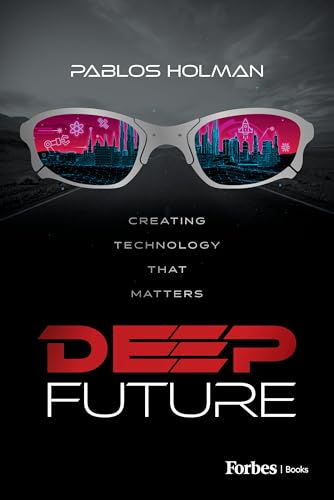
Deep Tech by Pablos Holman is a book by one of the most perennial hard tech entrepreneurs in America. Holman is known for his work at Blue Origin and Intellectual Ventures, and he currently runs a venture capital firm focused on what he calls “hard tech” — using technology to solve problems in the physical world rather than in the software or digital world that has been the focus of Silicon Valley for so long.
I picked this up because I’m interested in how technology is evolving and what the world might look like as we shift focus from apps and software back to solving actual physical problems.
What I Liked
The book gives deep insight into the real possibilities of technology beyond the digital realm. Holman makes a compelling case for why hard tech matters and provides clear parameters on why solving problems in the physical world is genuinely difficult. Technology constrained by physics, materials science, and thermodynamics requires more capital, more labor, and more expertise than building another social media app.
The examples around energy production and transportation were truly interesting. Holman shows how many problems we obsess over — like waste generation and carbon emissions — can become non-problems when we solve the upstream issue with better technology. Instead of managing waste better or optimizing carbon capture, we could potentially eliminate the waste or emissions entirely with fundamentally different energy and transportation systems.
It’s a fast read and well-written. Holman knows how to explain complex technical concepts without drowning you in jargon.
At minimum, the book provides genuine optimism to counter the constant deluge of doomscrolling and awful news. There are real people working on real solutions to real problems, and they’re making progress.
What I Did Not Like
Holman spends a good bit of time on his own background and accomplishments. While some context is useful, the book does read at times like it’s trying to generate buzz — both to attract people with interesting ideas who need investment and to attract investors who want to contribute to a venture capital fund doing something different.
I’m not in either of those camps. I’m just someone interested in the technology itself and where things are headed. The pitch elements felt unnecessary and sometimes got in the way of the more interesting content about the actual technology and problems being solved.
- Clear explanation of why hard tech requires more capital, labor, and expertise than software
- Interesting examples of how better technology can make current problems obsolete
- Fast read that provides genuine optimism about technological progress
- Spends too much time on author's background and accomplishments
- Reads at times like a VC fundraising pitch
- More suited for potential entrepreneurs/investors than general readers interested in technology

Quotes
The models we form in our brains are what got us here. They are beautiful and miraculous. They’re all unique and often good for different things. When humans trust incomplete models, we call it superstition. When humans use excellent models they can’t explain, we call it intuition.
This is the secret behind every successful software company in the last couple of decades. They could build faster than their obsoleted competition could imagine. They could try everything and throw out what didn’t work. If you take one thing away from this book, please understand that nobody is smart enough to guess what will be successful in the future. In business, in government, in life, we need to run a lot of experiments and throw out what doesn’t work
This is a (nuclear fuel) stockpile in Paducah, Kentucky. Over 700,000 metric tons of depleted uranium, left over from making reactors and from making bombs. We’ve been saving it for our grandkids, who I’m hopeful will be smarter than we are. In this one stockpile, there is enough energy to power the en-tire planet, including growth, for about the next thousand years. We don’t even need to mine uranium. There are similar stockpiles in Russia and China, too.
As any European can tell you, Americans can be the most arrogant and condescending people on Earth. We certainly aren’t trying to prove them wrong, and our egotistical vibes are turning people against us all over the world. Western Europe, however, offers a variety of snooty, thousand-year-old cultures, each with its own superiority complex. They all think they’re the best at what counts, and not just at soccer. There is no culture of importing a foreign ex-pert from anywhere to Italy, Spain, France, or Germany. Their descent on the economic leaderboard can be read as a cautionary tale of what happens when you become too conceited to learn from others.
The sad truth is that they’re right about Americans. If the US is so special, why can’t we learn to make faster trains than China? Why can’t our cities be clean like Tokyo, safe like Dubai, friendly like Riyadh? We should be trying to learn from the rest of the world, too. Saudi Arabia and the United Arab Emirates have figured out that the world is like one big soccer league. They’re on a massive shopping spree for the best people, the best ideas, and the best technologies from around the world to build their future. Even the best soccer players.
Change happens, inevitably. We can slow it down or stop it temporarily, but eventually, things will break and change is forced. This cycle is happening all around us, all the time. You can see it when seemingly impenetrable power structures fall apart. With 195 countries on the planet, there are al-most always a couple in the midst of col-lapse. Since 2000, over half the Fortune 500 companies have either ceased to exist, been acquired, or gone bankrupt. People crave predictability and safety, but that doesn’t mean they are going to get it.
Get Posts Automagically
…also via RSS or Fediverse – just copy link & paste in your favorite reader :)