Behave by Robert Sapolsky

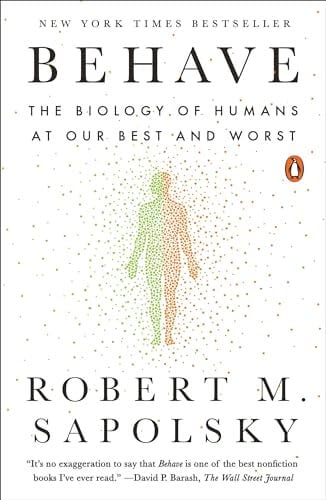
I picked up Behave out of frustration.
The popular discourse around brain chemistry had gotten to be too much. Dopamine does this. Serotonin does that. Endorphins are the wonder chemical. Every week there’s a new headline confidently explaining human behavior through a single neurotransmitter, and after a while, none of it quite adds up.
I wanted a scientist — a real one, who could also actually write — to explain what we actually know about the brain, how we know it, and what it means for the way we behave every day.
Behave is that book.
The Framework
What makes Behave work where so many neuroscience books fail is the structure. Sapolsky starts at the exact split second a behavior is triggered and then backs out — one time horizon at a time. What happened in the brain one second before that action? One minute before? One hour? One year? One lifetime? One evolutionary epoch?
It sounds simple, but it’s genuinely revelatory. Instead of a list of brain facts, you get a layered understanding of why — and more importantly, how many different kinds of why there are for any single human action.
The Layers Keep Going
The further you go into the book, the clearer it becomes that the brain doesn’t resolve into something tidy. The base layer — pure neuroscience — is almost the easy part. Across all mammals, the basic structures are similar enough that you can trace action in the amygdala to fear, or activity in the prefrontal cortex to long-term planning. You can see it in humans. You can see it in animals.
One detail that genuinely stopped me was von Economo neurons — a specific type of neuron found in mammals with a high capacity for social behavior. The wild thing is that they appear across completely unrelated species: whales, dolphins, orangutans, chimps, baboons. Species that share almost nothing else. Every time I’ve been to Zoo Atlanta and locked eyes with one of the orangutans, I’ve had this feeling that something is going on behind those eyes. Turns out there’s a structural reason for that feeling.
But the neuroscience is just the foundation. Above it sits cognitive science — how does consciousness and a sense of self emerge out of neurons firing? Then psychology — what do we do with the strange loops and stories and memories that the brain constructs? JBS Haldane once wrote that the universe is not only stranger than we suppose, but stranger than we can suppose. The more Sapolsky unpacks how the brain works, the more that quote feels like an understatement.
The Free Will Question
Sapolsky takes on the free will debate and does something I didn’t expect: he essentially dissolves it. He doesn’t argue one side or the other. He reframes the whole thing as a constructed debate — a question built on assumptions that the neuroscience itself doesn’t support. It’s one of the most intellectually satisfying moves in the book, and it’s worth the read for that section alone.
What I Liked
The framework is the big one. The “back out through time” structure isn’t just a clever organizing device — it actually changes how you think about behavior after you’ve read it.
Beyond that, the book is written in plain language with real stories and examples throughout. It’s long, but it’s a genuine page-turner. I read it at roughly half my normal pace because I kept stopping to make notes.
And the book is written by someone who has spent a career actually doing the science — not a science communicator packaging other people’s work. That comes through on every page. There’s a real difference between a book that explains neuroscience and a book written by someone who does neuroscience and is generous enough to let you in on it.
What I Didn’t Like
Honestly, not much. When you read a great nonfiction book about a hard topic, what it really does is remind you how rare it is — that most books on complex subjects either oversimplify into something useless or bury you in jargon until you give up. Behave does neither.
Bottom Line
If you’re a curious non-scientist who wants to understand how the brain actually creates behavior — not a pop-science summary, but the real, current, complicated state of the science — Behave is the book to read. Highly recommended.
- Brilliant "back out through time" framework makes complex neuroscience genuinely accessible
- Written by a real expert, not a science communicator — the depth shows on every page
- Dissolves the free will debate rather than picking a side, which is far more satisfying
- It's a long, note-taking kind of read — not a quick skim
- The layered brain science (neuroscience → cognitive science → psychology) can lose its thread without careful reading

Quotes
The amygdala isn’t about the pleasure of experiencing pleasure. It’s about the uncertain, unsettled yearning for a potential pleasure, the anxiety and fear and anger that the reward may be smaller than anticipated, or may not even happen. It’s about how many of our pleasures and our pursuits of them contain a corrosive vein of dis-ease.
p. 40 – on the amygdala’s core function with the hippocampus
Disgust of all stripes. The amygdala also receives a hugely interesting projection from the “insular cortex,” an honorary part of the prefrontal cortex, which we will consider at length in later chapters. If you (or any other mammal) bite into rancid food, the insular cortex lights up, causing you to spit it out, gag, feel nauseated, make a revolted facial expression-the insular cortex processes gustatory disgust. Ditto for disgusting smells.
Remarkably, humans also activate it by thinking about something morally disgusting-social norm violations or individuals who are typi-cally stigmatized in society. And in that circumstance its activation drives that of the amygdala. Someone does something lousy and selfish to you in a game, and the extent of insular and amygdaloid activation predicts how much outrage you feel and how much revenge you take. This is all about sociality-the insula and amygdala don’t activate if it’s a computer that has stabbed you in the back.
The insula activates when we eat a cockroach or imagine doing so. And the insula and amygdala activate when we think of the neighboring tribe.p. 41 on the insular cortex talking with the amygdala
Thus, fear and violence are not always connected at the hip. But a connection is likely when the aggression evoked is reactive, frenzied, and flecked with spittle. In a world in which no amygdaloid neuron need be afraid and instead can sit under its vine and fig tree, the world is very likely to be a more peaceful place.
p. 44 on the amygdala, fear, and violence
What does the frontal cortex do? Its list of expertise includes working memory, executive function (organizing knowledge strategically, and then initiating an action based on an executive decision), gratification postpone-ment, long-term planning, regulation of emotions, and reining in impul-sivity.
This is a sprawling portfolio. I will group these varied functions under a single definition, pertinent to every page of this book: the frontal cortex makes you do the harder thing when it’s the right thing to do.p. 45 on the frontal cortex
The sole exception is an obscure type of neuron with a distinctive shape and pattern of wiring, called von Economo neurons (aka spindle neurons). At first they seemed to be unique to humans, but we’ve now found them in other primates, whales, dolphins, and elephants. That’s an all-star team of socially complex species.
p. 46 on neurons for sociality
So the frontal cortex is awash in Calvinist self-discipline, a superes with its nose to the grindstone. But as an important qualifier, soon after we’re potty-trained, doing the harder thing with our bladder muscle becomes automatic. Likewise with other initially demanding frontal tasks. For example, you’re learning a piece of music on the piano, there’s a difficult trill, and each time as you approach it, you think, “Here is comes. Remember, tuck my elbow in, lead with my thumb.” A classic working-memory task. And then one day you realize that you’re five mes sures past the trill, it went fine, and you didn’t have to think about it. And that’s when doing the trill is transferred from the frontal cortex to more reflexive brain regions (e.g., the cerebellum). This transition to automa ticity also happens when you get good at a sport, when metaphorically your body knows what to do without your thinking about it.
The chapter on morality considers automaticity in a more important realm. Is resisting lying a demanding task for your frontal cortex, or is it effortless habit? As we’ll see, honesty often comes more easily thanks to automaticity. This helps explain the answer typically given after someone has been profoundly brave. “What were you thinking when you dove into the river to save that drowning child?” “I wasn’t thinking-before I knew it, I had jumped in.” Often the neurobiology of automaticity mediates doing the hardest moral acts, while the neurobiology of the frontal cortex mediates working hard on a term paper about the subject.p. 50 on the frontal cortex requires lots of energy, but only for habit building
What are the effects of vmPFC damage? Lots of things remain normal-intelligence, working memory, making estimates. Individuals can “do the harder thing” with purely cognitive frontal tasks (e.g., puzzles where you have to give up a step of progress in order to gain two more).
The differences appear when it comes to making social/emotional decisions-vmPFC patients just can’t decide. They understand the op-tions and can sagely advise someone else in similar circumstances. But the closer to home and the more emotional the scenario, the more they have problems.
Damasio has produced an influential theory about emotion-laden decision making, rooted in the philosophies of Hume and William James; this will soon be discussed. Briefly, the frontal cortex runs “as if experiments of gut feelings-“How would I feel if this outcome o curred?” and makes choices with the answer in mind. Damaging the vmPFC, thus removing limbic input to the PFC, eliminates gut feelings, making decisions harder.
Moreover, eventual decisions are highly utilitarian. vmPFC patients are atypically willing to sacrifice one person, including a family member, to save five strangers. They’re more interested in outcomes than in their underlying emotional motives, punishing someone who accidentally kills but not one who tried to kill but failed, because, after all, no one died in the second case.
It’s Mr. Spock, running on only the dIPFC. Now for a crucial point. People who dichotomize between thought and emotion often prefer the former, viewing emotion as suspect. It gums up decision making by get-ting sentimental, sings too loudly, dresses flamboyantly, has unsettling amounts of armpit hair. In this view, get rid of the vmPFC, and we’d be more rational and function better.
But that’s not the case, as emphasized eloquently by Damasio. People with vmPFC damage not only have trouble making decisions but also make bad ones. They show poor judgment in choosing friends and part-ners and don’t shift behavior based on negative feedback. For example, consider a gambling task where reward rates for various strategies change without subjects knowing it, and subjects can shift their play strategy. Control subjects shift optimally, even if they can’t verbalize how reward rates have changed. Those with vmPFC damage don’t, even when they can verbalize. Without a vmPFC, you may know the meaning of negative feedback, but you don’t know the feeling of it in your gut and thus don’t shift behavior.p. 56 on how there is no emotion vs thinking – they work together to be actually effective
In other words, dopamine is not about the happiness of reward. It’s about the happiness of pursuit of reward that has a decent chance of occurring.
p. 74 on dopamine
We do something even beyond this unprecedented gratification delay: we use the dopaminergic power of the happiness of pursuit to motivate us to work for rewards that come after we are dead-depending on your culture, this can be knowing that your nation is closer to winning a war because you’ve sacrificed yourself in battle, that your kids will inherit money be cause of your financial sacrifices, or that you will spend eternity in para dise. It is extraordinary neural circuitry that bucks temporal discounting enough to allow (some of) us to care about the temperature of the planet that our great-grandchildren will inherit. Basically, it’s unknown how we humans do this. We may merely be a type of animal, mammal, primate, and ape, but we’re a profoundly unique one.
p. 76 on hacking dopamine to an extreme
A final point related to the core of this book: While this neurobiology is mighty impressive, the brain is not where a behavior “begins.” It’s merely the final common pathway by which all the factors in the chapters to come converge and create behavior….
…it should not require neuroscience to validate someone’s internal state…or take neuroscience to “prove” what we think and feel…there is no tacit dualism in neuroscience – you can’t only refer to it when you want to have a “biological” explanation – all brain actions in everyone are “biological”
p. 80 on myths around biology
To brain operates in a vacuum, and over the course of seconds to N minutes, the wealth of information streaming into the brain influ-ences the likelihood of pro- or antisocial acts. As we’ve seen, pertinent information ranges from something as simple and unidimensional as shirt color to things as complex and subtle as cues about ideology. Moreover, the brain also constantly receives interoceptive information. And most important, much of these varied types of information is subliminal. Ulti-mately, the most important point of this chapter is that in the moments just before we decide upon some of our most consequential acts, we are less rational and autonomous decision makers than we like to think.
p. 98 on subconscious influences
Additional studies show that testosterone promotes prosociality in the right setting. In one, under circumstances where someone’s sense of pride rides on honesty, testosterone decreased men’s cheating in a game. In another, subjects decided how much of a sum of money they would keep and how much they would publicly contribute to a common pool shared by all the players; testosterone made most subjects more prosocial. 21
What does this mean? Testosterone makes us more willing to do what it takes to attain and maintain status. And the key point is what it takes. Engineer social circumstances right, and boosting testosterone levels during a challenge would make people compete like crazy to do the most acts of random kindness. In our world riddled with male violence, the problem isn’t that testosterone can increase levels of aggression. The problem is the frequency with which we reward aggression.p. 107 on testosterone
Mobilizing energy while sprinting for your life helps save you. Do the same thing chronically because of a stressful thirty-year mortgage, and you’re at risk for various metabolic problems, including adult-onset diabe-tes. Likewise with blood pressure: increase it to sprint across the savanna-good thing. Increase it because of chronic psychological stress, and you’ve got stress-induced hypertension. Chronically impair growth and tissue repair, and you’ll pay the price. Ditto for chronically inhibiting reproductive physiology; you’ll disrupt ovulatory cycles in women and cause plummeting erections and testosterone levels in men. Finally, while the acute stress response involves enhanced immunity, chronic stress sup-presses immunity, increasing vulnerability to some infectious diseases.
We have a dichotomy-if you’re stressed like a normal mammal in an acute physical crisis, the stress response is lifesaving. But if instead you chronically activate the stress response for reasons of psychological stress, your health suffers. It is a rare human who sickens because they can’t ac-tivate the stress response when it is needed. Instead, we get sick from activating the stress response too often, too long, and for purely psycho-logical reasons. Crucially, the beneficial effects of the stress response for sprinting zebras and lions play out over the course of seconds to minutes. But once you take stress to the time course of this chapter (henceforth referred to as “sustained” stress), you’ll be dealing with adverse conse-quences. Including some unwelcome effects on the behaviors that fill this book.
Either running from a lion or dealing with years of traffic jams is a drag. Which contrasts with stress that we love. 58 We love stress that is mild and transient and occurs in a benevolent
context. The stressful menace of a roller-coaster ride is that it will make us queasy, not that it will decapitate us; it lasts for three minutes, not three days. We love that kind of stress, clamor for it, pay to experience it. What do we call that optimal amount of stress? Being engaged, engrossed, and challenged. Being stimulated. Playing. The core of psychological stress is loss of control and predictability. But in benevolent settings we happily relinquish control and predictability to be challenged by the unexpected-a dip in the roller-coaster tracks, a plot twist, a difficult line drive heading our way, an opponent’s unexpected chess move. Sur-prise me-this is fun.
This brings up a key concept, namely the inverted U. The com-plete absence of stress is aversively boring. Moderate, transient stress is wonderful-various aspects of brain function are enhanced; glucocorti-coid levels in that range enhance dopamine release; rats work at pressing levers in order to be infused with just the right amount of glucocorticoids.p. 127 on stress
Hormones are great; they run circles around neurotransmitters, in terms of the versatility and duration of their effects. And this in-cludes affecting the behaviors pertinent to this book.
Testosterone has far less to do with aggression than most assume. Within the normal range, individual differences in testosterone levels don’t predict who will be aggressive. Moreover, the more an organism has been aggressive, the less testosterone is needed for future aggression. When testosterone does play a role, it’s facilitatory testosterone does not “invent” aggression. It makes us more sensitive to triggers of aggression, particularly in those most prone to aggression. Also, rising testosterone levels foster ag-gression only during challenges to status. Finally, crucially, the rise in testosterone during a status challenge does not necessarily in-crease aggression; it increases whatever is needed to maintain sta-tus. In a world in which status is awarded for the best of our behaviors, testosterone would be the most prosocial hormone in existence.
Oxytocin and vasopressin facilitate mother-infant bond formation and monogamous pair-bonding, decrease anxiety and stress, en-hance trust and social affiliation, and make people more coopera-tive and generous. rous. But this comes with a huge caveat-these hormones increase prosociality only toward an Us. When dealing with Thems, they make us more ethnocentric and xenophobic. Oxytocin is not a universal luv hormone. It’s a parochial one.
Female aggression in defense of offspring is typically adaptive and is facilitated by estrogen, progesterone, and oxytocin. Importantly, females are aggressive in many other evolutionarily adaptive cir-cumstances. Such aggression is facilitated by the presence of an-drogens in females and by complex neuroendocrine tricks for generating androgenic signals in “aggressive,” but not “maternal” or “affiliative,” parts of the female brain. Mood and behavioral changes around the time of menses are a biological reality (albeit poorly understood on a nuts-and-bolts level); in contrast, patholo-gizing these shifts is a social construct. Finally, except for rare, extreme cases, the link between PMS and aggression is minimal.
Sustained stress has numerous adverse effects. The amygdala becomes overactive and more coupled to pathways of habitual be-havior; it is easier to learn fear and harder to unlearn it. We process emotionally salient information more rapidly and automatically, but with less accuracy. Frontal function-working memory, im-pulse control, executive decision making, risk assessment, and task shifting is impaired, and the frontal cortex has less control over the amygdala. And we become less empathic and prosocial. Reduc-ing sustained stress is a win-win for us and those stuck around us.
“I’d been drinking” is no excuse for aggression.
Over the course of minutes to hours, hormonal effects are predom-inantly contingent and facilitative. Hormones don’t determine, command, cause, or invent behaviors. Instead they make us more sensitive to the social triggers of emotionally laden behaviors and exaggerate our preexisting tendencies in those domains. And where do those preexisting tendencies come from? From the con-tents of the chapters ahead of us.p. 136 on the summary of hormones
Manipulating neuroplasticity for recovery of function does have enor-mous, exciting potential in neurology. But this domain is far from the concerns of this book. Despite neuroplasticity’s potential, it’s unlikely that we’ll ever be able to, say, spritz neuronal growth factors up people’s noses to make them more open-minded or empathic, or to target neuro-plasticity with gene therapy to blunt some jerk’s tendency to displace aggression.
So what’s the subject good for in the realm of this book? I think the benefits are mostly psychological. This recalls a point from chapter 2, in the discussion of the neuroimaging studies demonstrating loss of volume in the hippocampus of people with PTSD (certainly an example of the adverse effects of neuroplasticity). I sniped that it was ridiculous that many legislators needed pictures of the brain to believe that there was something desperately, organically wrong with veterans with PTSD.
Similarly, neuroplasticity makes the functional malleability of the brain tangible, makes it “scientifically demonstrated” that brains change. That people change. In the time span considered in this chapter, people throughout the Arab world went from being voiceless to toppling tyrants; Rosa Parks went from victim to catalyst, Sadat and Begin from enemies to architects of peace, Mandela from prisoner to statesman. And you’d better bet that changes along the lines of those presented in this chapter occurred in the brains of anyone transformed by these transformations. A different world makes for a different worldview, which means a different brain. And the more tangible and real the neurobiology underlying such change seems, the easier it is to imagine that it can happen again.p. 153 on neuroplasticity
and extended to various cultures).” First is authoritative parenting. Rules and expectations are clear, consistent, and explicable “Because I said so” is anathema-with room for flexibility; praise and forgiveness trump punishment; parents welcome children’s input; developing children’s po-tential and autonomy is paramount. By the standards of the educated neurotics who would read (let alone write…) this book, this produces a good adult outcome-happy, emotionally and socially mature and ful-filled, independent and self-reliant.
Next is authoritarian parenting. Rules and demands are numerous, arbitrary, and rigid and need no justification; behavior is mostly shaped by punishment; children’s emotional needs are low priorities. Parental motivation is often that it’s a tough, unforgiving world and kids better be prepared. Authoritarian parenting tends to produce adults who may be narrowly successful, obedient, conformist (often with an undercurrent of resentment that can explode), and not particularly happy. Moreover, so-cial skills are often poor because, instead of learning by experience, they grew up following orders.
And then there is permissive parenting, the aberration that supposedly let Boomers invent the 1960s. There are few demands or expectations, rules are rarely enforced, and children set the agenda. Adult outcome: self-indulgent individuals with poor impulse control, low frustration toler-ance, plus poor social skills thanks to living consequence-free childhoods.
Baumrind’s trio was expanded by Stanford psychologists Eleanor Maccoby and John Martin to include neglectful parenting.” This addition produces a two-by-two matrix: parenting is authoritative (high demand, high responsiveness), authoritarian (high demand, low responsiveness), permissive (low demand, high responsiveness), or neglectful (low de-mand, low responsiveness).
Importantly, each style usually produces adults with that same approach, with different cultures valuing different styles.
p. 203 on parenting styles
But none of this is truly amazing. Because things must work these ways. While little in childhood determines an adult behavior, virtually everything in childhood changes propensities toward some adult behav ior. Freud, Bowlby, Harlow, Meaney, from their differing perspectives, all make the same fundamental and once-revolutionary point: childhood matters. All that the likes of growth factors, on/off switches, and rates of myelination do is provide insights into the innards of that fact.
Such insight is plenty useful. It shows the steps linking childhood point A to adult point Z. It shows how parents can produce offspring whose behaviors resemble their own. It identifies Achilles’ heels that ex plain how childhood adversity can make for damaged and damaging adults. And it hints at how bad outcomes might be reversed and good outcomes reinforced.
There is another use. In chapter 2 1 recounted how it required the demonstration of hippocampal volume loss in combat vets with PTSD to finally convince many in power that the disorder is “real.” Similarly, it shouldn’t require molecular geneties or neuroendocrinology factoids to prove that childhood matters and thus that it profoundly matters to pro-vide childhoods filled with good health and safety, love and nurturance and opportunity. But insofar as it seems to require precisely that sort of scientific validation at times, more power to those factoids.p. 222 on effects of childhood
a. Genes are not autonomous agents commanding biological events.
b. Instead, genes are regulated by the environment, with “environ-ment” consisting of everything from events inside the cell to the universe.
c. Much of your DNA turns environmental influences into gene tran-scription, rather than coding for genes themselves; moreover, evo-lution is heavily about changing regulation of gene transcription, rather than genes themselves.
d. Epigenetics can allow environmental effects to be lifelong, or even multigenerational.
e. And thanks to transposons, neurons contain a mosaic of different genomes.
In other words, genes don’t determine much. This theme continue we focus on the effects of genes on behavior.
p. 233 on genes
This sug gests a radical conclusion: it’s not meaningful to ask what a gene does, just what it does in a particular environment. This is summarized wonderfully by the neurobiologist Donald Hebb: “It is no more appropriate to say things like characteristic A is more influenced by nature than nutture than… to say that the area of a rectangle is more influenced by its length than its width.” It’s appropriate to figure out if lengths or widths explain more of the variability in a population of rectangles. But not in individ. ual ones.
As we conclude part 2 of this chapter, some key points:
a. A gene’s influence on the average value of a trait (i.c., whether it is inherited) differs from its influence on variability of that trait across individuals (its heritability).
b. Even in the realm of inherited traits-say, the inheritance of five fingers as the human average you can’t really say that there is genetic determination in the classically hard-assed sense of the word. This is because the inheritance of a gene’s effect requires not just passing on the gene but also the context that regulates the gene in that manner.c. Heritability scores are relevant only to the environments in which the traits have been studied. The more environments you study a trait in, the lower the heritability is likely to be.
d. Gene/environment interactions are ubiquitous and can be dra-matic. Thus, you can’t really say what a gene “does,” only what it does in the environments in which it’s been studied.
Current research actively explores gene/environment interactions.” How’s this for fascinating: Heritability of various aspects of cognitive de-velopment is very high (e.g., around 70 percent for IQ) in kids from high-socioeconomic starus (SES) families but is only around 10 percent in low-SES kids. Thus, higher SES allows the full range of genetic influ-ences on cognition to flourish, whereas lower-SES settings restrict them. In other words, genes are nearly irrelevant to cognitive development if you’re growing up in awful poverty-poverty’s adverse effects trump the genetics. Similarly, heritability of alcohol use is lower among religious than nonreligious subjects-i.e., your genes don’t matter much if you’re in a religious environment that condemns drinking. Domains like these showcase the potential power of classical behavior genetics.p. 248 on gene & environment interaction
partial list.
For the purposes of this chapter, the staggeringly large cultural differ ences in how life is experienced, in resources and privileges available, in opportunities and trajectories, are most interesting. Just to start with some breathtaking demographic statistics born of cultural differences a girl born in Monaco has a ninety-three-year life expectancy; one in An gola, thirty-nine. Latvia has 99.9 percent literacy; Niger, 19 percent. More than 10 percent of children in Afghanistan die in their first year, about 0.2 percent in Iceland. Per-capita GDP is $137,000 in Qatar, $609 in the Cen tral African Republic. A woman in South Sudan is roughly a thousand times more likely to die in childbirth than a woman in Estonia.
The experience of violence also varies enormously by culture. Some-one in Honduras is 450 times more likely to be murdered than someone in Singapore. 65 percent of women experience intimate-partner violence in Central Africa, 16 percent in East Asia. A South African woman is more than one hundred times more likely to be raped than one in Japan. Bea school kid in Romania, Bulgaria, or Ukraine, and you’re about ten times more likely to be chronically bullied than a kid in Sweden, Iceland, or Denmark (stay tuned for a closer look at this).10
Of course, there are the well-known gender-related cultural differ-ences. There are the Scandinavian countries approaching total gender equality and Rwanda, with 63 percent of its lower-house parliamentary seats filled by women, compared with Saudi Arabia, where women are not allowed outside the house unless accompanied by a male guardian, and Yemen, Qatar, and Tonga, with 0 percent female legislators (and with the United States running around 20 percent).”
Then there’s the Philippines, where 93 percent of people say they feel happy and loved, versus 29 percent of Armenians. In economic games, people in Greece and Oman are more likely to spend resources to punish overly generous players than to punish those who are cheaters, whereas among Australians such “antisocial punishment” is nonexistent. And there are wildly different criteria for prosocial behavior. In a study of em-ployees throughout the world working for the same multinational bank, what was the most important reason cited to help someone? Among Americans it was that the person had previously helped them; for Chi-nese it was that the person was higher ranking; in Spain, that they were a friend or acquaintance. 12
Your life will be unrecognizably different, depending on which cul-ture the stork deposited you into. In wading through this variability, there are some pertinent patterns, contrasts, and dichotomies.p. 272 on culture and it’s influence
Why should people in one part of the globe have developed collectiv-ist cultures, while others went individualist? The United States is the in-dividualism poster child for at least two reasons. First there’s immigration. Currently, 12 percent of Americans are immigrants, another 12 percent are (like me) children of immigrants, and everyone else except for the 0.9 percent pure Native Americans descend from people who emigrated within the last five hundred years. 20 And who were the immigrants? Those in the settled world who were cranks, malcontents, restless, hereti-cal, black sheep, hyperactive, hypomanic, misanthropic, itchy, unconven-tional, yearning to be free, yearning to be rich, yearning to be out of their damn boring repressive little hamlet, yearning. Couple that with the sec-ond reason for the majority of its colonial and independent history, America has had a moving frontier luring those whose extreme prickly optimism made merely booking passage to the New World insufficiently novel-and you’ve got America the individualistic.
p. 277 on US culture and individualism
. Social cap ital is the collective quantity of resources such as trust, reciprocity, and cooperation. You learn a ton about a community’s social capital with two simple questions. First: “Can people usually be trusted?” A community in which most people answer yes is one with fewer locks, with people watching out for one another’s kids and intervening in situations where one could easily look away. The second question is how many organiza tions someone participates in-from the purely recreational (e.g., a bowl ing league) to the vital (e.g., unions, tenant groups, co-op banks). A community with high levels of such participation is one where people feel efficacious, where institutions work transparently enough that people believe they can effect change. People who feel helpless don’t join orga-nizations.
Put simply, cultures with more income inequality have less social cap-ital. 35 Trust requires reciprocity, and reciprocity requires equality, whereas hierarchy is about domination and asymmetry. Moreover, a culture highly unequal in material resources is almost always also unequal in the ability to pull the strings of power, to have efficacy, to be visible. (For example, as income inequality grows, the percentage of people who bother voting generally declines.) Almost by definition, you can’t have a society with both dramatic income inequality and plentiful social capital. Or trans-lated from social science-ese, marked inequality makes people crummier to one another.
p. 293 on income inequality and social capital
Thus unequal cultures make people less kind. Inequality also makes people less healthy. This helps explain a hugely important phenomenon in public health, namely the “socioeconomic status (SES)/health gradi-ent” as noted, in culture after culture, the poorer you are, the worse your health, the higher the incidence and impact of numerous diseases, and the shorter your life expectancy.38
Extensive research has examined the SES/health gradient. Four quick rule-outs: (a) The gradient isn’t due to poor health driving down people’s SES. Instead low SES, beginning in childhood, predicts subsequent poor health in adulthood. (b) It’s not that the poor have lousy health and every-one else is equally healthy. Instead, for every step down the SES ladder, starting from the top, average health worsens. (c) The gradient isn’t due to less health-care access for the poor; it occurs in countries with universal health care, is unrelated to utilization of health-care systems, and occurs for diseases unrelated to health-care access (e.g., juvenile diabetes, where having five checkups a day wouldn’t change its incidence). (d) Only about a third of the gradient is explained by lower SES equaling more health risk factors (e.g., lead in your water, nearby toxic waste dump, more smok-ing and drinking) and fewer protective factors (e.g., everything from bet-ter mattresses for overworked backs to health club memberships).
What then is the principal cause of the gradient? Key work by Nancy Adler at UCSF showed that it’s not so much being poor that predicts poor health. It’s feeling poor-someone’s subjective SES (e.g., the answer to “How do you feel you’re doing financially when you compare yourself with other people?”) is at least as good a predictor of health as is objec tive SES.
Crucial work by the social epidemiologist Richard Wilkinson of the University of Nottingham added to this picture: it’s not so much that pov-erty predicts poor health; it’s poverty amid plenty-income inequality. The surest way to make someone feel poor is to rub their nose in what they don’t have….Why does income inequality lead to more crime? Again, there’s the psychosocial angle-inequality means less social capital, less trust, coop-eration, and people watching out for one another. And there’s the neoma-terialist angle inequality means more secession of the wealthy from contributing to the public good. Kaplan has shown, for example, that states with more income inequality spend proportionately less money on that key crime-fighting tool, education. As with inequality and health, the psychosocial and neomaterial routes synergize.
A final depressing point about inequality and violence. As we’ve seen, 1 rat being shocked activates a stress response. But a rat being shocked who can then bite the hell out of another rat has less of a stress response. Likewise with baboons-if you are low ranking, a reliable way to reduce glucocorticoid secretion is to displace aggression onto those even lower in the pecking order. It’s something similar here-despite the conservative nightmare of class warfare, of the poor rising up to slaughter the wealthy, when inequality fuels violence, it is mostly the poor preying on the poor.
This point is made with a great metaphor for the consequences of societal inequality. The frequency of “air rage” a passenger majorly, disruptively, dangerously losing it over something on a flight-has been increasing. Turns out there’s a substantial predictor of it: if the plane has a first-class section, there’s almost a fourfold increase in the odds of a coach passenger having air rage. Force coach passengers to walk through first class when boarding, and you more than double the chances further.Nothing like starting a flight by being reminded of where you fit into the class hierarchy. And completing the parallel with violent crime, when air rage is boosted in coach by reminders of inequality, the result is not a crazed coach passenger sprinting into first class to shout Marxist slogans. It’s the guy being awful to the old woman sitting next to him, or to the flight attendant.*
p. 293 on poverty among plenty, inequality, and behavior causes
Calhoun’s rats were more complicated than this (something underem-phasized in his lay writing). High-density living doesn’t make rats more aggressive. Instead it makes aggressive rats more aggressive. (This echoes the findings that neither testosterone, nor alcohol, nor media violence uniformly increases violence. Instead they make violent individuals more sensitive to violence-evoking social cues.) In contrast, crowding makes unaggressive individuals more timid. In other words, it exaggerates pre-existing social tendencies.
p. 298 on high density living
Like Keeley, Pinker concludes that warfare is nearly ubiquitous in traditional cultures, reporting 10 to 30 percent of deaths as being war re-lated in New Guinea tribes such as the Gebusi and Mae Enga, and a 35 to 60 percent range for Waorani and Jivaro tribes in the Amazon. Pinker es-timates rates of death due to violence. Europe currently is in the range of 1 death per 100,000 people per year. During the crime waves of the 1970s and 1980s, the United States approached 10; Detroit was around 45. Ger-many and Russia, during their twentieth-century wars, averaged 144 and 135, respectively. In contrast, the twenty-seven nonstate societies sur-veyed by Pinker average 524 deaths. There are the Grand Valley Dani of New Guinea, the Piegan Blackfoot of the American Great Plains, and the Dinka of Sudan, all of whom in their prime approached 1,000 deaths, roughly equivalent to losing one acquaintance per year. Taking the gold are the Kato, a California tribe that in the 1840s crossed the finish line near 1,500 deaths per 100,000 people per year.
p. 311 on violence
Both Fry and Boehm report killings akin to capital punishment for severe norm violations. What norms do nomadic HGs value most? Fair-ness, indirect reciprocity, and avoidance of despotism.
p. 323 on norms enforced by violence in hunter-gatherer societies
Why do humans have such marked deviations from kin selection? I
think this often reflects how humans go about recognizing relatives. We don’t do it with certainty, by innate recognition of MHC-derived phen mones, the way rodents do (despite our being able to distinguish degrees of relatedness to some extent by smell). Nor do we do it by imprinting on sensory cues, deciding, “This person is my mother because I remember that her voice was the loudest when I was a fetus.”Instead we do kin recognition cognitively, by thinking about it. But crucially, not always rationally-as a general rule, we treat people like relatives when they feel like relatives.
…
How’s this for irrationality? Back to people deciding whether to save the person or the dog. The decision depended not only on who the per-son was (sibling, cousin, stranger) but also on who the dog was a strange dog or your own. Remarkably, 46 percent of women would save their dog over a foreign tourist. What would any rational baboon, pika, or lion con-clude? That those women believe they are more related to a neotenized wolf than to another human. Why else act that way? “I’ll gladly lay down my life for eight cousins or my awesome labradoodle, Sadie.”
Human irrationality in distinguishing kin from nonkin takes us to the heart of our best and worst behaviors. This is because of something crucial-we can be manipulated into feeling more or less related to some-one than we actually are. When it is the former, wonderful things happen-we adopt, donate, advocate for, empathize with. We look at someone very different from us and see similarities. It is called pseu-dokinship. And the converse? One of the tools of the propagandist and ideologue drumming up hatred of the out-group-blacks, Jews, Muslims, Tutsis, Armenians, Roma-is to characterize them as animals, vermin, cockroaches, pathogens. So different that they hardly count as human. It’s called pseudospeciation, and as will be seen in chapter 15, it underpins many of our worst moments.
…
We’re the species with unprecedented cooperation among unrelated individuals, even total strangers; Dictyostelium colonies are green with envy at the human ability to do a wave in a football stadium. We work collectively as hunter-gatherers or as IT execs. Likewise when we go to war or help disaster victims a world away. We work as teams to hijack planes and fly them into buildings, or to award a Nobel Peace Prize.
Rules, laws, treaties, penalties, social conscience, an inner voice, mor-als, ethics, divine retribution, kindergarten songs about sharing-all driven by the third leg of the evolution of behavior, namely that it is evo-lutionarily advantageous for nonrelatives to cooperate. Sometimes.
One manifestation of this strong human tendency has been appreci ated recently by anthropologists. The standard view of hunter-gatherers was that their cooperative, egalitarian nature reflected high degrees of relatedness within groups-i.e., kin selection. The man-the-hunter ver-sion of hunter-gatherers viewed this as arising from patrilocality (ie., where a woman, when marrying, moves to live with the group of her new husband), while the groovy-hunter-gatherers version tied it to matrilocal-ity (i.e., the opposite). However, a study of more than five thousand peo-ple from thirty-two hunter-gatherer societies from around the world showed that only around 40 percent of people within bands are blood relatives. 63 In other words, hunter-gatherer cooperativeness, the social building block of 99 percent of hominin history, rests at least as much on reciprocal altruism among nonrelatives as on kin selection (with chapter 9’s caveat that this assumes that contemporary hunter-gatherers are good stand-ins for ancestral ones).
So humans excel at cooperation among nonrelatives. We’ve already considered circumstances that favor reciprocal altruism; this will be re-turned to in the final chapter. Moreover, it’s not just groups of nice chick-ens outcompeting groups of mean ones that has revivified group selectionism. It is at the core of cooperation and competition among hu-man groups and cultures.
p. 372 on human cooperation
Four important thoughts about kids dichotomizing:
Are children learning these prejudices from their parents? Not nec-essarily. Kids grow in environments whose nonrandom stimuli tac-itly pave the way for dichotomizing. If an infant sees faces of only one skin color, the salient thing about the first face with a different skin color will be the skin color.
Racial dichotomies are formed during a crucial developmental pe riod. As evidence, children adopted before age eight by someone of a different race develop the expertise at face recognition of the adoptive parent’s race.10
Kids learn dichotomies in the absence of any ill intent. When a kindergarten teacher says, “Good morning, boys and girls,” the kids are being taught that dividing the world that way is more meaningful than saying, “Good morning, those of you who have lost a tooth and those of you who haven’t yet.” It’s every-where, from “she” and “he” meaning different things to those lan-guages so taken with gender dichotomizing that inanimate objects are given honorary gonads.*11
Racial Us/Them-ing can seem indelibly entrenched in kids be-cause the parents most intent on preventing it are often lousy at it. As shown in studies, liberals are typically uncomfortable dis-cussing race with their children. Instead they counter the lure of Us/Them-ing with abstractions that mean squat to kids-“It’s wonderful that everyone can be friends” or “Barney is purple, and we love Barney.”Thus, the strength of Us/Them-ing is shown by: (a) the speed and mis imal sensory stimuli required for the brain to process group differences; (b) the unconscious automaticity of such processes; (e) its presence in other primates and very young humans; and (d) the tendency to group according to arbitrary differences, and to then imbue those markers with power.
p. 392 on Us / Them in kids
In-group obligation is shown by people feeling more need to make amends for transgressions against an Us than against a Them. For the former, people usually make amends to the wronged individual and act more prosocially to the group overall. But people often make in-group amends by being more antisocial to another group. Moreover, in such sce. narios, the guiltier the person feels about her in-group violation, the worse she is to Thems. 16
Thus, sometimes you help Us by directly helping Us, sometimes by hurting Them. This raises a broad issue about in-group parochialism: is the goal that your group do well, or simply better than Them? If the for-mer, maximizing absolute levels of in-group well-being is the goal, and the levels of rewards to Them is irrelevant; if the latter, the goal is maxi-mizing the gap between Us and Them.p. 394 on relating to Us. My observation – sounds like the difference between patriotism and nationalism
The automaticity is seen in another way. Consider an individual with an impassioned hatred for an array of out-groups. 35 There are two ways to explain this. Option 1: He has carefully concluded that group A’s trade policies hurt the economy and just happens to also believe that group B’s ancestors were blasphemous, and thinks that group C members don’t ex-press sufficient contrition for a war started by their grandparents, and per-ceives group D members as pushy, and thinks that group E undermines family values. That’s a lot of cognitive just-happens-to’s. Option 2: The guy’s authoritarian temperament is unsettled by novelty and ambiguity about hierarchies; this isn’t a set of coherent cognitions. As we saw in chapter 7, Theodor Adorno, in trying to understand the roots of fascism, formalized this authoritarian temperament. Individuals prejudiced against one type of out-group tend toward being prejudiced against other ones, and for affective reasons. 36 More on this in the next chapter.
p. 401 on how automatic prejudice precedes cognitive prejudice
D espite other primates displaying rudimentary abstractions of Us/Them-ing, humans are in a stratosphere of uniqueness. In this section I consider how:
we all belong to multiple categories of Us, and their relative impor-tance can rapidly change;
all Thems are not the same, and we have complex taxonomies about different types of Thems and the responses they evoke;
we can feel badly about Us/Them-ing and try to conceal it;
cultural mechanisms can sharpen or soften the edges of our dichot-omizing.p. 405 on the incredibleness of human Us / Them-ing
Wonderful research by Mary Wheeler and Susan Fiske of Prince-ton showed how categorization is shifted, studying the phenomenon of amygdala activation by pictures of other-race faces.51 In one group sub-jects tried to find a distinctive dot in each picture. An other-race face didn’t activate the amygdala; face-ness wasn’t being processed. In a second group subjects judged whether each face looked older than some age. Amygda-loid responses to other-race faces enlarged-thinking categorically about age strengthened thinking categorically about race. In a third group a veg-etable was displayed before each face; subjects judged whether the per-son liked that vegetable. The amygdala didn’t respond to other-race faces.
P 408 – on how we can trick the amygdala about implicit bias
But what about Thems who evoke more complex feelings? Tremen-dously influential work has been done by Fiske, with her “stereotype Content model.” This entire section concerns that work.
We tend to categorize Thems along two axes: “warmth” (is the indi-vidual or group a friend or foe, benevolent or malevolent?) and “compe-tence” (how effectively can the individual or group carry out their intentions?).
The axes are independent. Ask subjects to assess someone about whom they have only minimal information. Priming them with cues about the person’s status alters ratings of competence but not of warmth. Prime them about the person’s competitiveness and you do the opposite. These two axes produce a matrix with four corners. There are groups that we rate as being high in both warmth and competence-Us, naturally. And Americans typically view this group as containing good Christians, African American professionals, and the middle class.
And there’s the other extreme, low in both warmth and competence-our homeless, addicted mugger. Subjects typically hand out low-warmth/low-competence assessments for the homeless, people on welfare, and poor people of any race.…
exchide and demean. Between pride and envy is a desire to associate, to derive benefits from. And between envy and disgust are our most hostile urges to attack.
What fascinates me is when someone’s categorization changes. The most straightforward ones concern shifts from high-warmth/high-
competence (HH) status:
HH to HL: This is watching a parent decline into dementia, a situa-tion evoking extremes of poignant protectiveness,
HH to LH: This is the business partner who turns out to have been embezzling for decades. Betrayal.
And the rare transition from HH to LL-a buddy who made partner in your law firm, but then “something happened” and now he’s homeless. Disgust mingled with bafflement-what went wrong?
Equally interesting are shifts from other categorizations. There’s when you shift your perception of someone from HL to LL the janitor whom you condescendingly greet each day turns out to think you’re a jerk. Ingrate.
There’s the shift from LL to LH. When I was a kid in the sixties, the parochial American view of Japan was LL the shadow of World War II generating dislike and contempt-“Made in Japan” was about cheap plas-tic gewgaws. And then, suddenly, “Made in Japan” meant outcompeting American car and steel manufacturers. Whoa. A sense of alarm, of being caught napping at your post.
Then there’s the shift from LL to HL. This is when a homeless guy finds someone’s wallet and does cartwheels to return it-and you realize that he’s more decent than half your friends.
Most interesting to me is the transition from LH status to LL, which invokes gloating, glee, schadenfreude. I remember a great example of this in the 1970s, when Nigeria nationalized its oil industry and there was the (delusionally misplaced, it turns out) belief that this would usher in wealth and stability. I recall a Nigerian commentator crowing that within the decade, Nigeria would be sending foreign aid to its ex-colonial overlord, Great Britain (i.e., Brits would be shifting from LH to LL).
The glee explains a feature of persecution of LH out-groups, namely to first degrade and humiliate them to LL. During China’s Cultural Rev. olution, resented elites were first paraded in dunce caps before being shipped to labor camps. Nazis eliminated the mentally ill, already LL, by unceremoniously murdering them; in contrast, premurder treatment of the LH Jews involved forcing them to wear degrading yellow armbands, to cut one another’s beards, to scrub sidewalks with toothbrushes before jeering crowds. When Idi Amin expelled tens of thousands of LH Indo-Pakistani citizens from Uganda, he first invited his army to rob, beat, and rape them. Turning LH Thems into LL Thems accounts for some of the worst human savagery.
These variations are sure more complicated than chimps associating rivals with spiders.p. 413 on complex categories of Them
Related to our all being part of multiple Us/Them dichotomies is our simultaneous membership in multiple hierarchies. 7% No surprise, people emphasize the importance of the hierarchy in which they rank highest being captain of the company’s weekend softball team takes on more sig-nificance than the lousy, lowly nine-to-five job during the week. Particularly interesting are hierarchies that tend to map onto Us/Them categories (for example, when race and ethnicity overlap heavily with socioeconomic status). In those cases, those on top tend to emphasize the convergence of the hierarchies and the importance of assimilating the values of the core hierarchy (“Why can’t they all just call themselves ‘Americans’ instead of ‘Ethnicity-Americans?”). Interestingly, this is a local phenomenon-whites tend to favor assimilationist, unitary adherence to national values while African Americans favor more pluralism; however, the opposite occurs concerning campus life and policies among white and African American students at traditionally black universities. We can keep two contradictory things in our heads at the same time if that works to our benefit.
Thus, in order to lessen the adverse effects of Us/Them-ing, a shopping list would include emphasizing individuation and shared attributes, per-spective taking, more benign dichotomies, lessening hierarchical differ ences, and bringing people together on equal terms with shared goals. A be revisited.p. 422 on making us/them better
A n analogy concerning health: Stress can be bad for you. We no lon-ger die of smallpox or the plague and instead die of stress-related diseases of lifestyle, like heart disease or diabetes, where damage slowly accumulates over time. It is understood how stress can cause or worsen disease or make you more vulnerable to other risk factors. Much of this is even understood on the molecular level. Stress can even cause your im-mune system to abnormally target hair follicles, causing your hair to turn gray.
ole g-ly or ic of d s e n
0
All true, Yet stress researchers do not aim to eliminate, to “cure.” us of stress. It can’t be done, and even if it could, we wouldn’t want that-we love stress when it’s the right kind; we call it “stimulation.”
The analogy is obvious. From massive, breathtaking barbarity to countless pinpricks of microaggression, Us versus Them has produced oceans of pain. Yet our generic goal is not to “cure” us of Us/Them di-chotomizing. It can’t be done, unless your amygdala is destroyed, in which case everyone seems like an Us. But even if we could, we wouldn’t want to eliminate Us/Them-ing.
I’m a fairly solitary person-after all, I’ve spent a significant amount of my life studying a different species from my own, living alone in a tent in Africa. Yet some of the most exquisitely happy moments of my life have come from feeling like an Us, feeling accepted and not alone, safe and understood, feeling part of something enveloping and larger than my-self, filled with a sense of being on the right side and doing both well and good. There are even Us/Thems that I-eggheady, meek, and amor-phously pacifistic-would be willing to kill or die for.”
If we accept that there will always be sides, it’s a nontrivial to-do list item to always be on the side of angels. Distrust essentialism. Keep in mind that what seems like rationality is often just rationalization, playing catch-up with subterranean forces that we never suspect. Focus on the larger, shared goals. Practice perspective taking. Individuate, individuate, individuate. Recall the historical lessons of how often the truly malignant Thems keep themselves hidden and make third parties the fall guy.
And in the meantime, give the right-of-way to people driving cars with the “Mean people suck” bumper sticker, and remind everyone that we’re all in it together against Lord Voldemort and the House Slytherin.p. 424 on solving us/them
I love these findings. As I said, in lots of social species, attaining high rank is about sharp teeth and good fighting skills. But maintaining the high rank is about social intelligence and impulse control: knowing which provocations to ignore and which coalitions to form, understanding other individuals’ actions.
p. 434 on gaining / maintaining status
mity has a familiar human tinge to it. For example, a chimp is more likely to copy an action if he sees three other individuals do it once each than if one other individual does it three times. Moreover, learning can include “cultural transmission”-in chimps, for example, this includes learning types of tool construction. Conformity relates to social and emotional contagion where, say, a primate aggressively targets an individual just be-cause someone else is already doing so. Such contagion even works be-tween groups. For example, among marmosets aggression in a group becomes more likely if aggressive vocalizations are heard from the neigh-boring group. Other primates are even subject to the social contagion of yawning.52
My favorite example of nonhuman conformity is so familiar that it could come right out of high school. A male grouse courts a female who, alas, doesn’t feel magic in the air and rebuffs him. The researchers then make him seem like the hottest stud on the prairie-by surrounding him with some rapt, stuffed female grouse. Soon the reluctant maiden is all over him, pushing her statuesque rivals aside. 53
An even clearer demonstration of animal conformity was shown in a beautiful study of chimpanzees by Frans de Waal. In each of two groups the alpha female was separated from the rest and shown how to open a puzzle box containing food. Crucially, the two were shown different, equally difficult ways of doing it. Once the females had mastered their approaches, the chimps in each group got to watch their alpha female strut her stuff repeatedly with the puzzle box. Finally everyone got ac-cess to the puzzle box and promptly copied their alpha’s technique.54
Thus this is a cool demonstration of the spread of cultural information. But something even more interesting happened. A chimp in the group would occasionally stumble onto the alternative method-and would then abandon it, going back to doing it the “normal” way. Just because everyone else was doing so.*p. 457 on the biology of memetic behavior
We’re just like numerous other social species in terms of having marked status differences among individuals and hierarchies that emerge from those differences. Like many of these other species, we’re fantastically attuned to status differences, are sufficiently fascinated by them that we monitor status relations in individuals who are irrelevant to us, and can perceive status differences in a blink of an eye. And we find it deeply unsettling, with the amyg-dala leading front and center, when status relations are ambiguous and shifting.
As in so many other species, our brains, particularly the neocortex and most particularly the frontal cortex, have coevolved with the social complexity of status differences. It takes a lot of brainpower to make sense of the subtleties of dominance relations. This is no surprise, given that “knowing your place” can be so contextual. Navigating status differences is most challenging when it comes to attaining and maintaining high rank; this requires cognitive mas-tery of Theory of Mind and perspective taking; of manipulation, intimidation, and deceit; and of impulse control and emotion regu-lation. As with so many other primates, the biographies of our most hierarchically successful members are built around what provoca tions are ignored during occasions where the frontal cortex kept a level head.
Our bodies and brains, like those of other social species, beat the imprint of social status, and having the “wrong” rank can be cotro. sively pathogenic. Moreover, the physiology is not so much about rank per se as about its social meaning in your species
and particu. lar group, the behavioral advantages and disadvantages, and the psychological baggage of a particular rank.
And then we’re unlike any other species on earth in that we belong to multiple hierarchies, are psychologically adept at overvaluing those in which we excel, and maintain internal standards that can trump objective rank in their impact.
Humans committed themselves to a unique trajectory when we invented socioeconomic status. In terms of its caustic, scarring im-pact on minds and bodies, nothing in the history of animals be ing crappy to one another about status differences comes within light-years of our invention of poverty.
We’re really out there as a species in that sometimes our high-status individuals don’t merely plunder and instead actually lead, actually attempt to facilitate the common good. We’ve even developed bottom-up mechanisms for collectively choosing such leaders on occasion. A magnificent achievement. Which we then soil by having our choosing of leaders be shaped by implicit, auto-matic factors more suitable to five-year-olds deciding who should captain their boat on a voyage with the Teletubbies to Candyland.
Stripped to their idealistic core, our political differences concern differing visions of how best to bring about the common good. We tend to come as internally consistent packages of political stances ranging from the small and local to the mammoth and global. And with remarkable regularity our stances reflect our implicit, affec tive makeup, with cognition playing post-hoc catch up. If you really want to understand someone’s politics, understand their cognitive load, how prone they are to snap judgments, their approaches to reappraisal and resolving cognitive dissonance. Even more import-ant, understand how they feel about novelty, ambiguity, empathy, hygiene, disease and dis-ease, and whether things used to be better and the future is a scary place.
Like so many other animals, we have an often-frantic need to con-form, belong, and obey. Such conformity can be markedly mal-adaptive, as we forgo better solutions in the name of the foolishness of the crowd. When we discover we are out of step with everyone else, our amygdalae spasm with anxiety, our memories are revised, and our sensory-processing regions are even pressured to experi-ence what is not true. All to fit in.
Finally, the pull of conformity and obedience can lead us to some of our darkest, most appalling places, and far more of us can be led there than we’d like to think. But despite that, even the worst of barrels doesn’t turn all apples bad, and “Resistance” and “Hero-ism” are often more accessible and less rarefied and capitalized than assumed. We’re rarely alone in thinking this is wrong, wrong, wrong. And we are usually no less special or unique than those before us who have fought back.p. 475 summary of hierarchy, obedience, and resistance
And now for probably the most important finding in this chapter. What about subjects who never cheated? There are two very different scenar-jos, as framed by Greene and Paxton: Is resisting temptation at every turn an outcome of “will” of having a stoked dIPFC putting Satan into a ham-merlock of submission? Or is it an act of “grace,” where there’s no strug-gle, because it’s simple; you don’t cheat?
It was grace. In those who were always honest, the dIPFC, VIPFC, and ACC were in veritable comas when the chance to cheat arose. There’s no conflict. There’s no working hard to do the right thing. You simply don’t cheat.
Resisting temptation is as implicit as walking up stairs, or thinking “Wednesday” after hearing “Monday, Tuesday,” or as that first piece of regulation we mastered way back when, being potty trained. As we saw in chapter 7, it’s not a function of what Kohlbergian stage you’re at; it’s what moral imperatives have been hammered into you with such urgency and consistency that doing the right thing has virtually become a spinal reflex.
This is not to suggest that honesty, even impeccable honesty that re-sists all temptation, can only be the outcome of implicit automaticity.45 We can think and struggle and employ cognitive control to produce simi-lar stainless records, as shown in some subsequent work. But in circum-stances like the Greene and Paxton study, with repeated opportunities to cheat in rapid succession, it’s not going to be a case of successfully arm wrestling the devil over and over. Instead, automaticity is required.
We’ve seen something equivalent with the brave act, the person who, amid the paralyzed crowd, runs into the burning building to save the child. “What were you thinking when you decided to go into the house”? (Were you thinking about the evolution of cooperation, of reciprocal altruism, of game theory and reputation?) And the answer is always “I wasn’t thinking anything. Before I knew it, I had run in.” Interviews of Carnegie Medal recipients about that moment shows precisely that-a first, intuitive thought of needing to help, resulting in the risking of life without a second thought. “Heroism feels and never reasons,” to quote Emerson.46It’s the same thing here: “Why did you never cheat? Is it because of your ability to see the long-term consequences of cheating becoming nor-malized, or your respect for the Golden Rule, or ?” The answer is “I don’t know [shrug]. I just don’t cheat.” This isn’t a deontological or a con-sequentialist moment. It’s virtue ethics sneaking in the back door in that moment-“I don’t cheat; that’s not who I am.” Doing the right thing is the easier thing.
p. 520 On morality as a habit
But at the end of the day, the crucial issue is whether an empathic state actually produces a compassionate act, to avoid the trap of empathy being an end unto itself. The gap between the state and the act can be enormous, especially when the goal is for the act to be not only effective but also pristine in its motives.
For someone reading this book, a first challenge in bridging that gap is that much of the world’s suffering is felt by distant masses experiencing things that we haven’t an inkling of diseases that don’t touch us; pov-erty that precludes clean water, a place to live, the certainty of a nest meal; oppression at the hands of political systems that we’ve been spared, strictures due to repressive cultural norms that might as well be from an-other planet. And everything about us makes those the hardest scenarios for us to actually act-everything about our hominin past has honed us to be responsive to one face at a time, to a face that is local and familiar, to a source of pain that we ourselves have suffered. Yes, best that our compas-sion be driven by the most need rather than by the most readily shared pain. Nevertheless, there’s no reason why we should expect ourselves to have particularly good intuitions when aiming to heal this far-flung, het-erogeneous world. We probably need to be a bit easier on ourselves in this regard.Likewise, we should perhaps ease up a bit on the scratching-an-altru-ist problem. It has always struck me as a bit mean-spirited to conclude that it is a hypocrite who bleeds. Scratch an altruist and, most of the time, the individual with unpure motives who bleeds is merely the product of “altruism” and “reciprocity” being evolutionarily inseparable. Better that our good acts be self-serving and self-aggrandizing than that they don’t occur at all; better that the myths we construet and propagate about our-selves are that we are gentle and giving, rather than that we prefer to be feared than loved, and that we aim to live well as the best revenge.
Finally, there is the challenge of a compassionate act being left by the wayside when the empathic state is sufficiently real and vivid and awful.
I’m not advocating that people become Buddhists in order to make the world a better place. (Nor am I advocating that people don’t become Bud-dhists; what is the sound of one atheist waffling?) Most of us typically require moments of piercing, frothing shared pain to even notice those around us in need. Our intuitions run counter to doing it any other way-after all, just as one of the most frightening versions of humans at their worst is “cold-blooded” killing, one of the most puzzling and even off-putting of us at our best is “cold-blooded” kindness. Yet, as we’ve seen, a fair degree of detachment is just what is needed to actually act. Better that than our hearts racing in pained synchrony with the heart of someone suffering, if that cardiovascular activation mostly primes us to flee when it all becomes just too much to bear.
Which brings us to a final point. Yes, you don’t act because someone else’s pain is so painful-that’s a scenario that begs you to flee instead. But the detachment that should be aimed for doesn’t represent choosing a “cognitive” approach to doing good over an “affective” one. The detach-ment isn’t slowly, laboriously thinking your way to acting compassionately as an ideal utilitarian solution-the danger here is the ease with which you can instead think your way to conveniently concluding this isn’t your prob-lem to worry about. The key is neither a good (limbic) heart nor a frontal cortex that can reason you to the point of action. Instead it’s the case of things that have long since become implicit and automatic-being potty trained; riding a bike; telling the truth; helping someone in need.
p. 551 on empathy and compassion
Something similar happened in South Africa, much of it promulgated by Nelson Mandela, a genius at appreciating sacred values, Mandela, while at Robben Island, had taught himself the Afrikaans language and studied Afrikaans culture-not just to literally understand what his cap-tors were saying among themselves at the prison but to understand the people and their mind-set. At one point just before the birth of a free South Africa, Mandela entered into secret negotiations with the Afri kaans leader General Constand Viljoen. The latter, chief of the apartheid. era South African Defence Force and founder of the Afrikaner Volksfront group opposed to the dismantling of apartheid, commanded an Afrikaans militia of fifty to sixty thousand men. He was therefore in a position to doom South Africa’s impending first free election and probably trigger a civil war that would kill thousands.
They met in Mandela’s house, with the general apparently anticipat-ing tense negotiations across a conference table. Instead the smiling, cor-dial Mandela led him to the warm, homey living room, sat beside him on a comfy couch designed to soften the hardest of asses, and spoke to the man in Afrikaans, including small talk about sports, leaping up now and then to get the two of them tea and snacks. While the general did not quite wind up as Mandela’s soul mate, and it is impossible to assess the importance of any single thing that Mandela said or did, Viljoen was stunned by Mandela’s use of Afrikaans and warm, chatty familiarity with Afrikaans culture. An act of true respect for sacred values. “Mandela wins over all who meet him,” he later said. And over the course of the conver-sation, Mandela persuaded Viljoen to call off the armed insurrection and to instead run in the upcoming election as an opposition leader. When Mandela retired from his presidency in 1999, Viljoen gave a short, halting speech in Parliament praising Mandela in the latter’s native language, Xhosa.p. 578 on how the metaphors of Other can bring war…but also peace
But if you believe that there will be the accrual of any more knowl edge, you’ve just committed to either the view that any evidence for free will ultimately will be eliminated or the view that, at the very least, the homunculus will be jammed into ever tinier places. And with either of those views, you’ve also agreed that something else is virtually guaran-teed: that people in the future will look back at us as we do at purvey. ors of leeches and bloodletting and trepanation, as we look back at the fifteenth-century experts who spent their days condemning witches, that those people in the future will consider us and think, “My God, the things they didn’t know then. The harm that they did.”
Archaeologists do something impressive, reflecting disciplinary hu-mility. When archaeologists excavate a site, they recognize that future archaeologists will be horrified at their primitive techniques, at the de-structiveness of their excavating. Thus they often leave most of a site untouched to await their more skillful disciplinary descendants. For ex-ample, astonishingly, more than forty years after excavations began, less than 1 percent of the famed Qin dynasty terra-cotta army in China has been uncovered.
Those adjudicating trials don’t have the luxury of adjourning for a century until we really understand the biology of behavior. But at the very least the system needs the humility of archaeology, a sense that, above all else, we shouldn’t act irrevocably.p. 608 on the idea that “free will” is what we call “behavior that we don’t understand yet” and what that entails
But what do we actually do in the meantime? Simple (which is easy for me to say, looking at the legal world from the soothing distance of my laboratory): probably just three things. One is easy, one is very challeng-ing to implement, and the third is nearly impossible.
First the easy one. If you reject free will and the discussion turns to the legal system, the crazy-making, inane challenge that always surfaces is that you’d do nothing about criminals, that they’d be free to walk the streets, wreaking havoc. Let’s trash this one instantly-no rational person who rejects free will actually believes this, would argue that we should do nothing because, after all, the person has frontal damage, or because, af-ter all, evolution has selected for the damaging trait to traditionally be adaptive, or because, after all… People must be protected from individ-uals who are dangerous. The latter can no more be allowed to walk the streets than you can allow a car whose brakes are faulty to be driven. Rehabilitate such people if you can, send them to the Island of Misfit Toys forever if you can’t and they are destined to remain dangerous. Josh Greene and Jonathan Cohen of Princeton wrote an extremely clearheaded piece on this, “For the Law, Neuroscience Changes Nothing and Every-thing.” Where neuroscience and the rest of biology change nothing is in the continued need to protect the endangered from the dangerous.
Now for the nearly impossible issue, the one that “changes everything”-the issue of punishment. Maybe, just maybe, a criminal must suffer punishment at junctures in a behaviorist framework, as part of rehabilita-tion, part of making recidivism unlikely by fostering expanded frontal capacity. It is implicit in the very process of denying a dangerous individ-ual their freedom by removing them from society. But precluding free will precludes punishment being an end in and of itself, punishment be-ing imagined to “balance” the scales of justice.
It is the punisher’s mind-set where everything must be changed. The difficulty of this is explored in the superb book The Punisher’s Brain: The Evolution of Judge and Jury (2014) by Morris Hoffman, a practicing judge and legal scholar. He reviews the reasons for punishment: As we see from game theory studies, because punishment fosters coopera-tion. Because it is in the fabric of the evolution of sociality. And most im-portant, because it can feel good to punish, to be part of a righteous and self-righteous crowd at a public hanging, knowing that justice is being served.
This is a deep, atavistic pleasure. Put people in brain scanners, give them scenarios of norm violations. Decision making about culpability for the violation correlates with activity in the cognitive dIPFC. But decision making about appropriate punishment activates the emotional vmPFC, along with the amygdala and insula: the more activation, the more pun ishment. The decision to punish, the passionate motivation to do so, is a frothy limbic state. As are the consequences of punishing when subjects punish someone for making a lousy offer in an economic game, there’s activation of dopaminergic reward systems. Punishment that just feels good.
It makes sense that we’ve evolved such that it is limbic froth that is at the center of punishing, and that a pleasurable dopaminergic surge re-wards doing so. Punishment is effortful and costly, ranging from forgoing a reward when rejecting a lowball offer in the Ultimatum Game to our tax dollars paying for the dental plan of the prison guard who operates the lethal injection machine. That rush of self-righteous pleasure is what drives us to shoulder the costs. This was shown in one neuroimaging study of economic game play. Subjects alternated between being able to punish lousy offers at no cost and having to spend points they had earned to do so. And the more dopaminergic activation during no-cost punish ment, the more someone would pay to punish in the other condition
Thus the nearly impossible task is to overcome that. Sure, as I said, punishment would still be used in an instrumental fashion, to acutely shape behavior. But there is simply no place for the idea that punishment is a virtue. Our dopaminergic pathways will have to find their stimulation elsewhere. I sure don’t know how best to achieve that mind-set. But cru-cially, I sure do know we can do it because we have before: Once people with epilepsy were virtuously punished for their intimacy with Lucifer. Now we mandate that if their seizures aren’t under control, they can’t drive. And the key point is that no one views such a driving ban as virtuous, pleasurable punishment, believing that a person with treatment-resistant seizures “deserves” to be banned from driving. Crowds of goitrous yahoos don’t excitedly mass to watch the epileptic’s driver’s license be publicly burned. We’ve successfully banished the notion of punishment in that realm. It may take centuries, but we can do the same in all our current arenas of punishment.
Which brings us to the huge practical challenge. The traditional ratio-nales behind imprisonment are to protect the public, to rehabilitate, to punish, and finally to use the threat of punishment to deter others. That last one is the practical challenge, because such threats of punishment can indeed deter. How can that be done? The broadest type of solution is incompatible with an open society-making the public believe that im-prisonment involves horrific punishments when, in reality, it doesn’t. Per-haps the loss of freedom that occurs when a dangerous person is removed from society must be deterrence enough. Perhaps some conventional punishment will still be needed if it is sufficiently deterring. But what must be abolished are the views that punishment can be deserved and that punishing can be virtuous.
None of this will be easy. When contemplating the challenge to do so, it is important to remember that some, many, maybe even most of the people who were prosecuting epileptics in the fifteenth century were no different from us-sincere, cautious, and ethical, concerned about the serious problems threatening their society, hoping to bequeath their chil-dren a safer world. Just operating with an unrecognizably different mind-set. The psychological distance from them to us is vast, separated by the yawning chasm that was the discovery of “It’s not her, it’s her disease.” Having crossed that divide, the distance we now need to go is far shorter-it merely consists of taking that same insight and being willing to see its valid extension in whatever directions science takes us.
The hope is that when it comes to dealing with humans whose behav-iors are among our worst and most damaging, words like “evil” and “soul” will be as irrelevant as when considering a car with faulty brakes, that they will be as rarely spoken in a courtroom as in an auto repair shop. And crucially, the analogy holds in a key way, extending to instances of dan-gerous people without anything obviously wrong with their frontal cortex, genes, and so on. When a car is being dysfunctional and dangerous and we take it to a mechanic, this is not a dualistic situation where (a) if the mechanic discovers some broken widget causing the problem, we have a mechanistic explanation, but (b) if the mechanic can’t find anything wrong, we’re dealing with an evil car; sure, the mechanic can speculate on the source of the problem-maybe it’s the blueprint from which the car was built, maybe it was the building process, maybe the environment contains some unknown pollutant that somehow impairs function, maybe someday we’ll have sufficiently powerful techniques in the auto shop to spot some key molecule in the engine that is out of whack-but in the meantime we’ll consider this car to be evil. Car free will also equals “in-ternal forces we do not understand yet.”*4
Many who are viscerally opposed to this view charge that it is dehu-manizing to frame damaged humans as broken machines. But as a final, crucial point, doing that is a hell of a lot more humane than demonizing and sermonizing them as sinners.p. 610-612 on criminal justice, free will, and neuroscience
Tell, so much for the criminal justice system. Now on to the really W difficult part, which is what to do when someone compliments your zygomatic arches.
If we deny free will when it comes to the worst of our behaviors, the same must also apply to the best. To our talents, displays of willpower and focus, moments of bursting creativity, decency, and compassion. Logi-cally it should seem as ludicrous to take credit for those traits as to re-spond to a compliment on the beauty of your cheekbones by thanking the person for implicitly having praised your free will, instead of explaining how mechanical forces acted upon the zygomatic arches of your skull.
It will be so difficult to act that way. I am willing to admit that I have acted egregiously in this regard. My wife and I have brunch with a friend, who serves fruit salad. We proclaim, “Wow, the pineapple is delicious.” “They’re out of season,” our host smugly responds, “but I lucked out and found a decent one.” My wife and I express awestruck worship-“You really know how to pick fruit. You are a better person than we are.” We are praising the host for this supposed display of free will, for the choice made at the fork in life’s road that is pineapple choosing. But we’re wrong. In reality, genes had something to do with the olfactory receptors our host has that help detect ripeness. Maybe our host comes from a people whose deep and ancient cultural values include learning how to feel up a pineap-ple to tell if it’s good. The sheer luck of the socioeconomic trajectory of our host’s life has provided the resources to prowl an overpriced organic market playing Peruvian folk Muzak. Yet we praise our host.
I can’t really imagine how to live your life as if there is no free will. It may never be possible to view ourselves as the sum of our biology. Per-haps we’ll have to settle for making sure our homuncular myths are be-nign, and save the heavy lifting of truly thinking rationally for where it matters when we judge others harshly.p. 613 on free will as a useful fiction for everyday life
Video cameras are sufficiently ubiquitous these days to make “pri-vacy” a threatened phenomenon. One consequence of such ubiquity is that scientists can be voyeuristic in new ways. Which has produced an interesting finding.
It concerns riots in soccer stadiums-“football hooliganism,” battles between ethnic or nationalist groups, partisans of each team, or often right-wing skinheads going at it. Footage of such events shows that few people actually fight. Most are on the sidelines watching or running around like agitated, headless chickens. Of those who fight, most throw an ineffectual punch or two before discovering that punching makes your hand hurt. The actual fighters are a tiny subset. As stated by one re-searcher, “humans are bad at [close-range, hand-to-hand] violence, even if civilization makes us a bit better at it.43
Even more interesting is the evidence of our strong inhibitions against doing grievous harm to someone up close.
The definitive exploration of this is the 1995 book On Killing: The Psychological Cost of Learning to Kill in War and Society, by David Gross-man, a professor of military science and retired U.S. Army colonel.”
He frames the book around something noted after the Battle of Get-tysburg. Of the almost 27,000 single-load muskets recovered from the field, almost 24,000 of them were loaded and unfired; 12,000 were loaded multiple times, 6,000 loaded three to ten times. Lots of soldiers were standing there thinking, “I’m going to shoot soon, yes I am, hmm, maybe I should reload my rifle first.” These weapons were recovered from the thick of the battlefield, from men whose lives were at risk while they were reloading. In Gettysburg most deaths were caused by artillery, not the infantry on the ground. In the heat of crazed battle, most men would load, tend to the wounded, shout orders, run away, or wander in a daze.p. 644 our incompetence and aversion to killing
And three men halted the killings. Predictably, they were outsiders.
The catalyst was Warrant Officer Hugh Thompson Jr., age twenty-five, who was flying a helicopter, along with two crew members, Glenn An-dreotta and Lawrence Colburn. Perhaps pertinent to what occurred was the fact that Thompson descended from Native American survivors of the Trail of Tears death march; his religious parents raised him, in the 1950s in rural Georgia, were observant Catholics. to oppose segregation. Colburn and Andreotta
Thompson and his crew had flown over the village, intending to aid the infantry fighting Viet Cong. Instead of evidence of a battle, they saw masses of dead civilians. Thompson initially thought that the village was under attack, with Americans protecting villagers, but couldn’t figure out where the attack was coming from. He landed the copter amid the chaos and saw one soldier, Sergeant David Mitchell, firing into a mass of in-jured, wailing civilians in a ditch and another, Captain Ernest Medina, shoot a woman point-blank; Thompson realized who was doing the at-tacking. He confronted Calley, who was higher ranking than him and told him to mind his damn business.
Thompson saw a group of women and children huddling by a bunker with American soldiers approaching them, preparing to attack. Discussing what happened next, more than twenty years later, he described his feel-ings about those soldiers: “It’s-they were the enemy at that time, I guess. They were damn sure the enemy to the people on the ground.” He did something of dizzying strength and bravery, something that proves every word in this book about how Us/Them categorizations can change in an instant. Hugh Thompson landed his helicopter between the villagers and the soldiers, and with his machine guns oriented toward his fellow Amer-icans, ordered his crew to mow them down if they attempted to further harm the villagers.p. 658 on how 3 Americans stopped the American massacre of My Lai Vietnam
Time for one last singular person, one who inspires me enormously.
The person was the Anglican cleric John Newton, born in 1725. Well, that doesn’t sound too exciting. He’s best known for composing the hymn “Amazing Grace.” Oh, cool; that, along with Leonard Cohen’s “Hallelu-jah,” always move me. Newton also was an abolitionist, a mentor to Wil-liam Wilberforce in his parliamentary battle to outlaw slavery in the British Empire. Okay, getting better. Now get this as a young man, Newton had captained a slave ship. Bingo, that’s the setup-a man overseeing and profiting from slavery, a flash of religious and moral insight, dramatic re-categorization of Us and Them, dramatic expansion of his humanity, dra-matic commitment to make amends for the savagery he had done. You can practically see chapter 5’s neural plasticity on fire in Newton’s brain.
Nothing resembling this occurred.
Newton, the son of a ship captain, goes to sea with his father at age eleven. At eighteen he is pressed into service in the navy, tries to desert, and is flogged. Newton manages to escape and works on a West African slave ship. Get ready for him to see the similarity between the captivity of these people and his own experience, to have a revelation.
No such thing occurs.
He works on the slave ship and is apparently so detested by everyone that they dump him in what is now Sierra Leone with a slaver who gives him to his wife as a slave. He’s rescued; the ship he is on, returning to England, is caught in a horrific storm and starts to sink. Newton calls out to God, the ship doesn’t sink, and he has a spiritual conversion to evangel-ical Christianity. He signs up to work on another slave ship. Get ready now-he’s found God, has just been a slave himself, and is poised to sud-denly recognize the horror that was the slave trade.
Nope.
He professes some sympathy for slaves, grows deeper into his evan-gelical conversion. He eventually becomes captain of a slave ship and works another six years before stopping. At last he’s seen his actions for what they are.
Not that either.It’s because his health was declining from those tough voyages. He works as a tax collector, studies theology, applies to become an Anglican priest. And he invests his money in slave-trading ventures. In the parlance of my native Brooklyn, from when it was not yet trendy, can you believe this fuggin’ guy?
He becomes a popular preacher, known for his sermons and pastoral concern: he composes hymns, speaks out for the poor and downtrodden Presumably, somewhere along the way he stops investing in slavery: maybe because of his conscience, maybe because better investments come along. Still, not a word about slavery. Finally he publishes a pam-phlet denouncing it, thirty-four years after stopping being a slaver. That’s a lot of time spent as a blind wretch. Newton’s is a rare voice among abo-litionists, someone who has witnessed those horrors, let alone inflicted them. He becomes the major abolitionist voice in England and lives to see England ban the slave trade in 1807.
There’s no way I could ever be Thompson, Andreotta, or Colburn. I’m not brave; I run away to solitary African field sites instead of confront-ing difficult things. Maybe, at best, I would have been one of the soldiers standing in confusion, compelled by the inhibitions that Grossman dis-cusses into repeatedly checking my rifle to make sure it was loaded, rather than firing it. I see little indication that as an old man I will achieve the grace and moral stature of a Zenji Abe or a Richard Fiske. Bouazizi’s act is incomprehensible to me.
But Newton, Newton is different; Newton is familiar. He takes con-venient comfort from the Bible’s embrace of slavery, spends decades re-sisting the possibility of his personal morality moving past its conventions.
He shows great empathy but applies it selectively. He expands his circle of who counts as an Us, but only so far. We saw how the person who emerges from the crowd to run into the burning building typically acts before thinking, displaying an ingrained automaticity of doing the harder, better thing. There’s no automaticity with Newton. We can practically see his dIPFC laboring with all that rationalizing “There’s nothing I can do,” “It’s too big for one person to challenge,” “Better to be concerned about the needy who are close to home,” “I can use the profits from the investments for good works,” “Those people really are so fundamentally different,” “I’m tired.” Yes, journeys begin with a single step, but with Newton it’s ten steps forward, nine self-serving ones back. Thompson’s moment of moral perfection feels as unattainable to me as aspiring to be a gazelle or a waterfall or an incandescent sunset. But there’s hope for us, with our foibles and inconsistencies and frailties, as we watch Newton slowly lurch his way toward being a moral titan.p. 660 on John Newton’s (of Amazing Grace fame) full story
A key point of the previous chapter was that those in the future will look back on us and be appalled at what we did amid our scientific ignorance.
A key challenge in this chapter is to recognize how likely we are to even-tually look back at our current hatreds and find them mysterious.
Daniel Dennett has pondered a scenario of someone undergoing sur-gery without anesthesia but with absolute knowledge that afterward they’d receive a drug that would erase all memory of the event. Would pain be less painful if you knew that it would be forgotten? Would the same happen to hatred, if you knew that with time it would fade and the similarities between Us and Them would outweigh the differences? And that a hundred years ago, in a place that was hell on earth, those with the most temptation to hate often didn’t even need the passage of time for that to happen?
The philosopher George Santayana provided us with an aphorism so wise that it has suffered the fate of becoming a cliché-“Those who can-not remember the past are condemned to repeat it.” In the context of this final chapter, we must turn Santayana on his head-those who do not remember the extraordinary truces of the World War I trenches, or who do not learn of Thompson, Colburn, and Andreotta, or of the reconcilia-tive distances traveled by Abe and Fiske, Mandela and Viljoen, Hussein and Rabin, or of the stumbling, familiar moral frailties that Newton van-quished, or who do not recognize that science can teach us how to make events like these more likely those who do not remember these are con-demned to be less likely to repeat these reasons to hope.p. 679 on hope for peace – we’ve done it before, and we can keep doing it again – even if it is a constant battle
It’s great if your frontal cortex lets you avoid temptation, allowing you to do the harder, better thing. But it’s usually more effective if doing that better thing has become so automatic that it isn’t hard.
And it’s often easiest to avoid temptation with distraction and reap praisal rather than willpower.
While it’s cool that there’s so much plasticity in the brain, it’s no surprise it has to work that way.
Childhood adversity can scar everything from our DNA to our cul-tures, and effects can be lifelong, even multigenerational. How ever, more adverse consequences can be reversed than used to be thought. But the longer you wait to intervene, the harder it will be, Brains and cultures coevolve.
Things that seem morally obvious and intuitive now weren’t nee essarily so in the past; many started with nonconforming reasoning,
Repeatedly, biological factors (e.g., hormones) don’t so much cause a behavior as modulate and sensitize, lowering thresholds for envi. ronmental stimuli to cause it.
Cognition and affect always interact. What’s interesting is when one dominates.
Genes have different effects in different environments; a hormone can make you nicer or crummier, depending on your values; we ha-ven’t evolved to be “selfish” or “altruistic” or anything else-we’ve evolved to be particular ways in particular settings. Context, con-text, context.
Biologically, intense love and intense hate aren’t opposites. The opposite of each is indifference.
Adolescence shows us that the most interesting part of the brain evolved to be shaped minimally by genes and maximally by expe-rience; that’s how we learn-context, context, context.
Arbitrary boundaries on continua can be helpful. But never forget that they are arbitrary.
Often we’re more about the anticipation and pursuit of pleasure than about the experience of it.
You can’t understand aggression without understanding fear (and what the amygdala has to do with both).
Genes aren’t about inevitabilities; they’re about potentials and vul-nerabilities. And they don’t determine anything on their own.Gene/environment interactions are everywhere. Evolution is most consequential when altering regulation of genes, rather than genes themselves.
We implicitly divide the world into Us and Them, and prefer the former. We are easily manipulated, even subliminally and within seconds, as to who counts as each.
We aren’t chimps, and we aren’t bonobos. We’re not a classic pair-bonding species or a tournament species. We’ve evolved to be somewhere in between in these and other categories that are clear-cut in other animals. It makes us a much more malleable and resil-ient species. It also makes our social lives much more confusing and messy, filled with imperfection and wrong turns.
The homunculus has no clothes,
While traditional nomadic hunter-gatherer life over hundreds of thousands of years might have been a little on the boring side, it certainly wasn’t ceaselessly bloody. In the years since most hu-mans abandoned a hunter-gatherer lifestyle, we’ve obviously in-vented many things. One of the most interesting and challenging is social systems where we can be surrounded by strangers and can act anonymously.
Saying a biological system works “well” is a value-free assessment; it can take discipline, hard work, and willpower to accomplish ei-ther something wondrous or something appalling. “Doing the right thing” is always context dependent.
Many of our best moments of morality and compassion have roots far deeper and older than being mere products of human civ-ilization.
Be dubious about someone who suggests that other types of people are like little crawly, infectious things.
When humans invented socioeconomic status, they invented a way to subordinate like nothing that hierarchical primates had ever seen before.
“Me” versus “us” (being prosocial within your group) is easier than “us” versus “them” (prosociality between groups).It’s not great if someone believes it’s okay for people to do some horrible, damaging act. But more of the world’s misery arises from people who, of course, oppose that horrible act… but cite some particular circumstances that should make them exceptions. The road to hell is paved with rationalization.
The certainty with which we act now might seem ghastly not only to future generations but to our future selves as well.
Neither the capacity for fancy, rarefied moral reasoning nor for feeling great empathy necessarily translates into actually doing something difficult, brave, and compassionate.
People kill and are willing to be killed for symbolic sacred values. Negotiations can make peace with Them; understanding and re-specting the intensity of their sacred values can make lasting peace.
We are constantly being shaped by seemingly irrelevant stimuli, subliminal information, and internal forces we don’t know a thing about.
Our worst behaviors, ones we condemn and punish, are the prod-ucts of our biology. But don’t forget that the same applies to our best behaviors.
Individuals no more exceptional than the rest of us provide stun-ning examples of our finest moments as humans.If you had to boil this book down to a single phrase, it would be “It’s complicated.” Nothing seems to cause anything; instead ev-erything just modulates something else. Scientists keep saying, “We used to think X, but now we realize that…” Fixing one thing often messes up ten more, as the law of unintended consequences reigns. On any big, important issue it seems like 51 percent of the scientific studies conclude one thing, and 49 percent conclude the opposite. And so on. Eventually it can seem hopeless that you can actually fix something, can make things better. But we have no choice but to try. And if you are reading this, you are probably ideally suited to do so. You’ve amply proven you have intellectual tenacity. You probably also have running water, a home, adequate calories, and low odds of festering with a bad parasitic disease. You probably don’t have to worry about Ebola virus, warlords, or being invisible in your world. And you’ve been educated. In other words, you’re one of the lucky humans. So try.
Finally, you don’t have to choose between being scientific and be-ing compassionate.p. 672 on key takeaways
Fediverse Reactions

Get Posts Automagically
…also via RSS or Fediverse – just copy link & paste in your favorite reader :)