Human Condition by Hannah Arendt

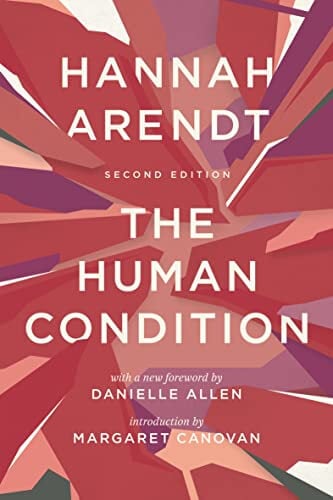
I picked up The Human Condition because I thought Hannah Arendt might have something useful to say about living in the 2020s. You know the feeling or at least seen all the people on the Internets go on about: work is unfulfilling but also necessary, we don’t want it to go away but we also do, and there’s this constant low-level alienation from political life, social life, and even the work we do every day. I figured if anyone could diagnose what’s going on, it would be Arendt.
She’s most famous for her work on totalitarianism, which I read in college and found deeply insightful. The Human Condition is one of her largest philosophical works and explores what labor, work, and action mean in a hyper-industrialized society. She wrote it in the post-World War II era—basically the world structure we still live in today.
Arendt is also interesting as a more actionable or practical follow-up to Martin Heidegger’s philosophical work. Heidegger’s ideas are fascinating on multiple levels, but they’re also incredibly abstract and tainted by his involvement with the Nazi party in the 1930s. Arendt was one of his students, and she carried along a lot of his philosophical frameworks while obviously making very different choices in real life. In fact, her experience fleeing Nazi Germany is one of the reasons she developed such an incisive critique of totalitarianism.
What I Liked
Arendt is absolutely right in her diagnosis of the problem. The specialization of labor in capitalist economies generates massive wealth, but it also makes political access and involvement incredibly difficult. Even on the local level, there are armies of consultants, professional employees, bureaucrats, and lobbyists. There’s just so much specialized knowledge required to jump out of whatever lane your work or life is in.
People feel alienated even in an active, involved democracy—and I think she nails why.
I also appreciate her general recommendation to engage and create, to act in the political realm. She’s right that we’ve lost something important when we retreat entirely into private life and specialized work. For a philosophy book, it’s well done and surprisingly readable.
What I Didn’t Like
Here’s where it falls apart for me: Arendt grounds all of this in a grand sweep of human history that leans heavily on ancient Greece as the ideal democracy. She assigns almost all value to human labor. Both of these create serious problems.
The ideal Greek polis she cites as a model of democratic participation was based on slavery and the subjugation of women. Sure, it had an open public sphere for debate and collective decision-making. But that sphere was exclusively for rich, aristocratic men. The idea that we need to “return” to something that was never actually accessible to most people is absurd.
Access to politics and a say in the direction of society has never been more widespread than it is now. That’s not to say it feels accessible—it often doesn’t—but the idea that you could have a Civil Rights movement or an environmental movement started by someone like Rachel Carson in ancient Greece is laughable. It didn’t happen. A random landowning man in ancient Athens might have had more direct say about whether to go to war than we feel we have now, but I’d argue we actually have far more political agency than Arendt gives us credit for.
The other major issue is her focus on labor. I think she’s right that humans want their work to mean something, to contribute to something beyond themselves. And yes, it’s very hard to find that meaning in modern work. But by assigning all value to labor—just as Marx was wrong to do—she misses opportunities to think about solutions.
She could have explored worker co-ops that are valuable not just because they preserve human labor, but because they allow workers to own assets, natural resources, and the means of production. She could have encouraged people to think about their art or knowledge as a form of human capital, which can be even more valuable than we could ever make pure labor alone.
Wrap-Up
Arendt correctly diagnoses the alienation and emptiness many people feel in modern life. Her critique of how industrialized capitalism separates us from meaningful political and social participation is sharp and still relevant.
But the book is built on a shaky foundation. The ancient Greek ideal never existed for most people, and her focus on labor as the primary source of human value misses better solutions that were already emerging when she was writing.
I’m glad I read it for the diagnosis, but I can’t say I recommend it unless you’re already deep into political philosophy and want to understand her influence on later thinkers.
- Accurately diagnoses political and social alienation in modern capitalist society
- Readable and well-structured for a philosophy book
- Insightful critique of how specialization limits civic participation
- Idealizes ancient Greek democracy while ignoring slavery and exclusion
- Assigns all value to labor, missing opportunities for better solutions
- Built on a historical foundation that never actually existed for most people

Quotes
Make art – it is work and action
Each time you write something and you send it out into the world and it becomes public, obviously everybody is free to do with it what he pleases, and this is as it should be. I do not have any quarrel with this. You should not try to hold your hand now on whatever may happen to what you have been thinking for yourself. You should rather try to learn from what other people do with it.