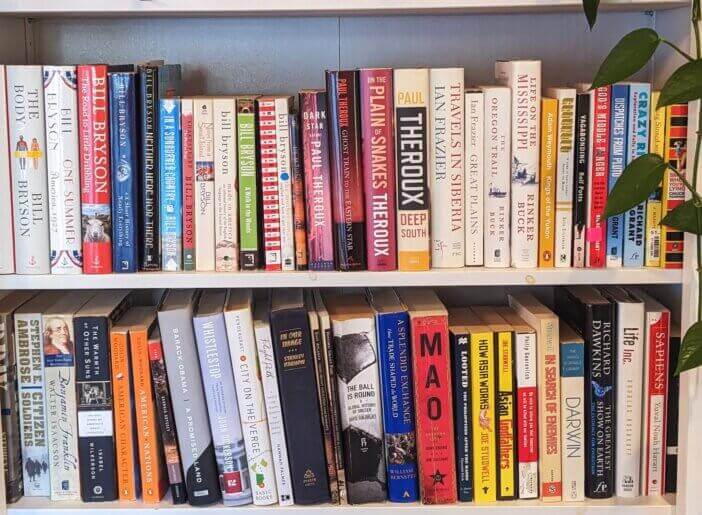
Moneyland by Oliver Bullough

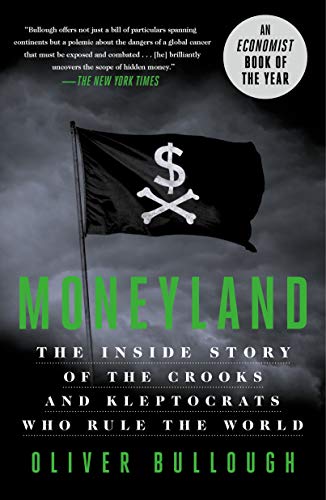
I picked up Moneyland by Oliver Bullough by accident. I was actually looking for his newer book, Everybody Loves Our Dollars, which is all about money laundering. It wasn’t available yet, so I grabbed Moneyland instead.
It was astounding.
But what’s most astounding is that Moneyland came out back in 2018. It predates the massive growth in cryptocurrency. It predates the second Trump administration. And yet everything it describes has only gotten bigger since.
What Is Moneyland?
Moneyland is a nonfiction book about the world of money that exists outside the control of any legal jurisdiction. It’s a world inhabited almost exclusively by very, very rich people who have managed to get their money into what Bullough calls Moneyland, a netherworld of infinite global jurisdictions where the money and the assets exist, but are never truly in any specific place.
Hidden wealth has always been around. But Moneyland, as Bullough describes it, really took off after the Bretton Woods system broke down in the 1970s. Combine that with the globalization of communications, and you get a world where ownership of assets can be global while legal and tax codes stay stubbornly territorial.
The book covers how that world works, how big it is, how fast it’s growing, and how it affects societies that remain (obviously) territorial and national.
What I Liked
It’s a fast, well-written read. It’s got memorable stories. It’s got villains. It’s got scrappy heroes. It has enough detail to be accurate and true to reality, but not so much academic detail that it drags the book down. The book opens with protesters in Kyiv wandering through the abandoned palace of ousted Ukrainian president Viktor Yanukovych, and it only gets wilder from there.
It’s not a conspiracy theory. I really enjoyed how Bullough frames Moneyland. It’s not some evil cabal pulling strings. It’s the natural outgrowth of three forces: global communications, territorial regulation, and everyday human greed. Even though we keep trying to crack down, Moneyland keeps growing because we keep pushing harder on all three.
It reminded me a lot of John Bogle’s Enough. Moneyland is basically what happens when nobody ever decides they have enough….combined with a race to the bottom to “protect” wealth.
It reveals a world of incredible influence. Most people in their everyday lives are aware that there are rich people. What they don’t realize is just how liquid and global these money flows are, and how much influence that money has on the territorial world the rest of us live in. Moneyland makes that world visible.
What I Did Not Like
My main complaint isn’t really the book’s fault. Moneyland moves so fast that any book written about it is going to be out of date the day it’s printed. But there are a couple of developments that I think are big enough to deserve their own chapters.
The US Became Moneyland
This one is the most ironic. The US used its hegemony to force global transparency through FATCA, the 2010 law that made foreign banks report on American account holders. Then, when the rest of the world signed on to a reciprocal reporting standard through the OECD, the US declined to join.
Instead, *we* used that same hegemony to become the place to put your money.
Because American states are the foundational legal unit in our federal system, states like Delaware, Wyoming, South Dakota, and Nevada can all become better homes for Moneyland than the Cayman Islands, Jersey, or any of the other notorious offshore jurisdictions. waves arm at entire Sunbelt-to-Mountain-West map
The book kind of ends right as that development is taking off, as an unforeseen consequence of FATCA. From what I can tell, that’s exactly where Everybody Loves Our Dollars picks up.
Everything Since 2018
The scale of global corruption has only become clearer. The 2021 Pandora Papers showed that the Panama Papers were just the beginning. In early 2025, the President Trump paused enforcement of the Foreign Corrupt Practices Act. The involvement of money in elections keeps growing. And many of the rules that were in place when Bullough wrote the book, like FATCA and international tax treaties, are being loosened rather than tightened.
There’s also a lot going on with Russian wealth since the war in Ukraine, and with Chinese wealth in the wake of Xi Jinping’s crackdown on corruption. I wish Bullough could have gotten into both.
Moneyland by Oliver Bullough is a fast-paced, eye-opening look at the hidden world where the very rich park money beyond the reach of any legal jurisdiction. Bullough frames it not as a conspiracy but as the natural result of global communications, territorial laws, and human greed. Published in 2018, it’s already outdated on crypto, US tax havens, and recent enforcement rollbacks, but remains an excellent foundation.
- Fast-paced and memorable, with real villains and scrappy heroes
- Frames Moneyland as a structural problem, not a conspiracy
- Reveals how liquid and global hidden wealth really is
- Predates the crypto boom and recent enforcement rollbacks
- Only touches on the US becoming the world’s new tax haven
- Skips Russian wealth after the Ukraine war and China’s corruption crackdown

Wrap-Up
If anything, Moneyland is still an excellent, eye-opening introduction to a world that is so fast-moving, so vast, and growing so quickly that any book on it is going to be inherently out of date. Read it as a foundation, not the final word.
I highly recommend getting it from the library, your local bookshop, or Amazon. And then go read Everybody Loves Our Dollars, which is next on my list.
This has long been a potentially attractive prospect. Even so, for decades, it wasn’t enough to bring in the kind of wealthy foreigners who kept their money in Switzerland, not least because of the proactive approach of US law enforcement. Putting your money in America looked worryingly like keep-ing your honey in a cave inhabited by a large bear. This means Moneyland in America was largely the preserve of Americans; foreigners preferred to keep their money out of the reach of the Internal Revenue Service. “Look, I used to work for an English investment bank, and no one who wasn’t a US person wanted to deal with the US at all, because of the IRS and the com-plexity, they just didn’t want to be next to the US,” said Greg Crawford, pres-ident of the Alliance Trust Company in Reno. “That has all kind of changed We have money from overseas now, we have significant money from overseas.’
Who indeed? If your wealth is protected from the United States govern-ment by the United States government, then what protection can an island in the Mediterranean offer? As Cotorceanu wrote in an article in Trusts & Trustees, an industry magazine, in 2015: “[T]hat ‘giant sucking sound’ you hear? It is the sound of money rushing to the USA to avoid [CRS] reporting. Unfortunately, much of that money will be undeclared.”
It is also the sound of Moneyland reasserting itself. This is not a con-spiracy-it never is but a natural consequence of the laws of the anthill. When the incentives are right, everyone acts in the same way. Nevada be-coming a tax haven is just the natural consequence of bright people seeking ways to make money for themselves (and save money for their clients), in a world where money moves freely but laws do not. If Nevada and the other popular trust-friendly states have as much money booked in at their law firms as South Dakota does, that means more than a trillion dollars is hiding from sight, avoiding taxes and oversight, and will be able to do so until long after even our great-grandchildren are dead; until perhaps the end of time.
New York State’s department of taxation and finance estimated in 2013 that it was losing around $150 million a year in taxes because its residents were putting assets into trust in other states, but there is no estimate for how much the rest of the world is losing. CRS hasn’t even been fully implemented yet, so the consequences of the traditional wealth havens losing their secrecy haven’t played out, yet already the effects are clearly visible in official statis-tics. According to some recent research from Gabriel Zucman (the French economist at Berkeley), Swiss institutions’ share of the world’s offshore wealth has dipped from around 50 percent to barely a quarter over the last decade. Asian tax havens are creeping up to join them. But is “offshore” even a use-ful concept any more? If the best tax haven is now the United States, we may need a whole new term for the places that adapt their laws to accommodate the needs and whims of the nomadic Moneylanders.
So far, too many citizens have believed the claims of the likes of Donald Trump or, in Britain, Nigel Farage, who argue that if we just tighten our borders against immigrants, we can make our countries great again. The real threat to the liberal order is not the poor immigrants, but unaccountable money. Offshore bandits are looting the world, and this looting is undermin-ing democracy, driving inequality and sucking ever-greater volumes of wealth into Moneyland, where we can’t follow it.
The solution is not to pull up the drawbridge, or to demonize foreigners who flee their collapsing countries in the hope of a better life in the lands where their nations’ money has found a home. The solution is to solve the root causes of the instability that is driving the refugee crises in the first place. If we can stop the ruling elites of Nigeria, or Russia, or Syria, or Central America from stashing their stolen wealth offshore, we can help stop them from stealing it. Remember, corruption is a crime of opportunity, and people are far less likely to steal if they know they won’t get away with it.
We need to shine light onto this dark side of globalization, impose trans-parency on the ownership of wealth and property and find out who really owns what. Once we have done that, the Moneyland pathway will collapse, and we’ll be able to prosecute the corrupt and identify them as the thieves that they are.
So what do we as citizens need to do? We need to know who owns what; we need to put crooks in jail; we need to stop our cities from laundering the stolen wealth of the world. And we need to support any politicians prepared to build the coalitions required to do this patient, taxing, technical and un-glamorous work. Only by doing this can we truly take back control of our economies and our societies, and halt the wholesale looting of the world that threatens us all.
Fediverse Reactions

Get Posts Automagically
…also via RSS or Fediverse – just copy link & paste in your favorite reader :)