5 Notes on Georgia State Astronomy’s Observatory Nights

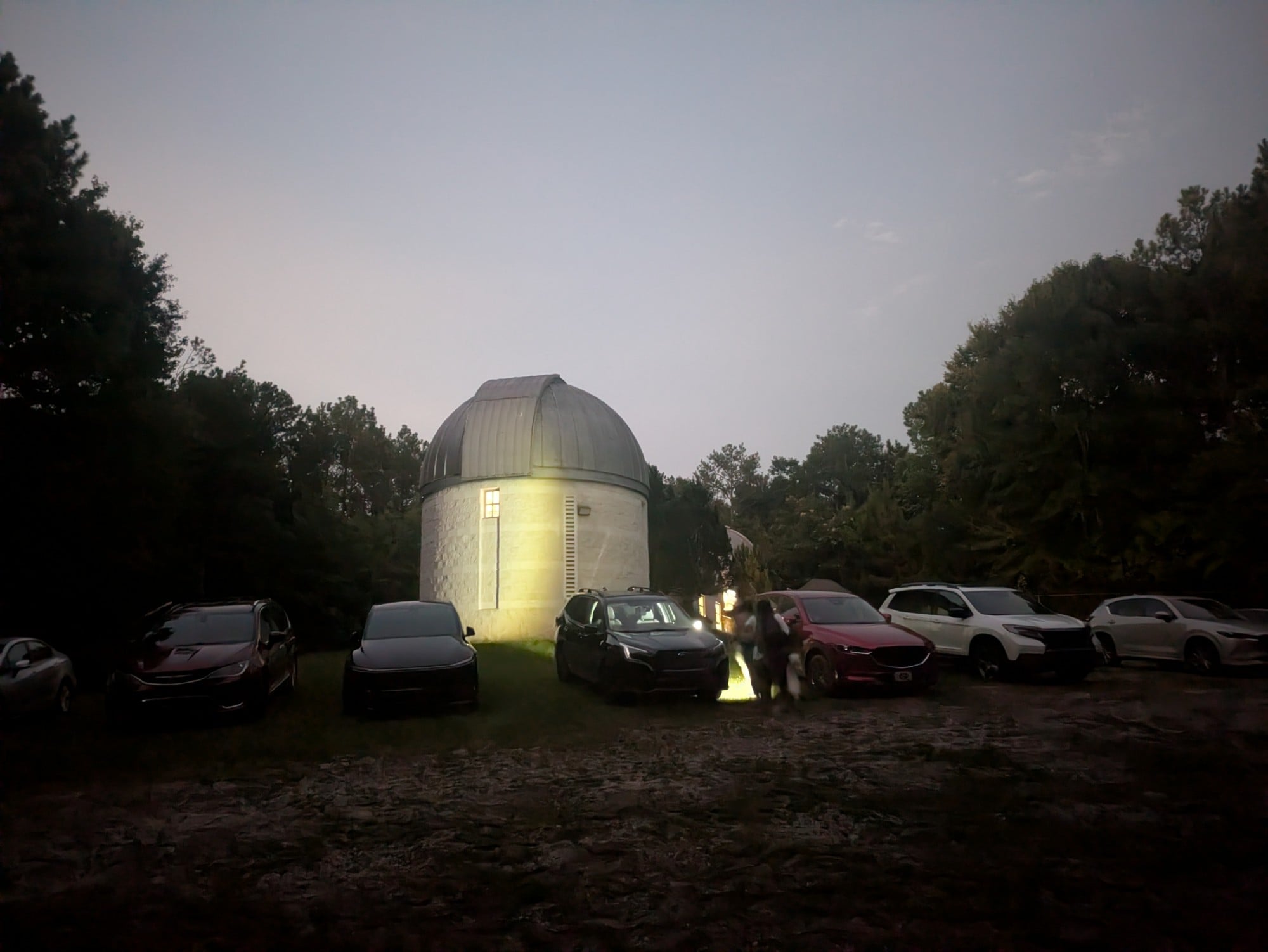
Georgia State University owns an observatory in Hard Labor Creek State Park, about an hour east of Atlanta. It is operated by their Physics and Astronomy Department, and they open it to the public once a month, usually from April until October. You can see the listings on their website and their Facebook page.
This August, I decided to go out and see what it was all about.
What a Public Night Actually Is
There is no structured program. That’s the first thing to understand.
You drive out, you park, you wait for it to get dark, the building gets unlocked, and a handful of graduate student volunteers point the telescope at whatever is worth pointing it at. You take turns at the eyepiece. You ask questions. That’s the event.
It’s very chill. There’s no organized talk and no organized setup, because the building was built for research and student projects, not for a grand public event. It’s just kind of like the building is open and there are student volunteers there to answer questions and hang out. It’s really awesome, especially if you come prepared.
The Event Has Some Obvious, but Not Obvious, Quirks
A few things that are completely obvious once you’ve been, and not at all obvious if you’ve never been to something like this.
There’s no payment, no reservation, and no booking. You just show up. The only thing you need to do beforehand is double-check their Facebook page for weather cancellations.
There’s no real signage. The observatory truly is in the middle of Hard Labor Creek State Park, and the turnout is easy to zoom right past. You’ll go by a large secondary parking area first, but there is also some parking inside the gated area. Keep an eye out.
It starts when it gets dark, not at a specific time. The building gets unlocked around 9pm, but the actual event depends on the sky. It has to be dark, there can’t be clouds, and you have to be able to see the stars. This is not some kind of super Hubble telescope that sees things your naked eye can’t. If your naked eye can see something up there, the telescope will make it brighter, bigger, and more clear. It is not going to peer deep into the atmosphere or look through a cloud. So check the cloud cover and check when the sun actually goes down. The astronomers said they’d be there until 11, and that you’d probably see the most stuff between about 10:30 and 11:00.
Think about what’s actually in the sky in August. This one is big enough that it gets its own section below.
The Telescopes Are Just Very Cool
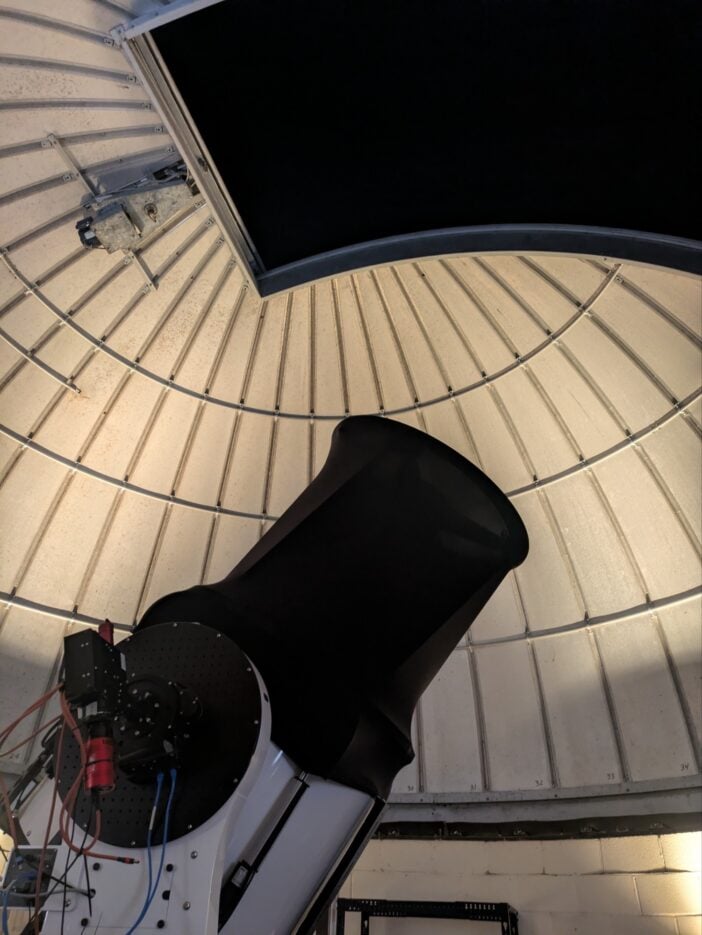
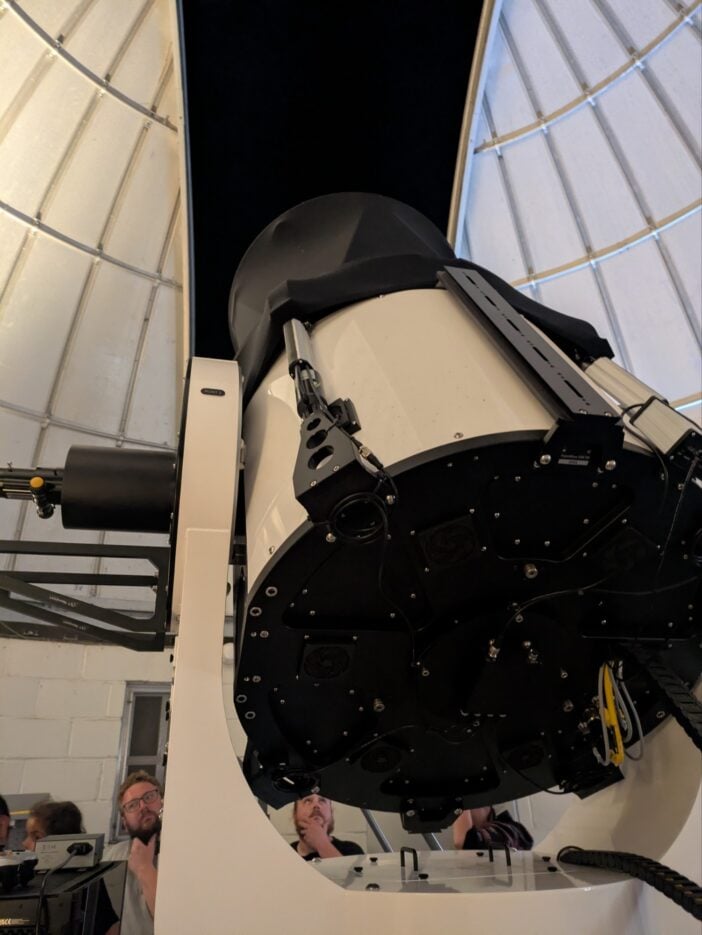
The telescope was built by PlaneWave Instruments, and telescopes are just cool. Being able to look through an eyepiece and see something magnified that much is genuinely incredible.
The thing that got me was the precision of the build. It’s large, it’s computerized, and it moves on its own rather than being pushed around by hand. The mathematics and the skill and the care that it takes to have one of these things is really impressive.
The Telescope Is There Because of the Air Force
Here’s the part I did not know going in.
One of the reasons that telescope exists at all is that it was paid for in large part by grants from the U.S. Air Force, which is trying to figure out how to use land-based observatories for early asteroid detection. The students at Georgia State get to use it essentially as a benefit of it being there in the first place.
And then the public gets one night a month as a benefit of that (notably since the citizens of Georgia own the State Park). There’s a whole chain of funding and priorities behind you standing in a field looking through an eyepiece, and it has almost nothing to do with you…except that it has everything to do with you, as a citizen of a country with a government that funds basic science & public goods. Keep that in mind when writing your Congressional Reps & voting in elections.
Summer Is the Worst Time of Year for Stargazing
One of the graduate students pointed out that summer is the worst time for stargazing in the Northern Hemisphere.
The reason is that the planets are the most interesting things to look at, and in the summer they don’t come out clearly until two, three, four o’clock in the morning. In the early evening, you’re mostly seeing a mix of isolated stars that are pretty far away, aren’t really part of anything, and have a lot of light pollution around them. A lot of the nights they hold these events, the moon isn’t even up over the horizon.
The best stargazing in the Northern Hemisphere is in the winter, when the huge constellations and the planets all come out at a reasonable hour. Which, of course, is exactly when the observatory is closed to the public.
So it’s worth knowing going in that you’re not seeing the sky at its best. You’re seeing the sky that happens to be available on a warm night in August.
It’s definitely worth downloading a stargazing app like Sky Map.
Astronomy Is Math and Imagination
Astronomy is one of those sciences that everyone is familiar with and that still seems totally foreign and strange the moment you actually engage with it.
The comparison that keeps coming to mind for me is agriculture. You’re limited by seasons. You’re limited by viewing time. You can’t speed up nature. You can’t run a quick little experiment on the bench the way you can in chemistry or biology. You are truly limited by observational resources.
The Math Part
That limitation is more literal than I appreciated. If you have a star or a galaxy or a hypothesis you want to gain data on, you have to book time on a telescope. The Keplers and the Hubbles get all of the press and notoriety, but even those have finite observing hours that people compete for.
Even this telescope, sitting in a state park in Georgia, is off-limits to the public during the winter because it’s booked for hours per day staring at one specific piece of sky, gathering observations. Every time I do an extended dive into astronomy, I come away reminded of how much time and precision and care and math it takes to make a discovery.
The Imagination Part
The other half is that you’re looking at light (not stuff illuminated by light).
Stars do sparkle and they do have color – I think we’re all familiar with the slight colors of different stars in the sky – but there’s no grand spectacle, at least not the kind of spectacle humans are used to. I got to see Arcturus through the telescope. I can also see Arcturus with my naked eye. Through the telescope it was brighter, more visible, more colorful. It did not look anything like the galaxy paintings or the enhanced Hubble photos we’ve all been trained on. It’s still just very much shiny light.
You have to use your imagination to realize that you’re staring at the actual thing. You’re not looking at a picture of a star. You’re looking at the star. And in a way that a lot of other science is obvious, I think astronomy is both obvious and not obvious at the same time.
Georgia State Has a Real History in Astronomy
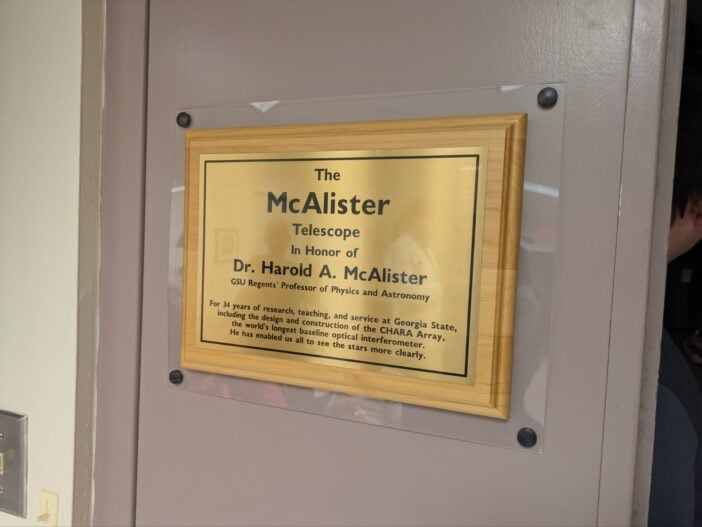
This is probably my bias as a University of Georgia graduate, but I always thought of Georgia State as a commuter college and a lesser research university.
What I found out is that Georgia State has a lot of top-tier, savvy professors who have spent the last four or five decades being absolutely dogged about chasing grants and opportunities to push physics and astronomy forward. They don’t just own and operate this observatory – they own and operate observatories in multiple places. They also helped build and operate the CHARA Array out on Mount Wilson in California, which is the world’s largest baseline optical interferometer.
Kudos to Georgia State.
Pre-Event Research Helps. Post-Event Research Helps Even More.
The one thing I wish I’d done was a little bit of research beforehand about what was going to be in the sky that evening.
What I did do, and I’m glad I did, was research afterward. That’s how I found out that Arcturus is a genuinely famous star. It’s named in the King James translation of Job (most modern translations read that word as the Bear instead), and it shows up in Polynesian and Assyrian writings. Humans have been looking at this thing and writing it down for a very long time, and I had never heard of it. I didn’t know what it was, or why it was there, or why it comes out in the summer sky.
It was a fascinating little rabbit hole that I only went down because of the experience – and going down it made the experience better in hindsight.
Next time I’ll figure out what’s going to be up there, why it’s there, and what’s coming out earlier or later in the night. I’ll also make sure my star map app is updated and calibrated so I can hold my phone up and actually know what I’m looking at.
Bring Your Nerdiest Questions
The other thing to prepare is questions.
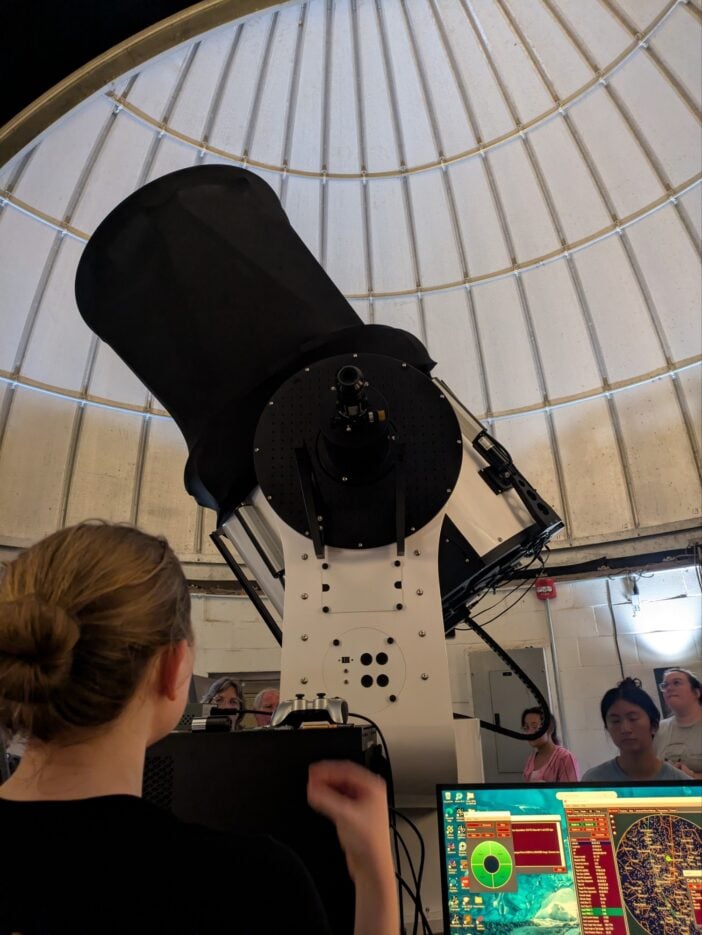
There were several graduate students there, and every one of them had a fascinating, in-depth thesis on solar flares they were working on. Being able to ask involved questions is encouraging to them, and it’s a genuinely rare opportunity to take a true expert and just pepper them with things you’ve wondered about.
Like – apparently we’re due for a Carrington Event (!?!)
It’s also always good to be around people who are all interested in the same thing. It’s encouraging and it’s fun.
Would I Go Back?
Yes – and the one thing I’d change is doing thirty minutes of homework first.
Check the Facebook page for cancellations, check the cloud cover, look up sunset, and plan to be there for the 10:30 to 11:00 window rather than showing up when the doors open. Then spend a few minutes figuring out what’s actually going to be overhead that night, so that when you get to the eyepiece you know what you’re looking at.
It’s a free, low-key, genuinely interesting way to spend a summer night an hour outside of Atlanta. Just go in knowing you’re looking at shiny light – and that the shiny light is real.
Get Posts Automagically
…also via RSS or Fediverse – just copy link & paste in your favorite reader :)