10 Notes on Visiting Wind Cave National Park

In June 2024, our family took a road trip through the Dakotas. One of our stops was Wind Cave National Park.
Wind Cave is one of the more underrated and lesser-known National Parks – even though it was one of the first. Theodore Roosevelt signed it into existence in 1903, making it the first cave anywhere in the world to be designated a national park.
After having such a good time at Mammoth Cave National Park, I was excited to see another cave system run by the National Park Service. Here are 10 notes from our visit.
1. Wind Cave Is Part of the Black Hills
Wind Cave National Park is nestled into the Black Hills and is very much part of that ecosystem.
Until I visited, I didn’t realize what a big deal the Black Hills are – geographically, ecologically, and geologically. They rise out of the surrounding prairie like an island. And they’re higher than the mountains I know best. Black Elk Peak tops out around 7,200 feet. Brasstown Bald, the highest point in Georgia’s Blue Ridge, is around 4,800 feet.
Wind Cave sits on the south side of the Black Hills formation. The rest of the Black Hills is a patchwork of Black Hills National Forest, large swaths of private land, Mount Rushmore National Memorial, and Custer State Park – one of the largest state parks in America.
2. Don’t Expect Typical National Park Amenities
Because of its size and location, Wind Cave doesn’t have many of the amenities you’d expect at a National Park. There’s a campground, but that’s about it.
That’s because Custer State Park shares a border with Wind Cave. Custer is where you’ll find most of the cabins, lodges, restaurants, and recreation opportunities.
It surprised me at first. But it makes sense once you think of the two parks as a single destination.
3. It’s Easy to Get to from Rapid City
Looking at a map, I thought Wind Cave was going to be a haul. It’s not. Thanks to highways running over flat grassland, it’s about an hour from Rapid City.
Rapid City is also close to Mount Rushmore and the rest of the Black Hills – and it’s right on the way if you’re headed east to Badlands National Park. In other words, Rapid City is a truly solid gateway city for National Parks and outdoorsy trips.
4. It’s Two Parks in One
Like Mammoth Cave, Wind Cave is really two parks sharing the same land.
There’s the below-ground park – the cave system – which you can only access on a ranger-led tour. And there’s the topside park – rolling hills and prairie grassland that you can explore on your own.
Most visitors come for the cave. But plan for both.
5. The Topside Is Seriously Underrated
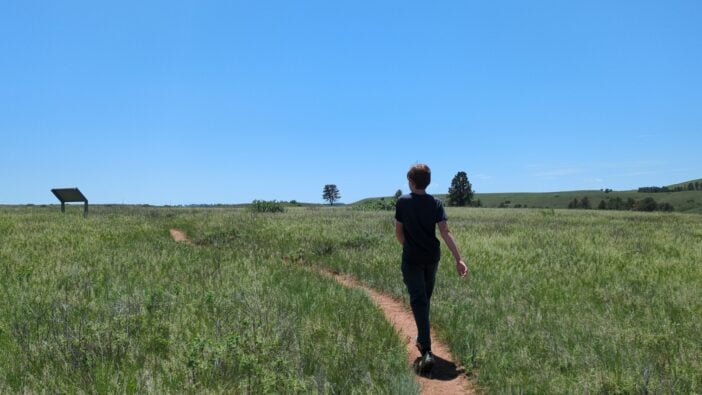
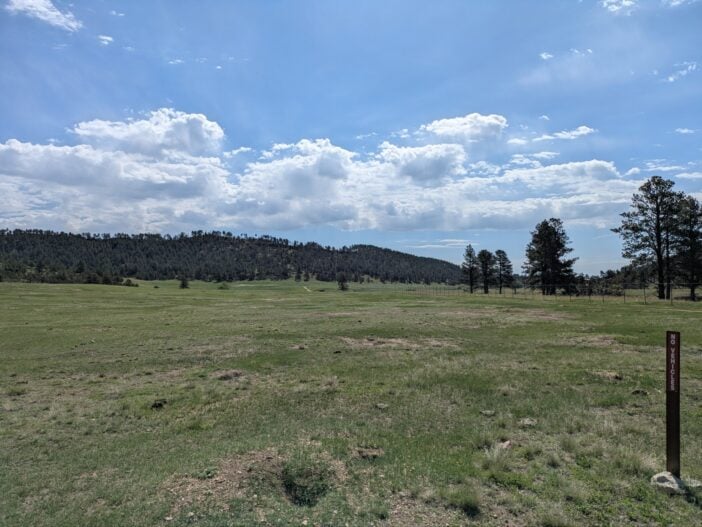
The topside of Wind Cave is mostly mixed-grass prairie that hasn’t been truly disturbed in over a century – other than prescribed burns, which the Park Service uses to keep the prairie on what would be its natural fire cycle.
The trails are excellent. We hiked three:
- Rankin Ridge – climbs to the highest point in the park, with stunning views across South Dakota.
- Lookout Point – heads out across the prairie and up to a hilltop viewpoint.
- Prairie Vista – a short, easy loop right from the visitor center through the grassland.
Each one shows off a different side of the park, from the hills to the prairie to all the different flora in between. If you’re into hiking in this ecosystem, the topside is worth a full day – maybe even a second one.
6. Bison & Prairie Dogs Steal the Show
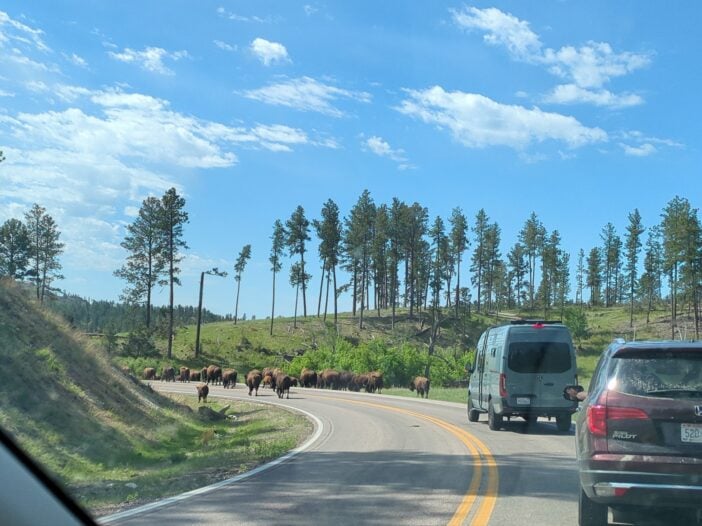
Wind Cave has one of the oldest bison herds in America. In 1913, the park was restocked with bison shipped from the Bronx Zoo, which had helped save the species from extinction. Today, it’s also one of the few herds considered free of cattle genes.
There are other bison herds in South Dakota – in Custer State Park, Badlands National Park, and on the national grasslands. But those ranges are sprawling, so you won’t necessarily run into them.
Wind Cave hits a sweet spot. It’s big enough for a significant herd, but small enough that you’ll almost certainly see some bison. Even when we didn’t see the herd itself, we saw plenty of solo males just wandering wherever they felt like. It’s incredible to see bison up close. (Just not too close – the Park Service says to stay at least 25 yards away.)
Then there are the prairie dogs. The park has several prairie dog towns, and I could sit and watch them all day. It’s nature’s reality TV show. Prairie dogs are great.
7. The Caves Are Incredible – Including the Actual Wind
The cave itself is fascinating on multiple levels.
First, it’s long. Wind Cave has more than 150 miles of mapped passages, making it one of the longest caves in the world. It’s a dry cave, and it formed in some of the same ways as Mammoth Cave (which holds the title for longest). It’s not as grand as Mammoth’s giant rooms – but it doesn’t need to be.
Second, the formations are striking. Wind Cave is famous for boxwork – thin, honeycomb-like fins of calcite that jut out from the walls and ceilings. The park holds an estimated 95% of the world’s known boxwork. It looks like nothing else I’ve ever seen underground.
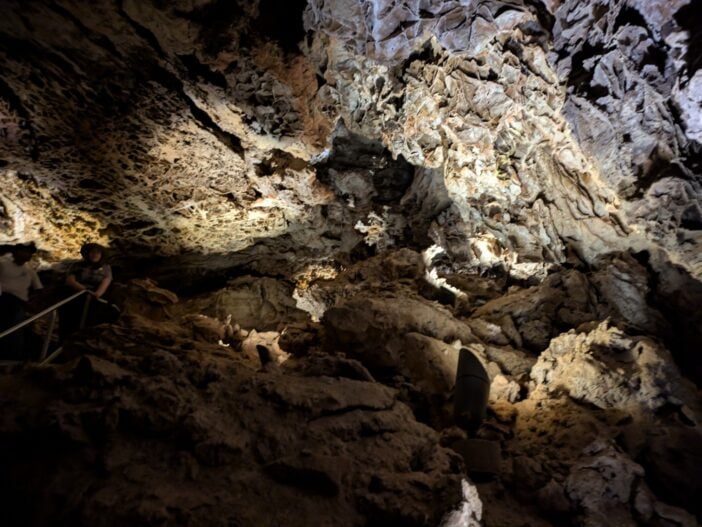
Third, just being down there is mind-boggling. The spaces are large enough that you don’t feel claustrophobic, but it’s hard to wrap your head around the fact that they exist at all.
And yes – there’s actual wind. Near the visitor center is the cave’s natural entrance, a small opening that’s partially fenced off because it’s a sacred site to the Lakota.
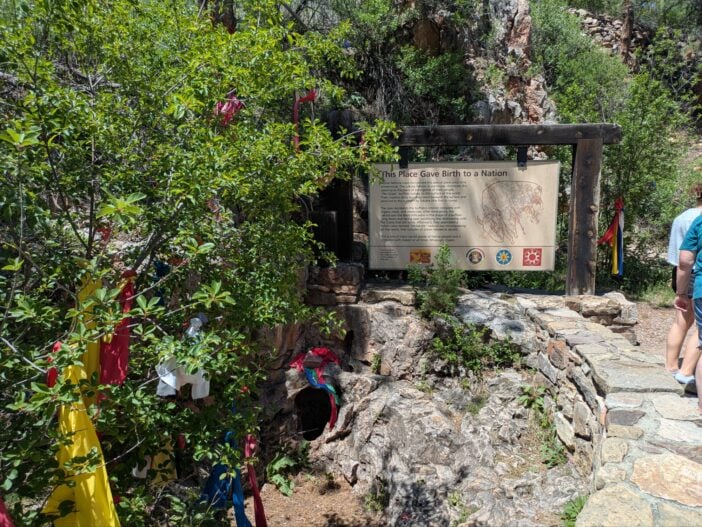
Because of the pressure difference between the cave and the surface, air rushes in or out of the opening depending on the weather. It’s cool to feel and worth the short walk over.
8. Tours Are Required – and They’re Worth It
To see the cave, you have to go on a ranger-led tour. There are several to choose from, ranging in accessibility and emphasis – some lean toward geology, others toward history. They all use the same elevator system, which is really what caps tour sizes.
We did the Fairgrounds Tour. It takes you a bit further down and through some fairly tight spaces – but not all the way to where you’re crawling. (That’s the Wild Cave Tour.)
The tours themselves are genuinely great. Having a trained ranger point out things you’d never notice on your own, answer questions, and – obviously – keep you from getting lost makes all the difference.
All tours start at the main visitor center, which has excellent exhibits on the park’s ecosystem, natural history, and human history. The whole operation is very well run. Props to the National Park Service – they’re the absolute best.
A few practical tips:
- Book ahead. Tours are reserved through Recreation.gov and fill up in the summer.
- Bring a layer. The cave stays in the mid-50s year-round – chilly after a hot June day on the prairie.
- Check tour status before you go. Elevator problems have limited or shut down tours at times in recent years.
9. The Lakota History – or, “Degrees of Terribleness”
With Wind Cave, there’s a lot going on between the Lakota and the United States government. And what I read genuinely took me aback.
Usually when I learn about the relationship between American Indians and the U.S. government (and settlers), the story gets flattened into good guys and bad guys. What I’ve learned is that we should really be talking about degrees of terribleness.
Take my home state of Georgia. After visiting Indian Springs State Park and New Echota Historic Site, I’ve come to see a range. The early treaties signed by James Oglethorpe and later the Continental Congress were not ideal – but given the era, you could argue some good faith on both sides. Then there’s the 1825 Treaty of Indian Springs, where William McIntosh signed away Creek land without the authority of the Creek Nation. And then there’s New Echota, the Cherokee capital, where Georgia flat-out ignored the U.S. Supreme Court in Worcester v. Georgia – and the federal government didn’t bother enforcing its own ruling.
Out West, I tended to lump it all together. The Black Hills changed that.
Unlike some other treaty cases, there’s no ambiguity or dispute here. It wasn’t a state breaking a treaty that the federal government tried to uphold. It wasn’t the federal government playing tribes against each other, or finding a breakaway leader to sign. In the 1868 Treaty of Fort Laramie, the U.S. government guaranteed the Black Hills to the Lakota. Then gold turned up in the Black Hills, and in 1877 Congress passed a law taking them anyway.
The U.S. government signed a treaty…and then straight up broke it.
You do not have to be a lawyer to see that. And the Supreme Court agreed. In United States v. Sioux Nation of Indians (1980), the Court ruled that the Black Hills had been taken illegally and awarded compensation. The Sioux Nation refused the money – because accepting it would mean giving up the land. That fund has since grown to well over a billion dollars and still sits untouched.
I don’t know who should own or manage the land today. It’s been so long that any solution has to deal with contemporary reality. And from what I understand, it’s probably not going to get settled anytime soon – though I do think it should be.
But the principle is clear. Every one of these treaty situations was deeply unethical. The Lakota claim to the Black Hills, though, is about as legally clear-cut as it gets – more unambiguous than any other tribal land dispute I’ve come across.
10. The Public Land Lesson: Go Big
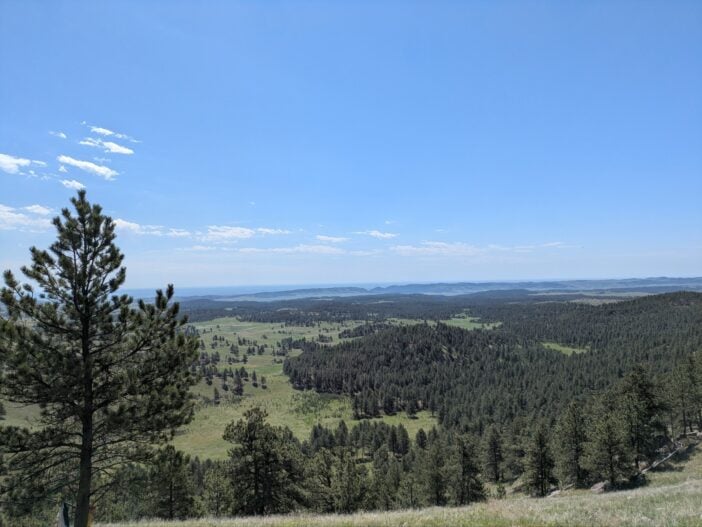
Whoever ends up owning or operating it, this land should be public, it should be preserved – and it should be bigger. There’s too much private land all up in the Black Hills.
Wind Cave came along in the early days of the park system, when no one quite knew what a national park was supposed to be. Yellowstone protected an entire landscape. But a lot of the parks that followed protected one specific feature – a cave at Wind Cave, cliff dwellings at Mesa Verde, the springs at Hot Springs. They’re great places. But they’re small, and they’re boxed in.
The lesson in hindsight is simple. If you have an opportunity to preserve public land, you gotta go big. Go as big as you possibly can. It’s hard in the moment, but future generations will not regret it.
That’s exactly what South Dakota did with Custer State Park, largely thanks to Governor Peter Norbeck. At around 71,000 acres, Custer is roughly twice the size of Wind Cave (about 34,000 acres). It’s a huge win for conservation, for preservation, and for all the species we share public land with.
I desperately hope that the next time Congress or a state legislature has a chance to set land aside, they remember that. Nobody ever looks back and wishes a park were smaller.
Wrap-Up
I don’t know if I’d plan a trip to the Dakotas just for Wind Cave. But if you’re out West and can loop it in, Wind Cave is absolutely worth a stop – especially paired with Custer State Park.
I’d also choose it hands down over Mount Rushmore. (I’ve got a separate post on Mount Rushmore.) Rushmore is carved into the Six Grandfathers, a mountain sacred to the Lakota, on the same land the U.S. took in violation of the 1868 treaty. It should not have become what it is – but now it’s a thing. It’s a thing.
Wind Cave, on the other hand, is a National Park. And between the two, Wind Cave is where America’s best idea lives.
Get Posts Automagically
…also via RSS or Fediverse – just copy link & paste in your favorite reader :)