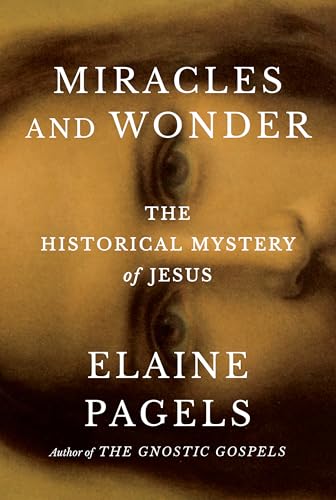
Miracles & Wonder by Elaine Pagels

I was a Religion minor at UGA, grew up in the Bible Belt, and have never really stopped being fascinated by the history of Christianity and the ancient world. So when Elaine Pagels publishes something new, I pay attention.
Pagels is one of the original researchers of the Nag Hammadi manuscripts and a lot of the Coptic and Gnostic texts that scholars are still working through today. She’s been doing serious, primary-source work in this space for decades. I did not know she was still actively publishing so it’s genuinely impressive to see her add another strong book to an already massive bibliography.
The Territory She’s Working In
Part of what makes ancient religious history so endlessly interesting is that we exist in this strange middle ground of knowing a lot and knowing exactly what we don’t know.
Think about it on a spectrum. On one end, you have civilizations like the Mississippians — I’ve visited Ocmulgee in Georgia — who left no written record at all. Everything you imagine about their world is speculation built on objects. On the other end, you have medieval Europe or imperial China, where the documentary record is so deep you can practically reconstruct daily life for the elites.
The Greek and Roman world sits in this maddening middle ground. We have so much that we know precisely what’s missing. And Jesus sits right in that gap. He didn’t write anything down. Most of his immediate followers were illiterate. What we have was passed down orally for decades before anyone committed it to papyrus.
That’s the territory Miracles and Wonder is working in.
What the Book Does Well
Pagels frames the book around the classic mysteries of the faith — the incarnation, the miracles, the passion, the resurrection — and uses that structure to dig into the historical and textual questions underneath each one.
The thing she does better than almost anyone else writing in this space is maintain academic rigor without losing the reader or losing respect for the subject. That’s a genuinely hard balance to strike when you’re writing about things that billions of people hold sacred. She strikes it.
I’ve read a lot of books in this lane — Zealot by Reza Aslan, Christianity: The First Three Thousand Years by Diarmaid MacCulloch, plenty of Bart Ehrman, and Catherine Nixey’s Heretic and The Darkening Age. They’re all fine, but Aslan and Nixey play a little fast and loose with the facts. Ehrman goes the other direction — so committed to academic rigor that the readability suffers. Pagels finds the middle.
If someone asked me to recommend one book in this space, I’d point them here over any of those.
What I (Re)Learned
I’ll be honest: I didn’t learn a lot that was genuinely new to me. I’ve read enough of these books that the broad strokes are familiar. But Pagels has a gift for synthesis and framing, and a few things landed freshly.
The Gospels were audience documents. Matthew was written for Jewish converts who needed proof that Jesus was in the lineage of the Hebrew prophets. Luke was directed at Gentiles. Mark is so old and unembellished that it reads completely differently from the others — very direct, no fluff, almost startling in how spare it is. Go back and read it if you haven’t recently.
And then there’s John, which is almost out of left field compared to the other three. Pagels articulates the difference cleanly: the synoptic Gospels — Matthew, Mark, and Luke — are about the message. John’s Gospel is about the messenger — the nature of Jesus himself. That framing really clicked for me.
The Thomas vs. John question. One of the more interesting arguments in the book involves the Gospel of Thomas, which was excluded from the canon, and John, which was included. If John takes the messenger and runs with it, the Gospel of Thomas takes the message and runs with it. Why one made the canon and the other didn’t is exactly the kind of “we know what we don’t know” problem that defines this whole field.
The pigs story. One of the stranger Gospel moments is when Jesus sends demons into a herd of pigs, and the pigs go charging off a cliff. It’s always read as just a weird miracle story. Pagels points out that the Roman legion occupying Judea at that time had a boar as their symbol. Coincidence? Maybe. Probably. We genuinely don’t know. But it’s a perfect example of her methodology — she flags it, notes the correlation, and then holds the line academically instead of running with the convenient explanation. That restraint is rare and valuable.
Her treatment of the Passion is similarly strong — she really digs into what we know about Pilate, how the Roman court system worked, how the Jewish court system worked, and all the messy interplay between them.
Bottom Line
If you’re at all interested in the historical Jesus, the early Christian world, or just ancient history in general — this is the book to read. Not because it will blow your mind with brand new revelations, but because Pagels is simply the best guide to this territory. She’ll help you understand what we know, what we don’t, and why the gap between them is still worth exploring.
Miracles and Wonder by Elaine Pagels is the best single book in the crowded "historical Jesus" genre — not because it breaks new ground, but because Pagels is the most trustworthy guide to territory where rigorous scholarship and genuine respect for the subject are both required. She covers the audience-driven nature of the Gospels, the Thomas vs. John question, and the murky details of the Passion with clarity and appropriate restraint. Recommended over Aslan, Ehrman, or Nixey.
- Best balance of academic rigor and readability in the genre — a better starting point than Aslan, Ehrman, or Nixey
- Concrete, well-framed examples (the Gospels as audience documents, Thomas vs. John) that make complex material genuinely click
- Respectful and even-handed treatment of material that billions of people hold sacred
- Readers already deep in this subject won't encounter much that's genuinely new
- The framing around the "mysteries of faith" assumes some baseline familiarity with Christian tradition
- Pagels' restraint — her refusal to run with convenient explanations — may frustrate readers looking for bolder conclusions