Inflation but Only In Human to Human Services

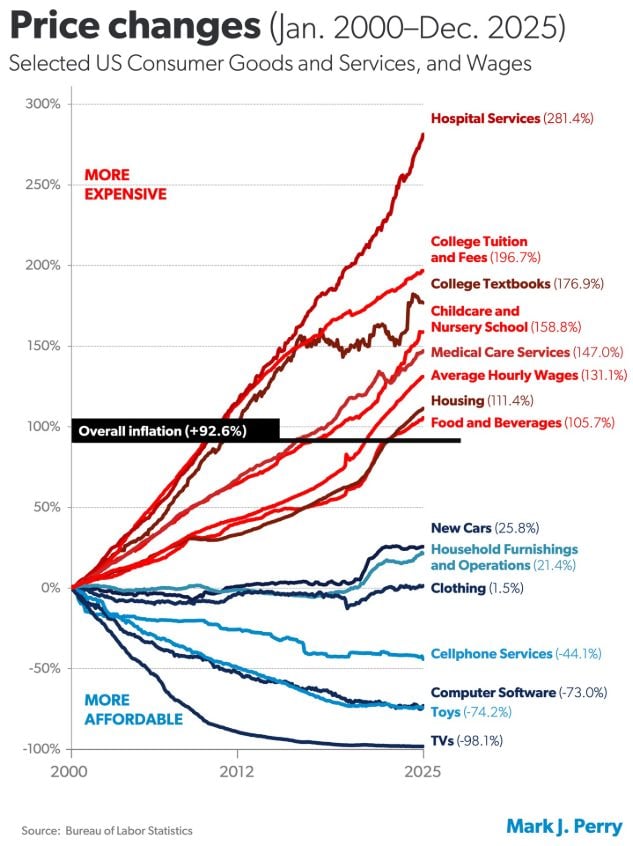
I love a good chart. This chart shows two major economic trends. First, Baumol’s Effect which is the tendency for wages in jobs that have experienced little or no increase in labor productivity to rise in response to rising wages in other jobs that did experience high productivity growth.
Second, there is the Cantillon Effect which describes how newly created money doesn’t raise all prices uniformly — those closest to the money creation (asset holders, financial institutions) benefit first, while wage earners feel the inflation later and to a lesser degree, effectively transferring real wealth upward. This can compound Baumol’s Effect by –
- Asset inflation raises the capital cost inputs — hospital real estate, equipment, insurance — almost immediately (Cantillon)
- Labor must nominally rise to afford those same inflated assets (housing, etc.), pushing up wage demands
- But hospitals cannot offset those rising labor costs through productivity gains — that’s precisely Baumol’s trap
- So the sector is getting squeezed from both ends simultaneously — capital costs and labor costs — with no productivity escape valve
- The result is that healthcare prices don’t just grow with inflation — they structurally outpace it, and outpace wages even faster, because the sector absorbs the worst of both phenomena.
Some economists frame this as “Baumol’s cost disease being turbocharged by financialization”.
What makes it particularly insidious is that demand for healthcare (and education) is largely inelastic, so the market doesn’t self-correct the way it might elsewhere. People can defer buying a car (which, also can be automated & scaled, so you can wait for a deal); they can’t easily defer a surgery (which, cannot be automated or scaled, so you have to just pay what it costs).