How X’s Algorithm Became a Dystopian Engagement Machine

I never deactivated my Twitter / X account when Elon took over in 2022. I just… stopped using it.
The content shifted almost overnight. The toxicity went from annoying to hilariously absurd. The algorithmic rage-bait became just dumb. And honestly, I just lost interest in social media altogether, mainly because it just became less informative and more entertaining.
For three years, my account sat dormant while I focused on literally anything else.
The Siren Song of New Tools
Late 2025, I got curious again. I’d been hearing that the algorithm had changed, that they’d open-sourced it, that maybe it wasn’t all rage-bait anymore. As a lurker, scrolling through without posting, it actually seemed… fine-ish? A few people that I wanted to follow were still there. Lists still worked (which even back in the day were the only dependable way to curate feeds). The content was less immediately toxic than I remembered.
Then I discovered WordPress plugins like Social Engine Pro that promised easy, simple, free automation of my old 2015 strategy — batch-write posts, schedule them, walk away (I wrote a post on my old site, but it still exists here). The exact workflow that used to work really well before TikTok showed everyone how to engineer a For You feed.
I thought: maybe I could come back. Maybe I could just automate a presence, share some links, not actually engage with the platform’s worst impulses, and still get some value out of it. There are few things that I find more interesting than building Rube Goldberg machines out of Google Sheets, APIs, and WordPress plugins.
I was also glad to see that the API seemed fine (?) and stable…even if it was highly limited before requiring some serious $$$.
Either way, I got Social Engine plugin all setup. So the technical side works. I could schedule out posts and sort of lurk & post at my leisure.
Then I started digging into how the algorithm actually works now.
What the heck. This thing is dystopian. Like a Black Mirror episode that doesn’t even encourage creativity – just pure addiction to manufactured “conversation.”
The Algorithm Is Designed to Trap You
X did open-source (err, more like “make transparent”) their recommendation algorithm back in March 2023, and what it reveals is genuinely ridiculous. This isn’t about showing you good content anymore. It’s about trapping you in engagement loops.
I mean, For You algorithms are an interesting innovation that everyone uses now. They are obviously junk food – pushing us towards our instinctive but passive biases rather than pushing us towards our instinctive but active biases. Not X. It’s “extra” (pun!).
Here’s how it works (primary source & secondary source) –
Your “For You” timeline is 50% from accounts you follow and 50% from complete strangers, selected through something called SimClusters — 145,000+ interest-based communities mapped to maximize the probability you’ll engage. Not that you’ll learn something. Not that you’ll passively enjoy it. That you’ll engage.
The algorithm uses Real Graph to predict engagement likelihood between specific users. If you have 100,000 followers but they don’t engage, those followers are worthless. A 5,000 follower account with active reply patterns will crush you every time.
The Engagement Multiplier System
The algorithm assigns weighted values to different actions, relative to a single like:
- Reply-to-reply exchange (you tweet, someone replies, you reply back): 75x more valuable
- Simple reply: 13.5x more valuable
- Profile visit + engagement: 12x more valuable
- Click + stay 2+ minutes: 10x more valuable
- Retweet: 1x
- Like: 0.5x (baseline)
Read that again. The algorithm gives you 75 times more distribution for getting into a back-and-forth argument with someone than for posting something insightful that people just like and move on from.
This isn’t designed to reward good content. It’s designed to reward the behavior pattern of someone who can’t log off. Someone who keeps checking back. Someone who’s engaged in the literal addiction sense of the word (like, different than passive consuming more and more and more).
The algorithm also assigns an Account Credibility score based on your historical engagement patterns. High credibility accounts (read: people who are constantly online replying to everything) get automatic distribution boosts. You’re rewarded for living on the platform.
The Three-Stage Addiction Trap
Every tweet goes through three algorithmic stages:
Stage 1: Initial Screening (0-30 Minutes)
Your tweet gets shown to 100-1,000 “test users.” If engagement is above 5%, it moves forward. Below 2%, it dies.
But here’s the thing: if you’re not there immediately to reply to early comments, you miss this window. The algorithm demands presence.
Stage 2: Small Traffic (30 Minutes – 6 Hours)
Momentum either builds or stalls. More replies from you = more distribution.
Stage 3: Large Traffic (6+ Hours)
Viral or dead. No middle ground.
This system doesn’t reward planning or thoughtfulness or even productivity with the app. It rewards compulsive presence – you have to be there, with the platform.
The Link Penalty Death Blow
Here’s where my fantasy of reviving my old strategy died completely.
Non-Premium accounts posting external links get zero exposure. Not reduced. Not “a little less.” Zero. Your link posts are invisible.
Non-Premium link posts have a median engagement rate next to nothing. The algorithm doesn’t just deprioritize them – it seems to hide them entirely.
Premium accounts ($8/month) posting links see reduced but viable engagement around 0.25-0.3%. Still terrible, but at least visible.
This means my entire old strategy – share interesting links, tag authors, drive traffic to good content elsewhere – is completely dead unless I pay $8/month for the privilege of maybe getting 0.3% engagement.
X doesn’t want you leaving the platform. Ever. Which, TBF, nor does any other platform. But at least other platforms lean into other formats and metrics like dwell time.
The Premium Paywall
Premium accounts get massive advantages:
- 4x visibility boost for tweets shown to followers
- 2x boost for tweets shown to non-followers
- Links actually work (barely)
- Priority reply placement
- Long-form posts up to 4,000 characters
Independent research shows Premium accounts now get around 10x the reach of free accounts. The system has become pay-to-play.
Video Über Alles
Content type hierarchy:
- Video: 5x base exposure (especially under 2 minutes 20 seconds)
- Images: 3x base exposure
- Text-only: 1x base exposure
Short form video dominates everything. Which makes sense when you realize the goal isn’t information – it’s time-on-platform. Video keeps you scrolling (and, on X, replying).
Why This Is Actually Dystopian
Old Twitter was toxic. It was addictive in all the ways social media is addictive. But at least it occasionally rewarded creativity, wit, insight. You could post something genuinely interesting and people would see it.
This new system doesn’t reward any of that. It rewards pure engagement theater.
The algorithm literally incentivizes the worst possible behavior:
- Never log off (first 30 minutes is everything)
- Get into reply wars (75x multiplier)
- Post constantly (15-20 tweets per day recommended)
- Never share external links (they’re invisible)
- Pay $8/month for basic functionality
- Post videos to maximize retention
It’s not social media anymore. It’s an engagement slot machine designed to keep you pulling the lever.
And here’s the thing that really gets me: it works. The people who succeed on X now are the ones who’ve fully committed to this pattern. They’re online constantly. They reply to everything. They start arguments. They perform conversation.
It’s genuinely Black Mirror stuff. Not even the creative Black Mirror episodes. Just the bleak ones about addiction and algorithmic manipulation.
The Alternatives Aren’t Great Either
Threads has impressed me in some ways. It’s less toxic, the algorithm isn’t quite as predatory, and Meta has seemingly learned something from past mistakes.
But it has all the known downsides of Meta – the data collection, the ad targeting, the general feeling that you’re the product. And more importantly, it just doesn’t have the genuinely interesting, novel content that X (or old Twitter) had. It’s boring. It’s fine.
Mastodon and the Fediverse — I love it philosophically. No algorithm. Chronological feeds. Distributed ownership. It’s everything social media should be.
But it’s incredibly small. The density of interesting people and ideas is absolutely there…just not the scale. You can build a decent community, but you’re not going to get the serendipitous discovery or the breadth of perspectives you get elsewhere. And it still has all the general downsides of social media – the time sink, the doom scrolling, the performance aspects.
For now, this website (with Activity-Pub enabled) is the only place I’m posting. I’ll use Mastodon to goof around and test out other Fediverse features. But consuming content still requires dabbling across X, Reddit, Threads, and everywhere else because no single platform has critical mass.
The Deep Irony
Here’s what just so unfortunate about all of this:
While X, Threads, and Mastodon are all fighting over text-based social media engagement metrics and algorithmic optimization… they’re all getting absolutely trounced by short-form video.
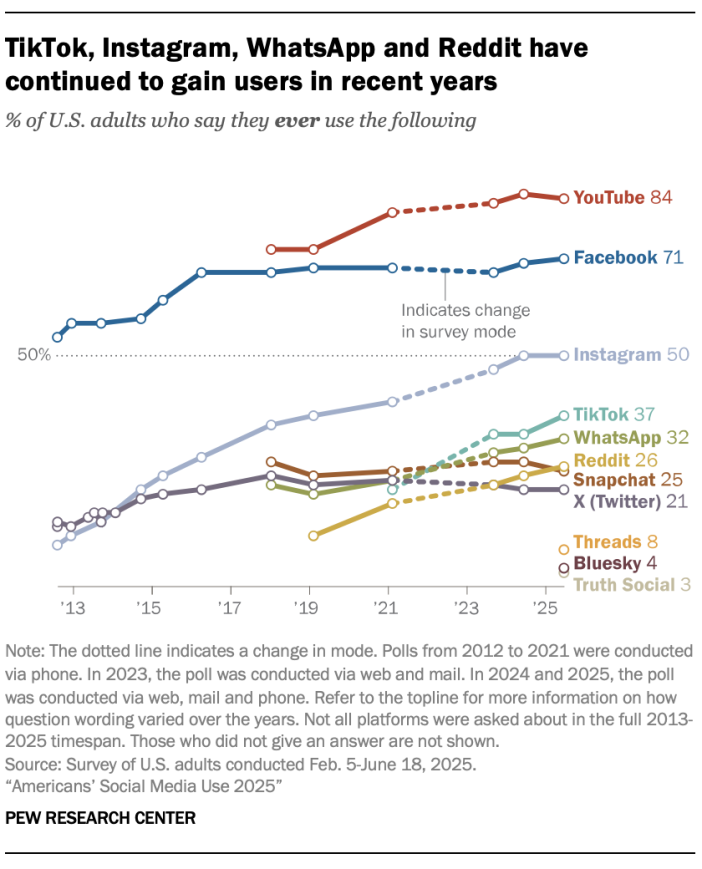
TikTok, Instagram Reels, YouTube Shorts — that’s where the attention actually is. Text-based social media is fighting over scraps while video eats everything.
All this dystopian engagement optimization, all these algorithmic games, all this manufactured conversation – it’s rearranging deck chairs on the Titanic.
What I’m Actually Doing
My 2015 strategy is dead, and I’m not interested in playing the new game. I’m not going to pay $8/month for the privilege of maybe getting 0.3% engagement on link posts. I’m not going to stay online for 30 minutes after every tweet to reply to comments. I’m not going to post 15-20 times per day to satisfy an algorithm designed to maximize my time-on-platform.
Even from a business perspective – it’s not worth it.
I’ll keep the account. I’ll lurk occasionally using Lists to follow the handful of people still posting interesting stuff. But active posting? That’s done.
I’m posting to Mastodon when I have something to say, fully aware that barely anyone will see it. I’m checking Threads occasionally. I’m scrolling Reddit. I’m watching YouTube.
But mostly I’m just… not using social media to find information or trends or people that much anymore.
The platforms have optimized so hard for engagement that they’ve optimized away the actual value. They’ve turned social media into a compulsion engine, and I’m just not interested in being the fuel.
If you’re still batch-scheduling tweets in 2026 hoping something sticks, save yourself the time. The game changed, and the new rules aren’t worth playing by (if it ever was anyway).