I Am A Strange Loop by Douglas Hofstadter

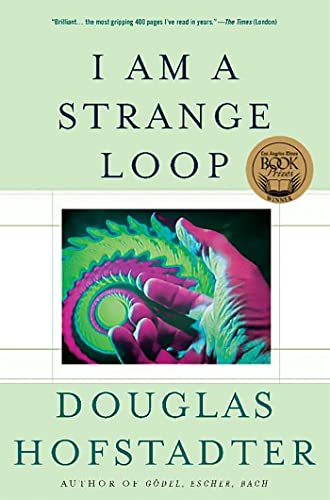
I Am a Strange Loop by Douglas Hofstadter is possibly one of the best science books I’ve ever read — even though I’m not entirely sure I understood half of it.
That’s not a knock on the book. It’s actually the most honest recommendation I can give for a subject this deep.
What the Book Is About
The book sits in an interesting gap. On one end, you have neuroscience — the hard biology of how the brain physically works. Robert Sapolsky’s Behave is probably the best book I’ve read on that side of things. On the other end, you have psychology — how we build mental models and categories to make sense of the world around us.
I Am a Strange Loop lives in the middle. It’s about consciousness itself: how a physical brain generates a subjective experience of being you.
Hofstadter uses the mathematics of self-referential systems — specifically Gödel’s incompleteness theorems — to explain how consciousness emerges. The basic idea is that a system complex enough to refer to itself generates something new: a loop that perceives, decides, and experiences. That loop is your “I.”
To make it concrete: when you want a piece of chocolate cake, there’s a neuroscientist’s version of that story — dopamine, synapses, reward pathways firing. And then there’s your version — the craving, the desire, the experience of wanting. Hofstadter is trying to explain exactly how those two versions connect. And for the first time, after reading a lot of books on this topic, this one actually helped me understand how.
What I Liked
The use of Gödel’s theorems is genuinely brilliant. Hofstadter doesn’t use the math to show off — he uses it as a framework that actually illuminates something. Self-referential loops are strange and paradoxical in mathematics, and he argues they’re equally strange and equally real inside your skull.
The personal stories scattered throughout the book are also standout moments. Hofstadter writes about his wife and the experience of building a model of another person’s consciousness inside your own mind. That is a profound and strange idea when you really sit with it — that the people we love exist, in some real sense, inside our own heads.
I also think his work has become more relevant, not less, in the current era of AI. The book sharpens the distinction between intelligence — which can be replicated, simulated, scaled — and consciousness, which is something else entirely. That’s a question that is no longer theoretical.
For readers who have bounced off Hofstadter’s earlier work — particularly Gödel, Escher, Bach, which is a masterpiece but famously dense — this book is considerably more accessible. It covers similar territory but stays more grounded throughout.
What I Didn’t Like
Some sections of the book get very heavy on the mathematics, and I won’t pretend they were easy going. A few chapters required more re-reads than I’d like to admit.
And honestly, I’m not sure I can give this book a proper review — because I’m not certain I fully grasped it. I understood the argument. I followed the thread. But full comprehension? Jury’s still out.
That said, I’ve read a lot of books on consciousness, and I Am a Strange Loop moved me further along than any of them. There’s something to be said for a book that leaves you with more clarity and more questions than you started with.
Who Should Read It
If you have any interest in consciousness, the mind, neuroscience, or the philosophical questions that AI is dragging back into the spotlight — this is worth your time. Bring patience for the denser sections. But the payoff is real.
- Best explanation of how consciousness emerges from neuroscience that I've found
- More accessible than Hofstadter's earlier work, especially Gödel, Escher, Bach
- More relevant than ever for understanding what AI can and can't replicate
- Several chapters are math-heavy and require serious re-reads
- Dense enough that full comprehension in one pass is unlikely for most readers
- Assumes some familiarity with cognitive science concepts to get the most out of it

Quotes
The pressures of daily life require us, force us, to talk about events at the level on which we directly perceive them. Access at that level is what our sensory organs, our language, and our culture provide us with. From earliest childhood on, we are handed concepts such as “milk”, “finger”, “wall”, “mosquito”, “sting”, “itch”, “swat”, and so on, on a silver platter. We perceive the world in terms of such notions, not in terms of microscopic notions like “proboscis” and “hair follicle”, let alone “cytoplasm”, “ribosome”, “peptide bond”, or “carbon atom”. We can of course acquire such notions later, and some of us master them profoundly, but they can never replace the silver-platter ones we grew up with. In sum, then, we are victims of our macroscopicness, and cannot escape from the trap of using everyday words to describe the events that we witness, and perceive as real.
This is why it is much more natural for us to say that a war was triggered for religious or economic reasons than to try to imagine a war as a vast pattern of interacting elementary particles and to think of what triggered it in similar terms even though physicists may insist that that is the only “true” level of explanation for it, in the sense that no information would be thrown away if we were to speak at that level. But having such phenomenal accuracy is, alas (or rather, “Thank God!”), not our fate.
We mortals are condemned not to speak at that level of no information loss. We necessarily simplify, and indeed, vastly so. But that sacrifice is also our glory. Drastic simplification is what allows us to reduce situations to their bare bones, to discover abstract essences, to put our fingers on what matters, to understand phenomena at amazingly high levels, to survive reliably in this world, and to formulate literature, art, music, and science.
What makes a strange loop appear in a brain and not in a video feedback system, then, is an ability the ability to think which is, in effect, a one-syllable word standing for the possession of a sufficiently large repertoire of triggerable symbols. Just as the richness of whole numbers gave PM the power to represent phenomena of unlimited complexity and thus to twist back and engulf itself via Gödel’s construction, so our extensible repertoires of symbols give our brains the power to represent phenomena of unlimited complexity and thus to twist back and to engulf themselves via a strange loop.
But there is a flip side to all this, a second key ingredient that makes the loop in a human brain qualify as “strange”, makes an “T” come seemingly namely, our out of nowhere. This flip side is, ironically, an inability Klüdgerotic inability to peer below the level of our symbols. It is our inability to see, feel, or sense in any way the constant, frenetic churning and roiling of micro-stuff, all the unfelt bubbling and boiling that underlies our thinking. This, our innate blindness to the world of the tiny, forces us to hallucinate a profound schism between the goal-lacking material world of balls and sticks and sounds and lights, on the one hand, and a goal-pervaded abstract world of hopes and beliefs and joys and fears, on the other, in which radically different sorts of causality seem to reign.
When we symbol-possessing humans watch a video feedback system, we naturally pay attention to the eye-catching shapes on the screen and are seduced into giving them fanciful labels like “helical corridor” or “galaxy”, but still we know that ultimately they consist of nothing but pixels, and that whatever patterns appear before our eyes do so thanks solely to the local logic of pixels. This simple and clear realization strips those fancy fractalic gestalts of any apparent life or autonomy of their own. We are not tempted to attribute desires or hopes, let alone consciousness, to the screen’s swirly shapes no more than we are tempted to perceive fluffy cotton-balls in the sky as renditions of an artist’s profile or the stoning of a martyr.
And yet when it comes to perceiving ourselves, we tell a different story. Things are far murkier when we speak of ourselves than when we speak of video feedback, because we have no direct access to any analogue, inside our brains, to pixels and their local logic. Intellectually knowing that our brains are dense networks of neurons doesn’t make us familiar with our brains at that level, no more than knowing that French poems are made of letters of the roman alphabet makes us experts on French poetry. We are creatures that congenitally cannot focus on the micromachinery that makes our minds tick and unfortunately, we cannot just saunter down to the corner drugstore and pick up a cheap pair of glasses to remedy the defect
The key question is thus very simple and very stark: Does the actual hardware matter? Did only Carol’s cells, now all recycled into the vast impersonal ecosystem of our planet, have the potential to support what I could call “Carol feelings” (as if feelings were stamped with a brand that identified them uniquely), or could other cells, even inside me, do that job?
To my mind, there is an unambiguous answer to this question. The cells inside a brain are not the bearers of its consciousness; the bearers of consciousness are patterns. The pattern of organization is what matters, not the substance. It ain’t the meat, it’s the motion! Otherwise, we would have to attribute to the molecules inside our brains special properties that, outside of our brains, they lack. For instance, if I see one last tortilla chip lying in a basket about to be thrown away, I might think, “Oh, you lucky chip! If I eat you, then your lifeless molecules, if they are fortunate enough to be carried by my bloodstream up to my brain and to settle there, will get to enjoy the experience of being me! And so I must devour you, in order not to deprive your inert molecules of the chance to enjoy the experience of being human!” I hope such a thought sounds preposterous to nearly all of my readers. But if the molecules making you up are not the “enjoyers” of your feelings, then what is? All that is left is patterns. And patterns can be copied from one medium to another, even between radically different media. Such an act is called “transplantation” or, for short, “translation”.
The sad truth is, of course, that no copy is perfect, and that my copies of Carol’s memories are hugely defective and incomplete, nowhere close to the level of detail of the originals. The sad truth is, of course, that Carol is reduced, in her inhabitation of my cranium, to only a tiny fraction of what she used to be. The sad truth is, my brain’s mosaic of Carol’s essence is far more coarse-grained than the privileged mosaic that resided in her brain was. That is the sad truth. Death’s sting cannot be denied. And yet death’s sting is not quite as absolute or as total as it might seem.
When the sun is eclipsed, there remains a corona surrounding it, a circumferential glow. When someone dies, they leave a glowing corona behind them, an afterglow in the souls of those who were close to them. Inevitably, as time passes, the afterglow fades and finally goes out, but it takes many years for that to happen. When, eventually, all of those close ones have died as well, then all the embers will have gone cool, and at that point, it’s “ashes to ashes and dust to dust”.
Several years ago, my email friend James Plath, knowing of my intense musings along these lines, sent me a paragraph from the novel The Heart Is a Lonely Hunter by Carson McCullers, with which I conclude this chapter.
Late the next morning he sat sewing in the room upstairs. Why? Why was it that in cases of real love the one who is left does not more often follow the beloved by suicide? Only because the living must bury the dead? Because of the measured rites that must be fulfilled after a death? Because it is as though the one who is left steps for a time upon a stage and each second swells to an unlimited amount of time and he is watched by many eyes? Because there is a function he must carry out? Or perhaps, when there is love, the widowed must stay for the resurrection of the beloved so that the one who has gone is not really dead, but grows and is created for a second time in the soul of the living?
This slow process of extinction I’ve just described, though gloomy, is a little less gloomy than the standard view. Because bodily death is so clear, so sharp, and so dramatic, and because we tend to cling to the caged-bird view, death strikes us as instantaneous and absolute, as sharp as a guillotine blade. Our instinct is to believe that the light has all at once gone out altogether. I suggest that this is not the case for human souls, because the essence of a human being truly unlike the essence of a mosquito or a snake or a bird or a pig is distributed over many a brain. It takes a couple of generations for a soul to subside, for the flickering to cease, for all the embers to burn out. Although “ashes to ashes, dust to dust” may in the end be true, the transition it describes is not so sharp as we tend to think.
It seems to me, therefore, that the instinctive although seldom articulated purpose of holding a funeral or memorial service is to reunite the people most intimate with the deceased, and to collectively rekindle in them all, for one last time, the special living flame that represents the essence of that beloved person, profiting directly or indirectly from the presence of one another, feeling the shared presence of that person in the brains that remain, and thus solidifying to the maximal extent possible those secondary personal gemmae that remain aflicker in all these different brains. Though the primary brain has been eclipsed, there is, in those who remain and who are gathered to remember and reactivate the spirit of the departed, a collective corona that still glows. This is what human love means. The word “love” cannot, thus, be separated from the word “I”; the more deeply rooted the symbol for someone inside you, the greater the love, the brighter the light that remains behind.
FROM the very start in this book, I have used a few key terms pretty much interchangeably: “self”, “soul”, “T”, “a light on inside”, and “consciousness”. To me, these are all names for the same phenomenon. To other people, they may not seem to denote one single thing, but that’s how they seem to me. It’s like prime numbers of the form 4+1 and prime numbers that are the sums of two squares on the surface these would seem to be descriptions of completely different entities, but on closer analysis they turn out to denote exactly the same entities.
In my way of looking at things, all of these phenomena come in shades of gray, and whatever shade one of them has in a particular being (natural or artificial), all the others have that same shade. Thus I feel that in talking about “I”-ness, I have also been talking about consciousness throughout. Yet I know that some people will protest that although I may have been addressing issues of personal identity, and perhaps the concepts of “I” and “self”, I haven’t even touched the far deeper and more mysterious riddle of consciousness. They will skeptically ask me, “What, then, is experience in terms of your strange loops? How do strange loops in the brain tell us anything about what it feels like to be alive, to smell honeysuckle, to see a sunset, or to listen to raindrops patter on a tin roof? That is what consciousness is all about! How does that have anything to do with your strange, loopy idea?”
I doubt that I can answer such questions to the satisfaction of these hard-core skeptics, for they will surely find what I say both too simple and too evasive. Nonetheless, here is my answer, stripped down to its essence:
Consciousness is the dance of symbols inside the cranium. Or, to make it even more pithy, consciousness is thinking. As Descartes said, Cogito ergo sum. Unfortunately, I suspect that this answer is far too compressed for even
my most sympathetic readers, so I will try to spell it out a little more explicitly. Most of the time, any given symbol in our brain is dormant, like a book sitting inertly in the remote stacks of a huge library. Every so often, some event will trigger the retrieval of this book from the stacks, and it will be opened and its pages will come alive for some reader. In an analogous way, inside a human brain, perceived external events are continually triggering the highly selective retrieval of symbols from dormancy, and causing them to come alive in all sorts of unanticipated, unprecedented configurations. This dance of symbols in the brain is what consciousness is. (It is also what thinking is.) Note that I say “symbols” and not “neurons”. The dance has to be perceived at that level for it to constitute consciousness. So there you have a slightly more spelled-out version.
The machinery that underwrites this wonderfully fluid sort of abstract perception and memory retrieval is at least a little bit like what the skeptics above were clamoring for it is a kind of perception of internal symbol-patterns, rather than the perception of outside events. Someone seems to be looking at configurations of activated symbols and perceiving their essence, thereby triggering the retrieval of other dormant symbols (which, as we have just seen, can be very large structures memory packages that store entire romantic sagas, for instance), and round and round it all goes, giving rise to a lively cycle of symbolic activity a smooth but completely improvised symbolic dance.
The stages constituting this cycle of symbol-triggerings may at first strike you as being wildly different from the act of recognizing, say, a magnolia tree in a flood of visual input, since that involves an outside scene being processed, whereas here, by contrast, I’m looking at my own activated symbols dancing and trying to pinpoint the dance’s essence, rather than pinpointing the essence of some external scene. But I would submit that the gap is far smaller than one might at first suppose.
My brain (and yours, too, dear reader) is constantly seeking to label, to categorize, to find precedents and analogues in other words, to simplify while not letting essence slip away. It carries on this activity relentlessly, not only in response to freshly arriving sensory input but also in response to its own internal dance, and there really is not much of a difference between these two cases, for once sensory input has gotten beyond the retina or the tympani or the skin, it enters the realm of the internal, and from that point on, perception is solely an internal affair.
In short, and this should please the skeptics, there is a kind of perceiver of the symbols’ activity but what will not please them is that this “perceiver” is itself just further symbolic activity. There is not some special “consciousness locus” where something magic happens, something other than just more of the same, some locus where the dancing symbols make contact with… well, with what? What would please the skeptics? If the “consciousness locus” turned out to be just a physical part of the brain, how would that satisfy them? They would still protest that if that’s all I claim consciousness is, then it’s just insensate physical activity, no different from and no better than the mindless careening of simms in the inanimate arena of the careenium, and has nothing to do with consciousness!
In sum, our decisions are made by an analogue to a voting process in a democracy. Our various desires chime in, taking into account the many external factors that act as constraints, or more metaphorically, that play the role of hedges in the vast maze of life in which we are trapped. Much of life is incredibly random, and we have no control over it. We can will away all we want, but much of the time our will is frustrated.
Our will, quite the opposite of being free, is steady and stable, like an inner gyroscope, and it is the stability and constancy of our non-free will that makes me me and you you, and that also keeps me me and you you.
Free Willie is just another blue humpback.
You and I are mirages who perceive themselves, and the sole magical machinery behind the scenes is perception the triggering, by huge flows of raw data, of a tiny set of symbols that stand for abstract regularities in the world. When perception at arbitrarily high levels of abstraction enters the world of physics and when feedback loops galore come into play, then “which” eventually turns into “who”. What would once have been brusquely labeled “mechanical” and reflexively discarded as a candidate for consciousness has to be reconsidered.
We human beings are macroscopic structures in a universe whose laws reside at a microscopic level. As survival-seeking beings, we are driven to seek efficient explanations that make reference only to entities at our own level. We therefore draw conceptual boundaries around entities that we easily perceive, and in so doing we carve out what seems to us to be reality. The “I” we create for each of us is a quintessential example of such a perceived or invented reality, and it does such a good job of explaining our behavior that it becomes the hub around which the rest of the world seems to rotate. But this “I” notion is just a shorthand for a vast mass of seething and churning of which we are necessarily unaware.
Sometimes, when my leg goes to sleep (as we put it in English) and I feel a thousand pins and needles tingling inside it, I say to myself, “Aha! So this is what being alive really is! I’m getting a rare glimpse of how complex I truly am!” (In French, one says that one has “ants in one’s leg”, and the cartoon character Dennis the Menace once remarked that he had “ginger ale in his leg” two unforgettable metaphors for this odd yet universal sensation.) Of course we can never come close to experiencing the full tingling complexity of what we truly are, since we have, to take just one typical example, six billion trillion (that is, six thousand million million million) copies of the hemoglobin molecule rushing about helter-skelter through our veins at all moments, and in each second of our lives, 400 trillion of them are destroyed while another 400 trillion are created. Numbers like these are way beyond human comprehension.
But our own unfathomability is a lucky thing for us! Just as we might shrivel up and die if we could truly grasp how minuscule we are in comparison to the vast universe we live in, so we might also explode in fear and shock if we were privy to the unimaginably frantic goings-on inside our bodies. We live in a state of blessed ignorance, but it is also a state of marvelous enlightenment, for it involves floating in a universe of mid-level categories of our own creation categories that function incredibly well as survival enhancers.
In the end, we self-perceiving, self-inventing, locked-in mirages are little miracles of self-reference. We believe in marbles that disintegrate when we search for them but that are as real as any genuine marble when we’re not looking for them. Our very nature is such as to prevent us from fully understanding its very nature. Poised midway between the unvisualizable cosmic vastness of curved spacetime and the dubious, shadowy flickerings of charged quanta, we human beings, more like rainbows and mirages than like raindrops or boulders, are unpredictable self-writing poems metaphorical, ambiguous, and sometimes exceedingly beautiful. vague,
To see ourselves this way is probably not as comforting as believing in ineffable other-worldly wisps endowed with eternal existence, but it has its compensations. What one gives up on is a childlike sense that things are exactly as they appear, and that our solid-seeming, marble-like “I” is the realest thing in the world; what one acquires is an appreciation of how tenuous we are at our cores, and how wildly different we are from what we seem to be. As Kurt Gödel with his unexpected strange loops gave us a deeper and subtler vision of what mathematics is all about, so the strange-loop characterization of our essences gives us a deeper and subtler vision of what it is to be human. And to my mind, the loss is worth the gain.