The First Man by Albert Camus

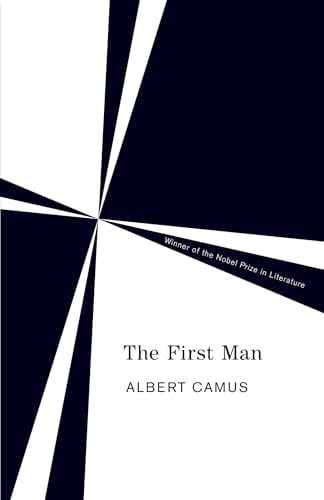
The First Man is the manuscript that was found at Albert Camus’s side after his death in a car accident in 1960. It sat unpublished for decades — held back by his estate, his daughter and granddaughter — before finally being released to the public.
That backstory alone is enough to make it worth picking up.
What the Book Is
It’s an autobiography in everything but name. Camus wrote himself as a character and drew out the same themes that run through The Stranger and The Plague — individual agency, the weight of mortality, the absurdity of a life shaped more by external forces than by personal will. The plot is light. The character development is everything.
What makes it work is the writing itself. His descriptions of Algiers — the coast, the beach, the heat, the texture of a city that shaped him — are exactly what you’d hope for from Camus – lyrical, evocative, and completely his own.
Why It Wasn’t Published Sooner
The estate’s hesitation made sense, even if the decision to eventually publish it was the right one.
Camus held political opinions that put him at odds with almost everyone around him. He was anti-colonialist, which alienated him from the French conservatives. He was also deeply anti-Soviet, which made him a pariah on the left at a time when Soviet sympathies were fashionable in Parisian intellectual circles. He fit nowhere, ideologically speaking — and The First Man made that unmistakably clear.
Beyond the politics, the manuscript simply wasn’t finished. You can feel it. There are threads that go undeveloped, directions the book could have gone with more time and more editing. Camus obviously didn’t live to do that work, and the book reflects it.
What I Liked
The writing is the reason to read this book. If you’ve spent any time with Camus, you know what his prose feels like — and this has all of it. The semi-autobiographical frame actually makes it more personal and more intimate than his fiction, which is saying something.
The political subtext is also fascinating in retrospect. A man who refused to pick a side in the defining ideological battle of his era, who got attacked from both directions for it, writing a memoir that tried to make sense of his own origins. There’s something very honest about it.
What I Didn’t Like
The unfinished quality is real and it does affect the experience. This isn’t a polished novel — it’s a draft, and it reads like one in places. If you come in expecting the tight, controlled structure of The Stranger, you’ll feel the difference.
Should You Read It?
I wouldn’t call it the first Camus book I’d hand someone. Start with The Stranger or The Plague if you haven’t already.
But if you’re already a fan — if you like his voice, his style, the way he thinks — then The First Man is absolutely worth your time. It’s a rare thing: a look at a major writer trying to figure out what he was doing, left unfinished, published anyway. Imperfect and worth it.
- Signature lyrical prose and evocative descriptions of Algiers at their best
- Rare autobiographical intimacy not found in his fiction
- Fascinating political subtext from a man who fit no ideological camp
- Unfinished manuscript — loose threads and underdeveloped sections show
- Not a strong entry point for readers new to Camus

Random Quotes
No, school did not just provide them an escape from family life. At least in M. Bernard’s class, it fed a hunger in them more basic even to the child than to the man, and that is the hunger for discovery. No doubt they were taught many things in their other classes, but it was somewhat the way geese are stuffed: food was presented to them and they were asked to please swallow it.
In M. Germain’s’ class, they felt for the first time that they existed and that they were the objects of the highest regard: they were judged worthy to discover the world. And even their teacher did not devote himself just to what he was paid to teach them; he welcomed them with simplicity into his personal life, he lived that life with them, told them about his childhood and the lives of children he had known, shared with them his philosophy but not his opinions, for though he was for example anti-clerical, like many of his colleagues, he never said a word against religion in class, nor against anything that could be the object of a choice or a belief, but he would condemn with all the more vigor those evils over which there could be no argument-theft, betrayal, rudeness, dirtiness.p. 147
The way the book was printed would give the reader advance notice of the pleasure he would derive from it. P. and J. did not like books set in large type with wide margins, such as pleased readers of more refined tastes, but rather pages set in small type stretching all the way across tightly justified lines, filled to the brim with words and sentences, like those enormous rustic dishes you can eat at long and heartily without ever emptying them, and are all that can satisfy some gigantic appe-tites. They had no use for subtleties; they knew nothing and wanted to know everything. It mattered little if the book was poorly written and crudely printed, as long as the writing was clear and it was full of violent activity; those books, and those alone, would feed their dreams, and on that they could go into a heavy sleep.
Moreover, each book had its own smell according to the paper on which it was printed, always delicate and discreet, but so distinct that with his eyes closed J. could have told a book in the Nelson series’ from one of the contemporary editions Fasquelle was then publishing. And each of those odors, even before he had begun reading, would transport Jacques to another world full of promises already [kept], that was beginning even now to obscure the room where he was, to blot out the neighborhood itself and its noises, the city, and the whole world, which would completely vanish as soon as he began reading with a wild exalted intensity that would transport the child into an ecstasy so total that even repeated commands could not extract him: “Jacques, for the third time, set the table.” Finally he would set the table, his expression empty and without color, a bit staring, as if drunk on his reading, and he would return to his book as if he had never put it down. “Jacques, eat,” and finally he would eat food that, heavy as it was, seemed less real and less solid than what he found in the books; then he cleared the table and went back to his book.
p. 249