Atlanta Then & Now by Michael Rose

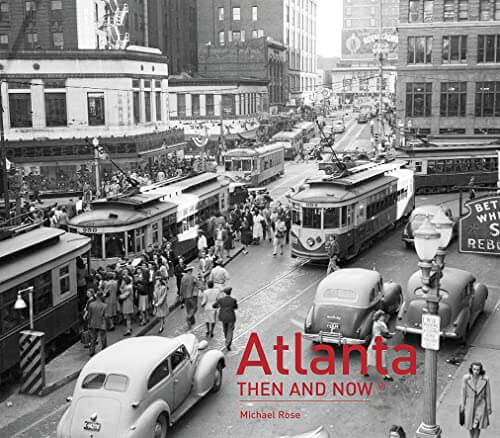
I picked up Atlanta Then and Now expecting to feel nostalgic about demolished buildings and lost architecture around Atlanta. Instead, I got a 150-year lesson in how Atlanta has always been Atlanta — sprawling, shifting, and chasing the next trendy neighborhood.
The book pairs historical photos with modern shots of the same locations. It’s a simple format, but flipping through side-by-side comparisons from the 1870s to today reveals something unexpected: Atlanta’s character hasn’t changed nearly as much as the buildings have (lots of buildings are gone, like soooo many).
The Pattern Goes Way Back
Atlanta has been a sprawling, hodgepodge city since it rebuilt after the Civil War. Even in the 1870s and 1880s, one neighborhood would become fashionable, then another, then another. People zigzagged across the city chasing opportunity and status (also, racism – lots and lots of racism, which, is very much tied up with wealth in the US).
The mode of transportation changed — streetcars gave way to highways, and now the Beltline drives redevelopment — but the fundamental pattern stayed the same. Each generation sprawls outward along whatever transportation network exists, leaving older areas to decay or reinvent* themselves (or get demolished).
*just as an aside that “reinvention” in Atlanta does come with costs.
It’s kind of remarkable. The Interstate system didn’t create Atlanta’s sprawl problem. It just turbocharged a tendency that was already baked into the city’s DNA.
The Density Paradox
Here’s what struck me most: even though Atlanta’s Central Business District is bigger now than it was in 1920 or 1950, the street life was denser back then.
The photos from mid-century Downtown show sidewalks packed with pedestrians. Streetcars brought thousands of people to Five Points daily. Retail lined every block. The streets had energy.
Midtown might have more residents now than those old photos of Downtown. And yet, I can’t shake the feeling that we’ve lost something in the translation. The 21st century American city — even a growing one like Atlanta — just doesn’t generate the same spontaneous street life.
Part of it is car dependence. Part of it is that retail and residential don’t mix the way they used to. Part of it is Amazon. I guess?
But looking at those old photos, I wonder if we’re ever getting that density of human activity back.
What It Means for Atlanta
The book doesn’t editorialize. It just shows you what was and what is. But flipping through it, I kept coming back to the same thought: we’ve been making basically the same development choices for 150 years.
Follow the new transportation. Build outward instead of upward. Let older neighborhoods figure out their own reinvention. Repeat.
That pattern built Atlanta into a major American city. It also created the traffic, the inequality, and the disconnection that defines so much of modern Atlanta life.
The question is whether we’re learning anything from these photos, or if the next generation will flip through an Atlanta Then and Now from 2075 and see the exact same pattern playing out along whatever replaces the Beltline (the Stitch? Westside Park?).
I hope they see something different. But history suggests otherwise.
Worth a Look
Atlanta Then and Now is worth picking up if you’re interested in the city’s history. It’s not going to give you deep analysis or policy prescriptions. But sometimes the most valuable history books are the ones that just show you the evidence and let you draw your own conclusions.
For me, the conclusion is clear: Atlanta is going to Atlanta. We’ve been sprawling and shifting for 150 years, and unless something fundamental changes, we’ll be doing it for 150 more.
Atlanta Then and Now pairs historical and modern photos revealing the city's unchanging character: sprawling development chasing transportation networks since the 1870s. Despite a larger CBD today, old photos show denser street life that feels lost. The book doesn't editorialize but illustrates 150 years of Atlanta making the same choices—building outward, letting older areas reinvent themselves, and repeating the pattern endlessly.