Hiking with Nietzsche by John Kaag

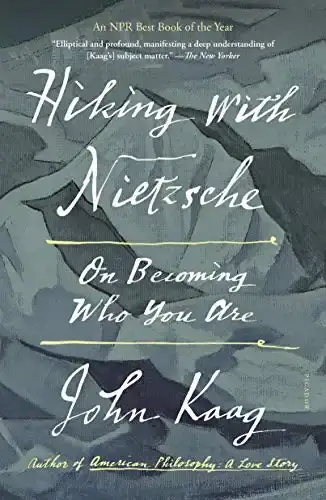
I picked up Hiking with Nietzsche after reading John Kaag’s book on American philosophy. He’s a fabulous writer who uses personal anecdotes to weave deeper, more modern, and more personal connections to big philosophical ideas.
The book interweaves memoir with philosophy as Kaag retraces Friedrich Nietzsche’s steps through the Swiss Alps. It follows two journeys—Kaag’s first visit as a depressed 19-year-old, and his return two decades later with his wife (also a philosophy scholar…but a Kantian) and small daughter.
The physical act of hiking serves as both metaphor and method for understanding Nietzsche’s philosophy. As Kaag climbs the same paths that inspired Thus Spoke Zarathustra, he examines how those abstract ideas emerge from direct confrontation with nature and physical challenge.
What I Liked
Someone like Nietzsche is just so overbearing and overhyped and confusing that it takes metaphor and story and experience to connect the bigger ideas. Kaag does this incredibly well.
One of the bigger ideas that stuck with me is that everyone’s life evolves over time, and the point is to live the life you have—not some grand imaginary ideal. Be here and now, in the world that you’re in. The book makes that philosophical concept feel real and accessible through Kaag’s own struggles with depression, marriage, parenthood, and middle age.
The Alpine setting becomes more than just backdrop. Sils Maria, where Nietzsche spent crucial summers, reveals how landscape and climate influenced his thinking about human nature. The book shows how philosophy doesn’t just happen in books—it happens in the world.
The family dynamics add unexpected depth. Kaag’s wife pulls him back when he’s spiraling into his own head, and their daughter offers a different perspective on joy and living fully. It’s philosophy grounded in real relationships.
What I Did Not Like
John Kaag can definitely be very earnest. I mean, very earnest. And he knows it—he’s self-aware about it, and his wife definitely pulls him in at points like “you’re kind of doing too much, you okay?”
It makes him a fabulous writer, but the book can also be a little overwrought at times. A little too much.
Wrap-Up
I loved this book. I love stories that interweave philosophers who had bigger ideas in their time that still seem relevant and interesting now. Kaag pulls it off beautifully, even if he occasionally gets a bit too deep in his own feelings about it all.
If you want to understand Nietzsche without wading through dense German philosophy texts, or if you’re interested in how big ideas connect to actual lived experience, this is a great read.
John Kaag retraces Nietzsche's Alpine hiking routes across two visits—first as a depressed teenager, then decades later with his family. The book uses personal memoir and physical journey to make Nietzsche's dense philosophy accessible through real-world experience. Kaag's earnest writing style effectively connects abstract ideas about living fully in the present to concrete struggles with depression, marriage, and parenthood, though his intensity occasionally veers into overwrought territory.
- Makes Nietzsche's complex philosophy accessible through memoir, metaphor, and actual hiking experiences
- Explores how life evolves and the importance of living in the present rather than chasing imaginary ideals
- Family dynamics add grounded perspective, with Kaag's wife and daughter offering counterbalance to Kaag's writing style
- Kaag's very earnest writing style can feel overwrought at times
- Occasionally does too much emotionally, even by his own admission

Quotes
Now I shall relate the history of Zarathustra,” Nietzsche prepares his reader in Ecce Homo. Continuing, he explains: The fundamental conception of this work, the idea of eternal recurrence, this highest formula of affirmation that is at all attainable, belongs in August 1881: it was penned on a sheet with the notation underneath “6000 feet beyond man and time.”
That day I was walking through the woods along the lake of Silvaplana; at a powerful pyramidal rock not far from Surlei I stopped. It was then that this idea came to me. We didn’t stop at the rock but continued into the hamlet of Sils-Maria, past the post office and the single grocery store, to the Hotel Edelweiss. Behind the hotel, tucked against the wooded hill just as I remembered it, was the Nietzsche-Haus. The door and shutters had been repainted the same color. Nothing, after seventeen years, appeared to have changed. It was not the pyramidal rock where Nietzsche conceived of the eternal recurrence, but it would do.
The idea is a wonderful, awful one: What if some day or night a demon were to steal into your loneliest loneliness and say to you: “This life as you now live and have lived it you will have to live once again and innumerable times again; and there will be nothing new in it, but every pain and every joy and every thought and sigh and everything unspeakably small or great in your life must return to you, all in the same succession and sequence—even this spider and this moonlight between the trees, and even this moment and I myself…” Indeed, “what if?”
Nietzsche’s demon is giving voice to an age-old metaphysical suggestion, namely that the movement of reality is best described in terms of cycles and epicycles, a snake devouring itself. Hinduism and Buddhism, each in its own varied way, express something similar in the doctrine of karma. Everything happens by way of repetition. A building crumbles and is rebuilt on the same site. Glaciers move day after day, so do rains, and lives.
The old gives birth to the new, which immediately, at varying rates, becomes old. Schopenhauer, Nietzsche’s hero, expresses something of this cosmic point but explains that to take it seriously is often to face its debilitating psychological effects. In his Studies in Pessimism, he writes, “He who lives to see two or three generations is like a man who sits some time in the conjurer’s booth at a fair, and witnesses the performance twice or thrice in succession. The tricks were meant to be seen only once; and when they are no longer a novelty and cease to deceive, their effect is gone.”
Nietzsche largely agreed and thought that most of us, most of the time, would be crushed by such an idea—to repeat this, and everything, ad infinitum. To relive the regret, the tedium, the disappointment of a single life over the course of an indefinite future, this would be truly hellish.
Past the Nietzsche-Haus, across the river that bisects Sils, up three steep switchbacks, three identical sections of road that took us above the town: finally we arrived, once again, at the Waldhaus. Nietzsche’s demon wasn’t finished on the topic of eternal return. It is more than just a metaphysical description or, in Schopenhauer’s case, an explanation of why life is so dreadfully monotonous. It is a challenge—or, better, a question—that is to be answered not in words but in the course of life: “The question in each and every thing, ‘Do you want this again and innumerable times again?’ would lie on your actions as the heaviest weight! Or how well disposed would you have to become to yourself and to life to long for nothing more fervently than for this ultimate eternal confirmation and seal?” Are we, in the words of William Butler Yeats, “content to live it all again”?
Being content in this sense is not being distracted from, or lulled to sleep by, or resigning oneself to a fate that cannot be avoided. It is to live to your heart’s content with the knowledge that you will do this, and everything, again, forever. We made our last turn into the Waldhaus driveway and came to rest beneath its canopied entryway.
Nietzsche suggests that the affirmation of the eternal return is possible only if one is willing and able to become well-adjusted to life and to oneself. To be well-adjusted, for Nietzsche, is to choose, wholeheartedly, what we think and where we find and create meaning. The specter of infinite monotony was for Nietzsche the abiding impetus to assume absolute responsibility: if one’s choices are to be replayed endlessly, they’d better be the “right” ones. It might be tempting to think that the “rightness” of a decision could be affixed by some external moral or religious standard, but Nietzsche wants his readers to resist this temptation.
Nietzsche’s demon, after all, comes to us when we are all alone, his question can be heard only in one’s “loneliest loneliness,” and therefore the answer cannot be given by consensus or on behalf of some impersonal institutions. It is, indeed, the most personal of answers—the one that always determines an individual choice. Of course you can choose anything you want, to raise children or get married, but don’t pretend to do it because these things have some sort of intrinsic value—they don’t.
Do it solely because you chose them and are willing to own up to them. In the story of our lives, these choices are ours and ours alone, and this is what gives things, all things, value. Only when one realizes this is he or she prepared to face the eternal recurrence, the entire cycle, without the risk of being crushed. Only then is one able to say with Yeats, “[A]nd yet again,” and truly mean it.
For a long time, I thought that the “eternal return” was best understood as the ouroboros, the ancient symbol of infinity, a snake eating its own tail. Vicious and all-consuming, eternity destroys and creates in equal measure. The animal tries in vain to get ahold of itself but, in so doing, pulls only farther away. But perhaps the “eternal return” didn’t always have to be this bleak and sinister.
When you walk toward the mountains through Alpine valleys, you sometimes pass ancient farmhouses. They’re nothing particularly special. After a while they all look the same. But they’re not. On the sides of some of them, above doorframes and under windows, worn down by countless seasons, is a carving—primeval and reassuring. Three rabbits, conjoined by interlocking ears, chasing one another in a perpetual merry-go-round.
These “three hares” are everywhere: from twelfth-century Mongol metalwork in Iran, to medieval churches in Devon, England, to eighteenth-century synagogues in Germany. Shafan, shafan, shafan, in Hebrew. The symbol is radially symmetrical, fluid, and ongoing. The hares are a sign of rebirth. They are also a puzzle expressed in the ancient German riddle: “Three hares sharing three ears, but every one of them has two.”
afraid and have a foreboding of danger- why not, if only to amuse yourselves… try to put the question in a different way? Why not ask whether the source of your pain might be inside you yourselves?… Might it not be an amusing exercise for each one of you to examine what ails you and try to determine its source?” Perhaps the hard- est part of the eternal return is to own up to the tortures that we create for ourselves and those we create for others. Owning up: to recollect, to regret, to be responsible, ultimately to forgive and love. “What makes me Zarathustra,” Hesse contended, “is that I have come to know Zarathustra’s destiny. That I have lived his life. Few men know their destiny. Few men live their lives. Learn to live your lives.”